


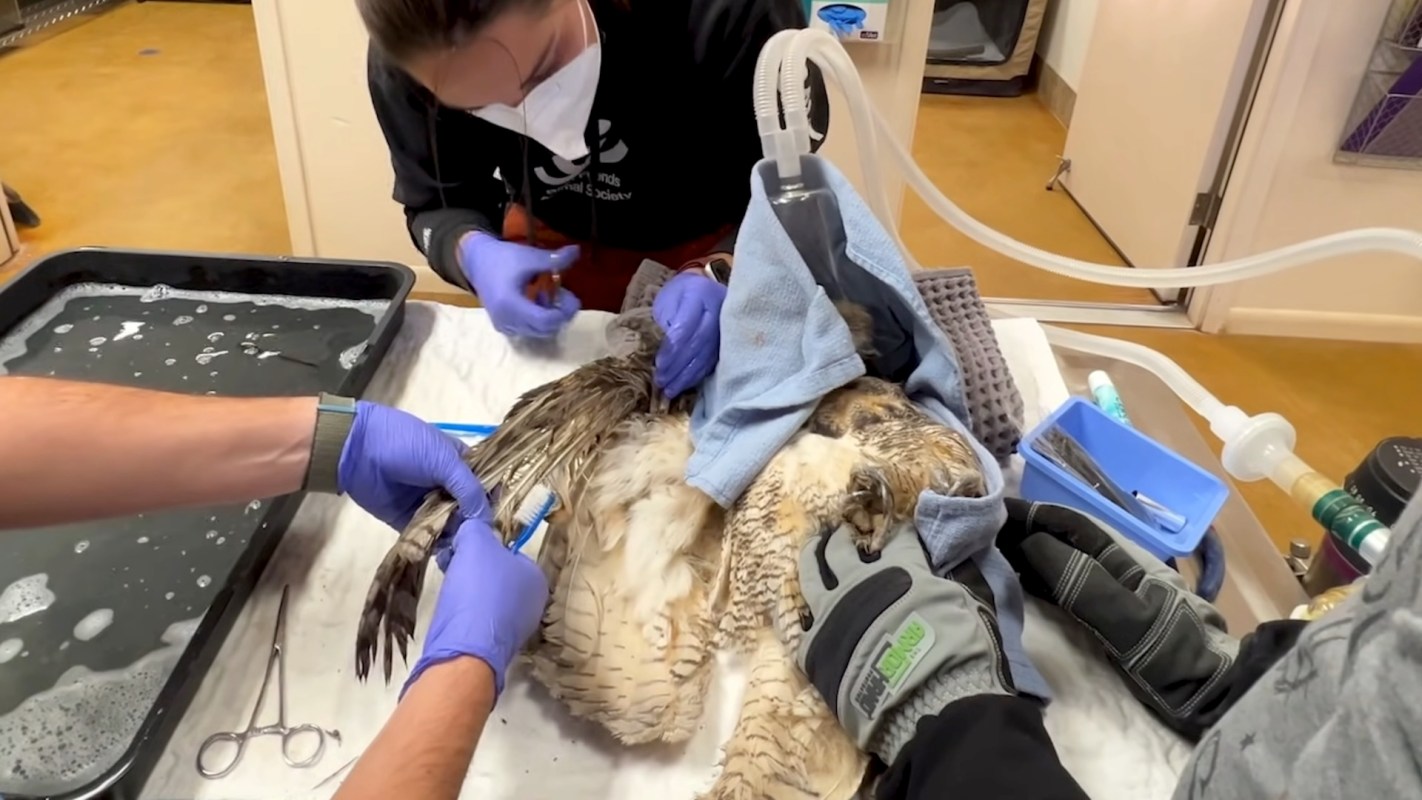
At Best Friends Animal Sanctuary in Kanab, Utah, staff recently cared for an unusual patient: an adolescent great horned owl rescued from a concrete mixer at a resort construction site.
Almost from the moment he was discovered, the owl's survival became a community effort.
Construction workers found the bird inside a truck-mounted mixer while pouring concrete in late October, according to The Associated Press. They immediately rinsed him off and wrapped him in a towel, buying valuable time before sanctuary staff stepped in.
What followed were days of painstaking rehabilitation. Staff carefully removed hardened concrete from the owl's face, chest, and right wing using forceps, toothbrushes, and dish soap.
The rescue also highlights a broader issue facing wildlife as development expands into natural habitats. Animals increasingly encounter roads, machinery, and construction infrastructure that can leave them injured or displaced.
As top nighttime predators, great horned owls play an important role in maintaining ecological balance by controlling rodent populations and other prey species.
TCD Picks » Quince Spotlight
💡These best-sellers from Quince deliver affordable, sustainable luxury for all




For this owl, however, the biggest challenge came after the concrete was removed.
Great horned owls rely on specialized feather edges that allow them to fly almost silently while hunting.
In this case, the concrete had severely frayed the bird's feathers, creating a loud whooshing sound during flight — a serious disadvantage for a predator that depends on stealth to survive.
Staff initially hoped the owl would naturally molt and replace the damaged feathers.
When that did not happen on schedule, the sanctuary turned to a centuries-old falconry technique known as imping, which involves attaching donor feathers to the damaged feather shafts.
"The first few feathers were extremely nerve-wracking, but as we got into the groove, the imping became more comfortable, and everything went smoothly," said Bart Richwalski, a supervisor at the sanctuary, per the AP.
Staff monitored the owl's feather growth for weeks before anesthetizing him for the procedure.
Using feathers donated from another deceased owl of similar size, they carefully matched, trimmed, and attached replacements to rebuild the bird's right wing. By the end of the 90-minute operation, the owl had received 10 replacement primary feathers and one replaced secondary feather.
The final test was whether he could fly quietly enough to survive in the wild.
After recovering in a large aviary, the owl quickly took flight. Richwalski used a decibel meter to confirm the wing noise had returned to a safe level.
"It feels so, so good. I think my heart finally started beating again," Richwalski said, per the AP. "The nervousness was starting to overtake the excitement, but once I saw him fly out that opening in the roof … it was a sight to see. It was so fun."

Get TCD's free newsletters for easy tips, smart advice, and a chance to earn $5,000 toward home upgrades. To see more stories like this one, change your Google preferences here.







