


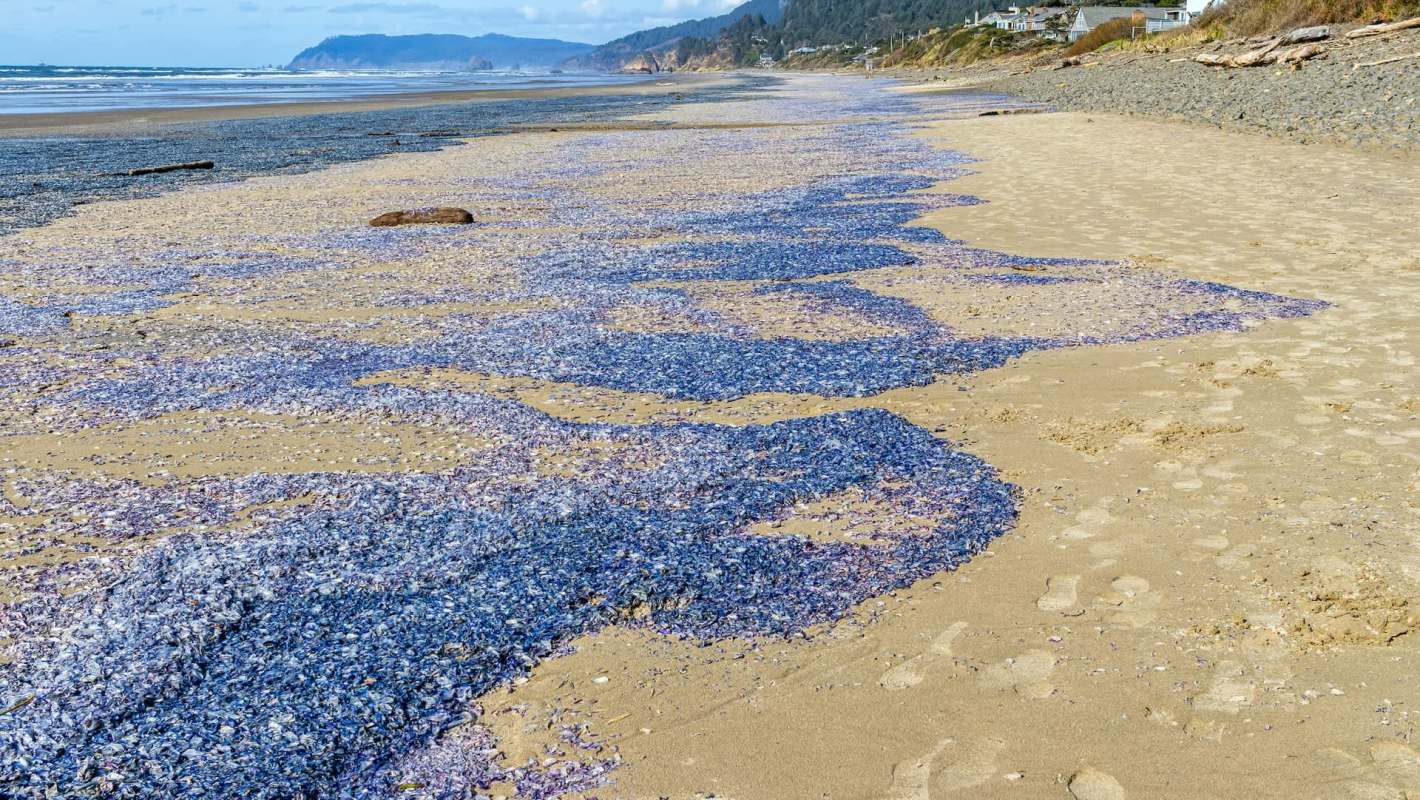
California's beaches are shimmering with unexpected blue "jewels" this spring — and they're not plastic, glass, or gemstones.
According to USA Today, large numbers of vivid indigo marine creatures called by-the-wind sailors are turning up along the Pacific coasts of California, Oregon, and Washington, drawing attention for both their appearance and biology.
Researchers said the strandings are unusually dense, especially in California. The phenomenon is also giving the public a rare chance to help scientists better understand the mysterious creatures and what may be driving these massive appearances.
Douglas McCauley, director of the Benioff Ocean Initiative at the University of California, Santa Barbara, told USA Today that he came across the creatures in late April while heading to a great white shark observation project. Instead of a typical shoreline, he found by-the-wind sailors stretched across "the entire length" of the beach.
"In a lifetime of living and doing marine science in Southern California, I've never seen that many pile up on a beach," McCauley said.
As described by USA Today, these ocean drifters usually come ashore on the Pacific Coast when spring offshore winds shift, but this year's buildup appears especially intense.
TCD Picks » Quince Spotlight
💡These best-sellers from Quince deliver affordable, sustainable luxury for all




The animals, scientifically known as Velella velella, are closely related to jellyfish, though they are not true jellyfish. They are hydrozoans, members of the broader cnidarian phylum, and each floating raft functions as an integrated organism made up of specialized polyps. Their triangular sails allow them to skim across the ocean's surface, pushed by the wind for thousands of miles until weather conditions send them ashore.
Scientists told USA Today that there is still a surprising amount they don't know about these creatures, despite decades of documentation. Steven Haddock of the Monterey Bay Aquarium Research Institute said researchers want to better predict when and where these flotillas will appear.
One Washington state study suggested larger concentrations may follow especially warm winters, though Haddock and the paper's authors said additional research is still needed. That question is drawing even more attention after California's record-breaking warm winter and intense marine heat wave offshore.
For beachgoers, the event is mostly a stunning natural display, but it may also be an opportunity to contribute to science. Researchers are encouraging people on beaches and boats to report sightings through the iNaturalist app, ideally with GPS-enabled photos. Those observations could help experts map blooms more precisely and better understand where these floating colonies gather.
Studies cited by the scientists show that V. velella feed on zooplankton, fish eggs, and krill, while ocean sunfish, or mola mola, have been seen feasting on large flotillas offshore. Researchers are also studying their unusual design for engineering applications, including ocean sensors and small unmanned surface vehicles.
As McCauley told USA Today, "the ocean is filled with jewels," but this one has captured unusual attention because of the mystery behind it. Haddock added that part of the appeal is "just kind of the sheer spectacle" when "people go to the beach and they see these huge numbers washed up."

Get TCD's free newsletters for easy tips, smart advice, and a chance to earn $5,000 toward home upgrades. To see more stories like this one, change your Google preferences here.







