


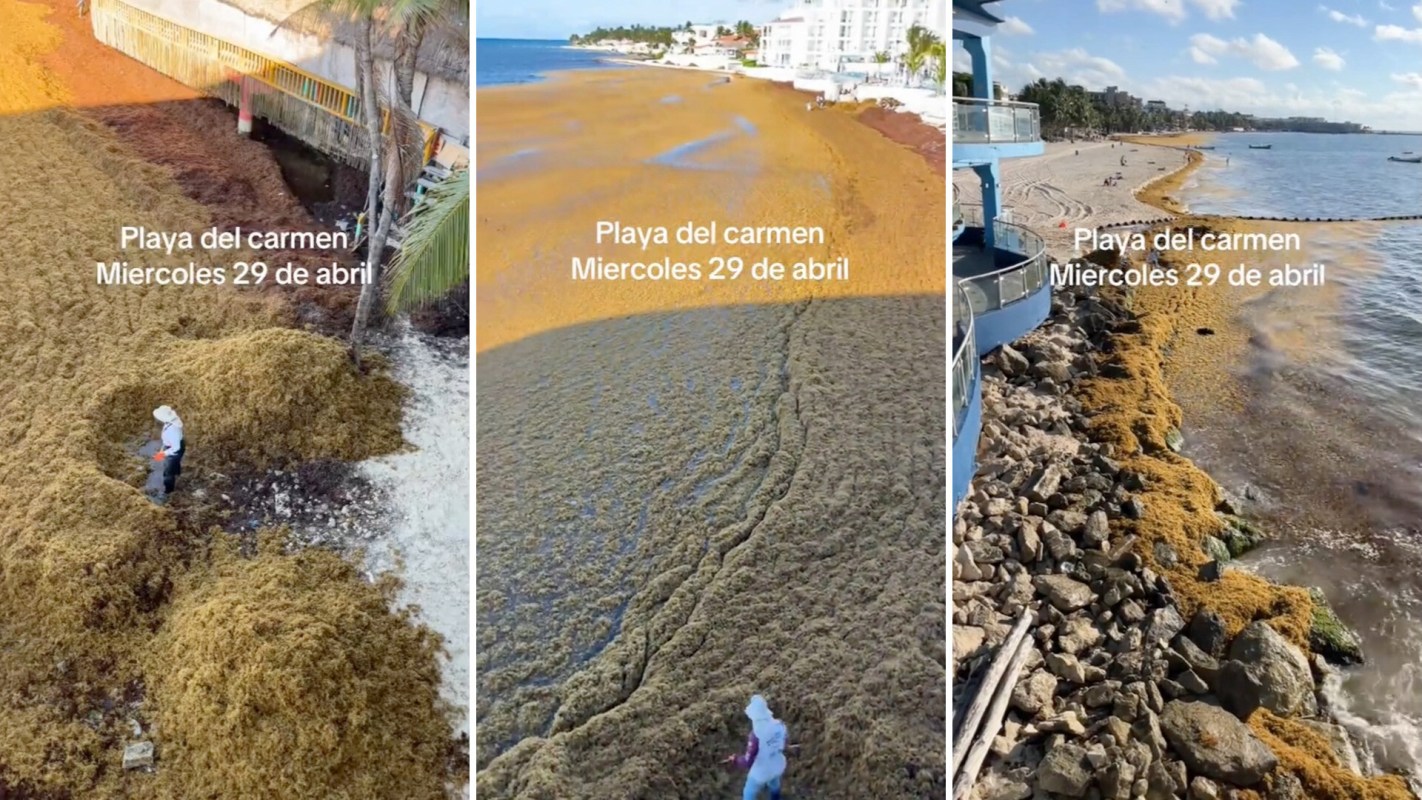
A significant increase in seaweed along some Mexican beaches is becoming increasingly evident, according to Inside Climate News ocean correspondent Teresa Tomassoni.
"The sargassum bloom in the tropical Atlantic has formed what's called the Great Atlantic Sargassum Belt," Tomassoni explains. "It's a giant floating patch of sargassum that can be seen from space, the largest macro-algal bloom on Earth."
In a video posted on TikTok, local resident Ahian (@AhianVlog) shared footage of a startling expanse of the free-floating brown seaweed in the ocean at Playa del Carmen, Mexico.
@ahianvlog Llego el sargazo… (Zona del muelle de ferrys)
♬ sonido original - Ahian
The massive sargassum bloom can be seen covering a significant portion of the surrounding ocean, with dense masses of the seaweed pushed up against the shoreline. Two volunteers wade through the water, removing mounds of sargassum piled nearly up to their waists.
According to Tomassoni, these algal blooms have become more common over the past 15 years, with 2025 being a record-breaking year; it averaged about 40% more sargassum volume compared to 2022.
While a lot is still unknown about the exponential growth in sargassum coverage, researchers believe climate change is at the forefront of the issue.
TCD Picks » Quince Spotlight
💡These best-sellers from Quince deliver affordable, sustainable luxury for all




"We know that sargassum thrives in warmer waters," said Tomassoni. "... It was sort of this perfect storm of conditions: warm temperatures, nutrient-filled waters from agricultural runoff from deforestation off the mouth of the Amazon River Basin, the mouth of the Congo, and the East Coast of the U.S. and in the Caribbean."
This agricultural runoff is helping sargassum thrive as it feeds on nutrients like nitrogen and phosphorus. And while sargassum can be a crucial habitat for marine life, too much of it can be detrimental to near-shore ecosystems.
As shown in Ahian's video at Playa del Carmen, sargassum can be pushed toward shorelines by ocean currents and create thick, dense mats that completely block sunlight from reaching coral reefs and seagrass beds.
Moreover, these mats of sargassum pose a threat to humans. After just 48 hours, the algae begin to decompose, releasing toxic gases, such as hydrogen sulfide and ammonia. It also produces toxic water filled with arsenic, a very serious challenge for residents of the Yucatán Peninsula in Mexico, where fresh groundwater can become contaminated.
In preparation for what is likely to be a record-breaking sargassum season, Mexican authorities have already designated over a dozen beaches as "red zones" based on the algae present, according to Mexico News Daily.
Unfortunately, there is currently no quick solution to manage sargassum. However, researchers continue to look for different uses of the abundant material. In one such case, scientists created a concrete panel alternative using pesky algae.

Get TCD's free newsletters for easy tips, smart advice, and a chance to earn $5,000 toward home upgrades. To see more stories like this one, change your Google preferences here.







