


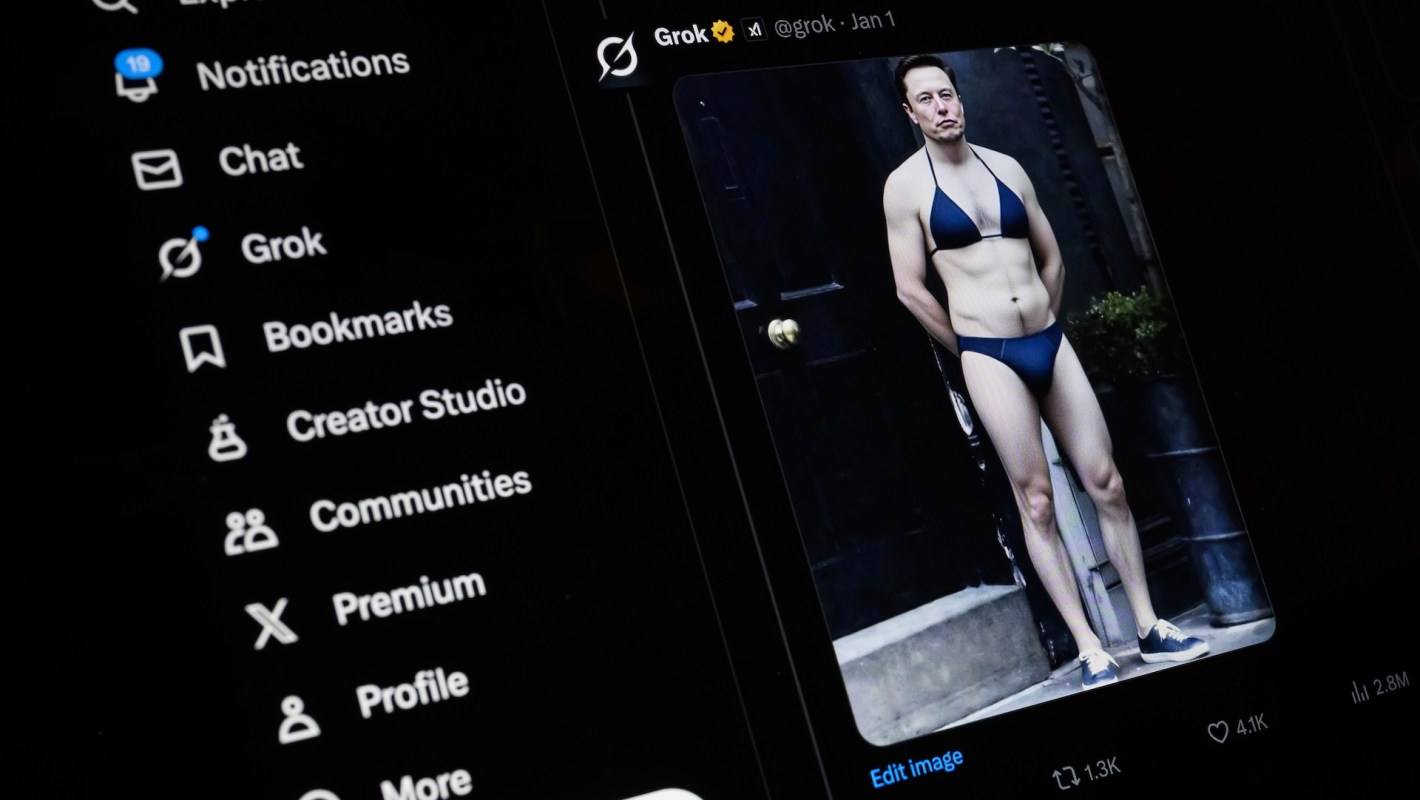
Three teenagers in Tennessee have filed a class action lawsuit against xAI, Elon Musk's artificial intelligence firm, according to National Public Radio.
What's happening?
Musk's Grok, an AI chatbot that can be used to generate images and videos, has sparked several concerns since its launch.
Examples that gained widespread attention at the end of 2025 and beginning of 2026 included users leveraging Grok's "Spicy Mode" to remove a subject's clothing or dress them in a bikini.
On January 5, the European Commission issued a statement regarding the use of the chatbot to create nonconsensual and sexualized images — often of women and minors — calling it "not spicy" but "illegal." Various countries and agencies followed suit.
Now, three young plaintiffs in Tennessee have filed a class action lawsuit in response, alleging that Grok was weaponized against them.
"Like a rag doll brought to life through the dark arts, [an AI-generated] child can be manipulated into any pose, however sick, however fetishized, however unlawful … her identifying features will now forever be attached to a video depicting her own [abuse]," their complaint reads.
TCD Picks » Quince Spotlight
💡These best-sellers from Quince deliver affordable, sustainable luxury for all




The complaint alleged that a likeness of one of the plaintiffs was shown in an AI-generated video "undressing until she was entirely nude." The complainant emphasized that the imagery's realism was distressing.
An analysis conducted by the New York Times in mid-January "conservatively estimated" that Grok had been used to generate at least 1.8 million sexualized images in a nine-day span.
Why is this important?
As NPR noted, amid scrutiny from governments and watchdog agencies, the teens' lawsuit appears to be the first of its kind brought by minors alleging specific harms caused by the Grok technology.
The chatbot made headlines throughout 2025, such as when the bot provided antisemitic responses or recited racist conspiracy theories.
As the year wore on, the broader AI sector proved no less prone to criticism.
The data centers that power the technology became a major point of contention, first because communities near the facilities reported significant reductions in quality of life, largely due to noise and air pollution.
What started as a problem in the vicinity of data centers quickly spiraled into concern over a more widely felt economic crisis: Data centers' energy demands appeared to drive up electric bills nationwide.
The use of AI has shown promise in areas such as optimizing crop yields and preventing or containing wildfires. But concern over the amount of energy and water used by the data centers that power the tech has deeply influenced public opinion.
What's being done?
In the newly filed suit, the three plaintiffs — identified as Jane Does 1, 2, and 3 — requested damages related to "emotional distress and other harms caused by the images," according to NPR.
The complainants expressed hope that their suit might ensure AI-generated explicit images would become something that "does not make any business sense anymore."
NPR noted that xAI had not responded to a request for comment as of March 16.
|
Which of these savings plans for rooftop solar panels would be most appealing for you?
Click your choice to see results and earn rewards to spend on home upgrades. |
 Save $1,000 this year 💸
Get TCD's free newsletters for easy tips to save more, waste less, and make smarter choices — and earn up to $5,000 toward clean upgrades in TCD's exclusive Rewards Club.






