


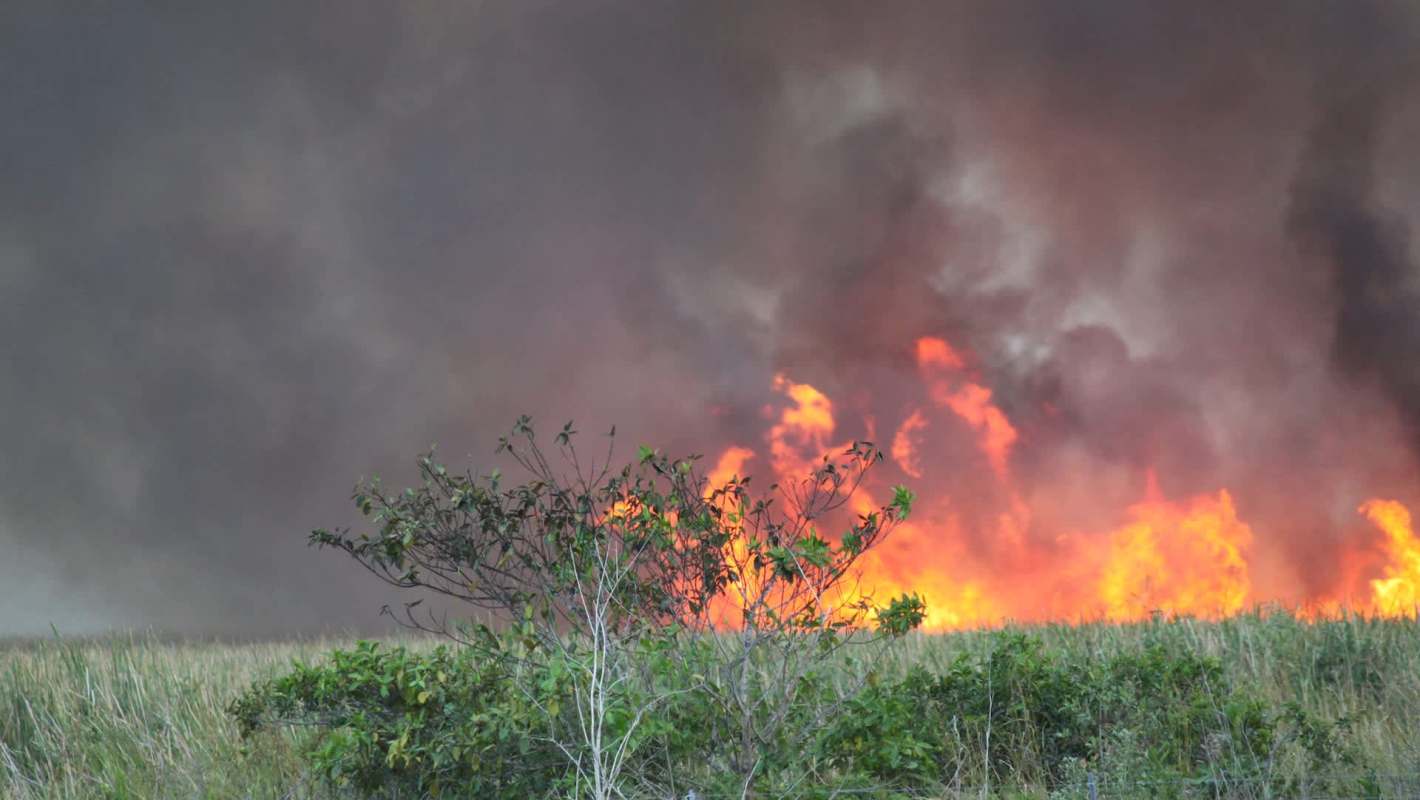
A massive wildfire continues to burn in southern Florida amid expanding drought conditions in the state. The National Fire burning near Naples forced the closure of a portion of a national preserve and an interstate. The fire has charred more than 30,000 acres, making it Florida's biggest wildfire of 2026.
Officials in Florida shut down a section of Interstate 75, also referred to as Alligator Alley, due to dense smoke and poor visibility caused by the fire, which was 0% contained as of early Thursday. Local fire managers today transferred their command of the fire to the Southern Area Gray Team, Type 1 Interagency Incident Management Team (IMT), one of the highest-level wildfire management teams in the U.S.
🔥 Interstate 75 (Alligator Alley) is in the process of being closed between SR-29 (Exit 80) and US-27 (Exit 23) due to poor visibility/dense smoke from the National Fire. 🔥
— NWS Miami (@NWSMiami) February 26, 2026
Seek alternative routes! @MyFDOT_SWFL @CollierEM @ReadyBroward https://t.co/iuQr4U3D21 pic.twitter.com/OpD31mPj6e
"As additional non-local resources arrive, some local resources will be released, making them available to respond to future initial attack incidents," explained the National Park Service. "The incoming fire team will work closely with local fire management and Big Cypress National Preserve staff to ensure continuity and sustained response. Public and firefighter safety remain the highest priorities."
A drought that is dragging on in Florida, coupled with low levels of relative humidity, is fueling the rapid spread of a large wildfire burning in the Big Cypress National Preserve just east of Naples. Florida has had an unusually warm and dry winter. The first two months of the season were the 20th driest and 35th warmest such period on record for the state.
"The drought we are experiencing, as well as the recent frost created really dry conditions and that is carrying the fire through," U.S. Wildland Fire Services communication specialist Riki Hoopes told the Palm Beach Post. "We are seeing fuels that normally stall or stop fire getting burned through."
The entire state of Florida is experiencing a drought, with nearly two-thirds of the Sunshine State in a severe drought, category four out of five, according to the latest U.S. Drought Monitor report. So far this winter, the Naples area has received only 50% of its normal rainfall. As of Wednesday, Naples has had only about a third of its normal rainfall for February.
TCD Picks » Quince Spotlight
💡These best-sellers from Quince deliver affordable, sustainable luxury for all




The forecast for Naples is dry through the end of the week. Meteorologists with the Miami-South Florida National Weather Service cautioned that the fire is so large it could disrupt the weather pattern in the southwest part of the state.
"The National Wildfire continues to burn in Big Cypress National Preserve this morning," noted the forecast discussion for the region. "The size of the wildfire may result in mesoscale changes to atmospheric conditions in the vicinity of the wildfire. During the overnight and daybreak hours, dense smoke may reduce visibilities downstream of the fire, especially along Alligator Alley."
Officials are concerned about the potential for "super fog" to form, which could lower visibility to as little as 10 feet or less."Super fog forms when a mixture of smoke and moisture released from damp smoldering organic material such as brush, leaves and trees, mixes with cooler, nearly saturated air," as defined by the National Weather Service. "Super fog can be very dangerous when present over highways, and has been the cause of several large, multi-vehicle pileups."
Our warming world is amplifying extreme weather events like wildfires.
|
Which of these savings plans for rooftop solar panels would be most appealing for you?
Click your choice to see results and speak your mind. |
 Save $1,000 this year 💸
 "In recent decades, wildfires have increased in size and intensity, and the fire season has lengthened," observed the U.S. Geological Survey. "This and other factors have increased wildfire suppression costs and risks to human health and safety."
Researchers at the non-profit Climate Central say our overheating planet has worsened the risk posed by wildfire smoke. "Per-person exposure to harmful wildfire smoke in the U.S. was four times higher during 2020-2024, on average each year, than during 2006-2019," according to a Climate Central report. "Wildfire smoke can spread hundreds or even thousands of miles away, harming health far from areas with active fires."

Get TCD's free newsletters for easy tips to save more, waste less, and make smarter choices — and earn up to $5,000 toward clean upgrades in TCD's exclusive Rewards Club.







