


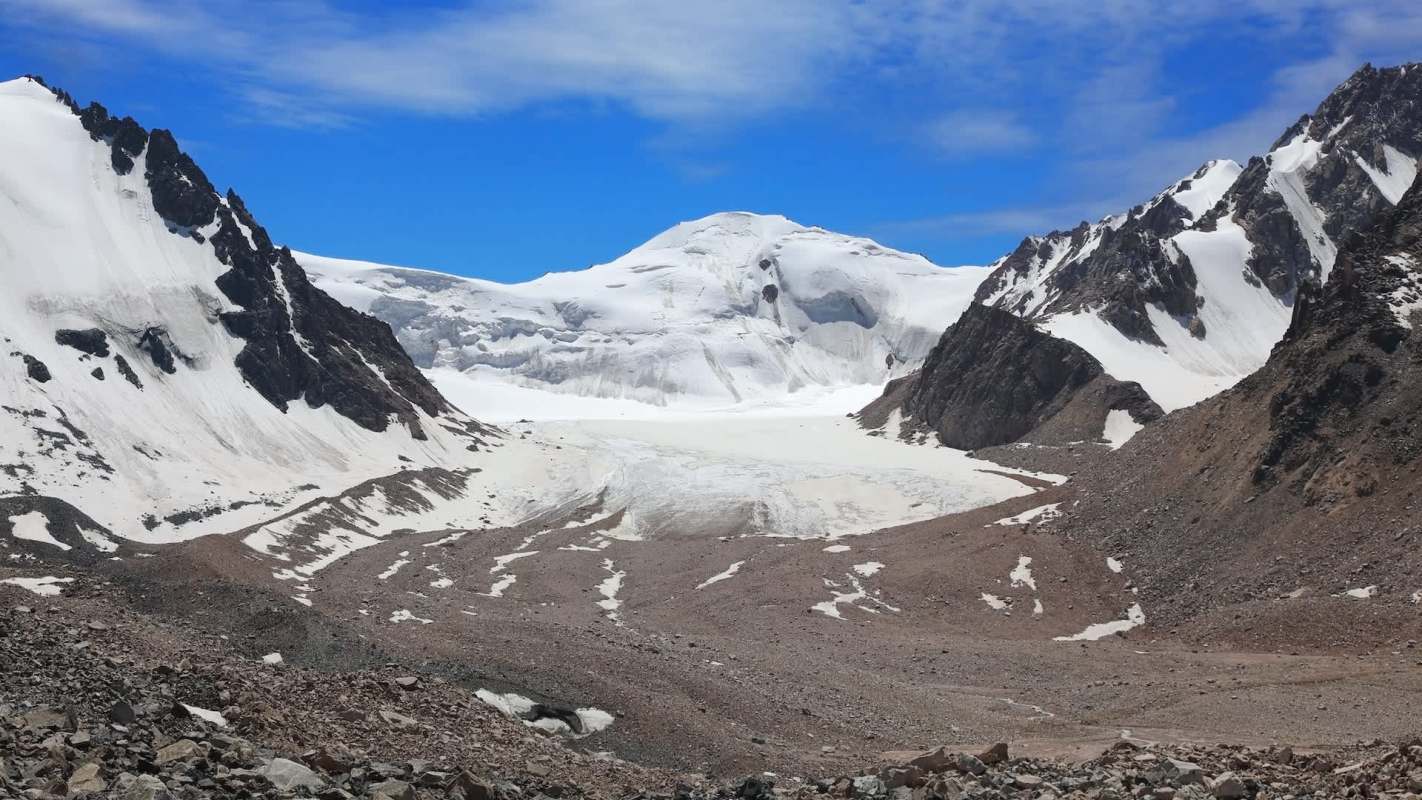
Central Asia's glaciers are melting faster than glaciologists expected. Researchers working on Kyrgyzstan's Adygene Glacier measured about 36 centimeters of ice loss in just 20 days, The Christian Science Monitor reported.
What's happening?
After a year, Adygene Glacier's surface had dropped by more than 13½ feet. Under normal conditions, that kind of loss would be around 3 to 6 feet.
Glaciologist Bakyt Ermenbaev explained the risk of the glacier's core melting in the next decade: "To put it mildly, it'll be a water deficit. But to put it bluntly, it'll be a catastrophe."
The current situation reflects how quickly snow and ice are disappearing in the mountains of Kyrgyzstan and Tajikistan — the sources of roughly three-quarters of the basin's water.
Most of the water moves downstream. Around 90% ends up in Uzbekistan, Kazakhstan, and Turkmenistan, where it gets used on farms, in industries, and for everyday needs. Disagreements over when to release water dragged on for years and weighed on relationships between the countries. Now, some of that tension has eased.
"This is now the turning point to something much better," said Volker Frobarth, OSCE ambassador to Kyrgyzstan, pointing to new joint water and energy agreements across the region.
TCD Picks » Quince Spotlight
💡These best-sellers from Quince deliver affordable, sustainable luxury for all




Why is glacier loss threatening the region?
Glaciers used to release water slowly through the summer. As they shrink, rivers swing between too little and too much. That kind of instability can quickly cause crops to suffer, drive up food costs, and strain health systems. The same patterns have started to affect food supplies in other parts of the world that are facing water shortages.
While this case focuses on Central Asia, scientists say it reflects a broader pattern in the Arctic, where warming temperatures are driving rapid ice loss. As Arctic sea ice and glaciers melt, global sea levels rise, threatening coastal communities.
Thawing Arctic permafrost could increase the spread of infectious diseases, as long-frozen microbes and pathogens are released into the environment — underscoring how ice loss in remote regions can carry direct consequences for human health and livelihoods worldwide.
Extreme weather tied to rising global temperatures elevates the stakes. Longer droughts keep cutting into harvest. Flooding does damage, too, often to roads, fields, and buildings that were already struggling.
|
What's the most you'd pay per month to put solar panels on your roof if there was no down payment?
Click your choice to see results and speak your mind. |
 $200 or more 💰
 In some places, water systems fail altogether, leaving people short of food or forcing them to move. Versions of this are already playing out around major lakes under stress, while ice loss elsewhere keeps pushing sea levels higher along exposed coasts.
How are countries responding to glacier loss?
Governments in Central Asia have recently started working together on large hydropower projects, something that was unlikely not long ago. In 2025, one of the driest years in decades, they made short-term adjustments to water releases and electricity sharing to get through the season.
Seeing how these pressures overlap makes it clear that local ice loss has wider consequences. That connection shows up in critical environmental issues, as water, food, health, and economic stability are affected as the temperature rises.

Get TCD's free newsletters for easy tips to save more, waste less, and make smarter choices — and earn up to $5,000 toward clean upgrades in TCD's exclusive Rewards Club.







