


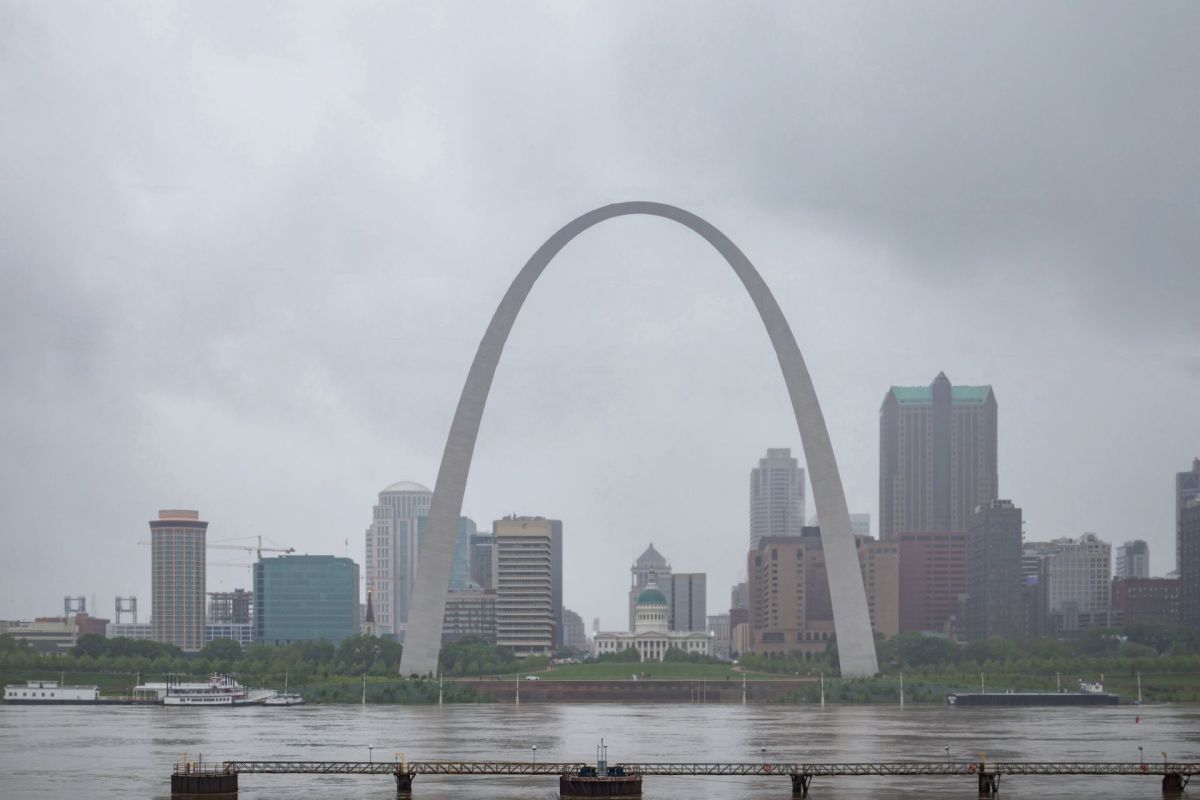
St. Louis sizzled Sunday, at least by normal December standards. The temperature soared to 78 degrees, 36 above average, to break a record for that date.
"We've never had a day this warm in December before, and then we're shoving all that warm air away and going down well below normal temperatures," Chris Kimble, a meteorologist with the St. Louis National Weather Service office, told the St. Louis Post-Dispatch. "It's kind of a shock to the system."
A recent streak of above-average temperatures in St. Louis stretched to seven days Sunday as temperatures soared to spring-like levels. That streak comes to an abrupt end today as Arctic air sweeps south into the central U.S., carried by gusty northwest winds.
St. Louis will be reeling from weather whiplash Monday. After Sunday's record high, which is more typical for late May, temperatures have dropped dramatically. They tumbled to 28 degrees by 8 p.m. Sunday and fell to 15 by 8 a.m. Monday. The National Weather Service is forecasting a high of 28 degrees there Monday, 50 degrees colder than Sunday.
A storm system rapidly intensified over the Great Plains this weekend, swept northeast into the Midwest and Great Lakes, and pulled unseasonably warm air northward ahead of it, setting the stage for the record-breaking warmth seen in St. Louis. The "bomb cyclone" was fueled by the clash between Arctic cold sinking south and eastward and near-record-to-record warmth surging northward.
"Bombogenesis, a term used by meteorologists, occurs when a midlatitude (the latitudes between the tropics and polar regions) cyclone rapidly intensifies, or strengthens, over a 24-hour period," according to the National Oceanic and Atmospheric Administration. "This intensification is represented by a drop in millibars, a measurement of pressure used in meteorology." This means a drop of at least 24 millibars of pressure in a 24-hour period in the central U.S.
TCD Picks » Quince Spotlight
💡These best-sellers from Quince deliver affordable, sustainable luxury for all




A report from the University of Miami suggested our warming world could be playing a part in supercharging bomb cyclones. Drawing on National Weather Service records, researchers determined that the number of bomb cyclones in the Atlantic Basin rose by roughly 40% between 1980 and 2020.
"It's probably connected to warmer ocean temperatures," explained Ben Kirtman, a professor of atmospheric sciences. "As the climate system warms, the higher latitudes warm faster than the lower latitudes, and the energy for the system of midlatitude cyclones is that contrast between north and south."
"But that's not the whole story," Kirtman added. "The challenge is what happens when you weaken that polar-equator temperature gradient — you get a wavier pattern in the midlatitude wind jet stream." A wavier jet stream creates deeper dips that pull cold air farther south. Those cold-air intrusions help trigger midlatitude cyclones, increasing storm activity in ways tied to Arctic warming.
One thing is for certain in St. Louis: It has been a warm year for the city.
The period from January through November this year was the 14th-warmest such period on record. Going back even further, the 24-month period from December 2023 through November 2025 was the third-warmest such period on record for the city, according to the National Centers for Environmental Information.
|
How often do you worry about air pollution where you live? Click your choice to see results and speak your mind. |
 Always 😷
Get TCD's free newsletters for easy tips to save more, waste less, and make smarter choices — and earn up to $5,000 toward clean upgrades in TCD's exclusive Rewards Club.







