


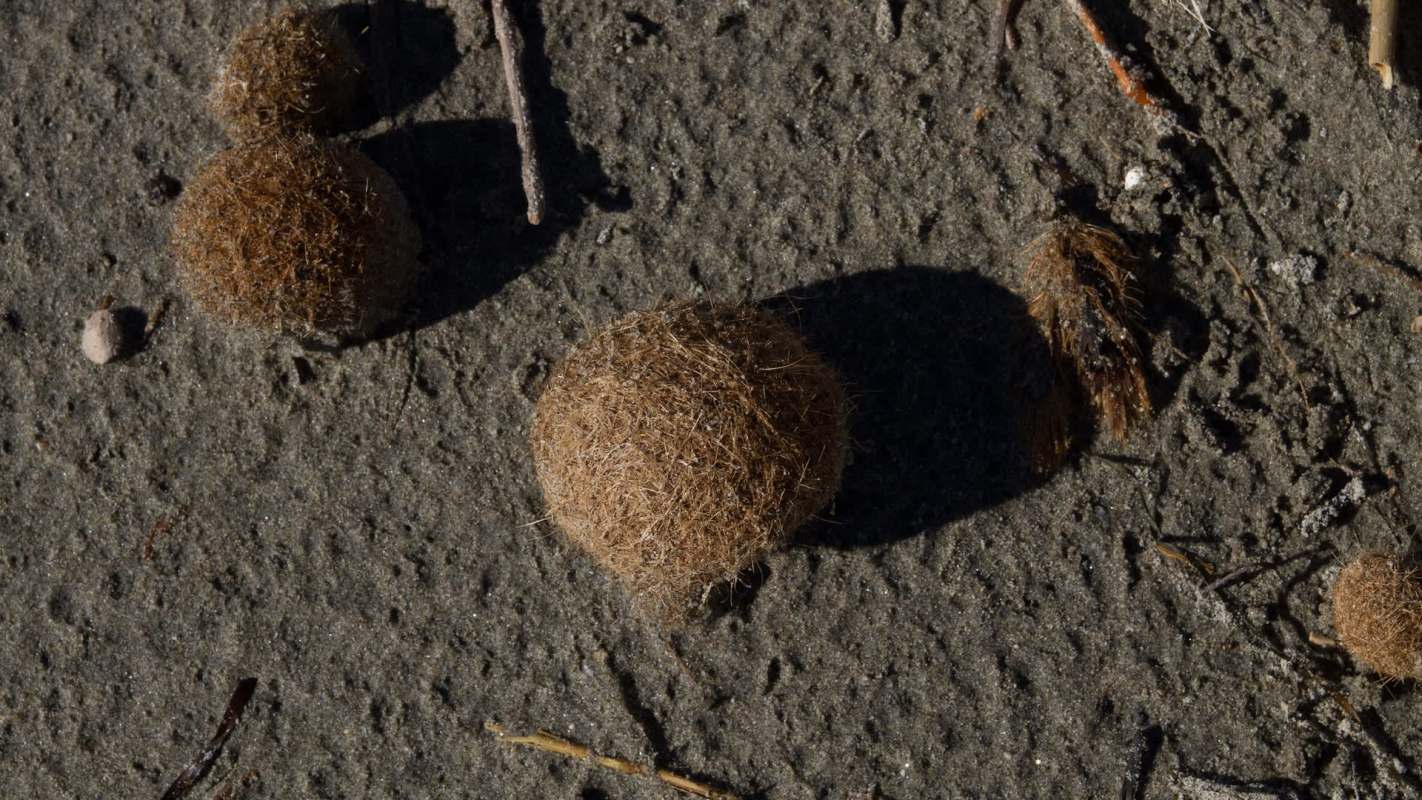
By taking a closer look at so-called Neptune balls that wash up on shore, scientists have gained a better understanding of how the ocean processes plastic waste.
"There is strong evidence that the seafloor constitutes a final sink for plastics from land sources. There also is evidence that part of the plastics lying on the shallow seafloor are washed up back to the shoreline," wrote the authors of a study published in Scientific Reports.
"However, little is known on the natural trapping processes leading to such landward return," they continued.
Hoping to shed some light on this mystery, the study's authors examined Neptune balls that had washed up on beaches in Mallorca, Spain.
Found mostly in and around the Mediterranean Sea, Neptune balls are essentially tightly packed spheres of old seagrass. According to the BBC, humans have put Neptune balls to use for millennia, turning the dense bundles of discarded undersea foliage into everything from bedding to housing insulation.
In recent years, however, scientists have discovered a new and important role that Neptune balls have played in the environment: collecting microplastics.
TCD Picks » Quince Spotlight
💡These best-sellers from Quince deliver affordable, sustainable luxury for all




Seagrass grows in vast underwater meadows along the seafloor. These meadows provide important habitat for marine life while also fulfilling other key ecosystem services.
As microplastics pass through areas dense with seagrass, they are trapped by the leaves. When seagrass sheds these leaves every autumn, forming Neptune balls, the plastic detritus remains stuck within.
When these Neptune balls wash up on beaches, they bring the microplastics with them.
"We say it's a way of the sea returning the trash to us that was never meant to be on the seafloor," said Anna Sanchez-Vidal, one of the study's authors, per the BBC.
|
How concerned are you about the plastic waste in our oceans? Click your choice to see results and speak your mind. |
 Extremely 😫
 The researchers concluded that in the Mediterranean alone, seagrass meadows could trap as many as 900 million plastic fragments every single year.
While experts have long understood that seagrass meadows and the resulting Neptune balls play an important role in the ecosystem, only recently have they begun to recognize their importance in trapping and removing plastic from aquatic habitats.
"We've never seen them as a remediation or as a way to clean the trash from the sea," said Sanchez-Vidal, per the BBC.
Plastic waste poses a growing threat to the environment and to human health. According to Oceana, roughly 33 billion pounds of plastic waste end up in the world's oceans every single year.
"That's roughly equivalent to dumping two garbage trucks full of plastic into the oceans every minute," the group said on its website.
Although the full extent of its impact is not yet understood, plastic pollution puts ecosystems, food supplies, and human health at risk.
Reducing plastic waste will take an all-of-the-above approach, including lowering plastic production, recycling whenever possible, and finding innovative ways to remove plastic from the environment.
By looking more closely at natural phenomena like Neptune balls, researchers have been able to find potential solutions in unexpected places.
To help make a difference in reducing plastic waste, you can choose plastic-free options for everyday products and steer clear of plastic bags, single-use plastic water bottles, and plastic food containers.

Join our free newsletter for good news and useful tips, and don't miss this cool list of easy ways to help yourself while helping the planet.







