


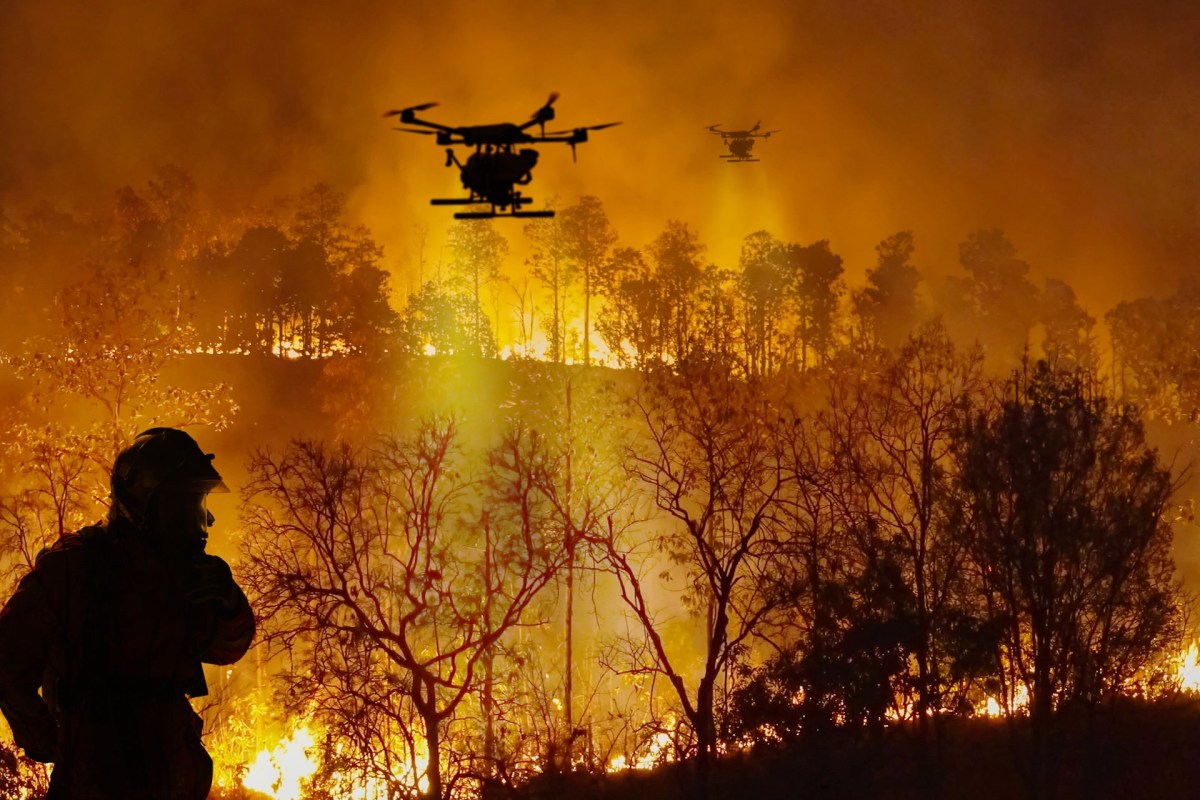
In the near future, when natural disasters hit, drones may have an easier time locating survivors thanks to a development by researchers at the University of Michigan.
Oftentimes, in the wake of a natural disaster, visibility is difficult. Rubble may be strewn about, or areas may be smoke-heavy, preventing drones flying overhead from seeing survivors in need of rescuing.
However, according to Interesting Engineering, a research project involving researchers at the University of Michigan and funded by the U.S. Army Research Office and Ground Vehicle Systems has presented a significant breakthrough.
Instead of relying solely on visual perception, the research team aimed to have drones recreate bat-inspired echolocation using ultrasonic pulses to "see" their surroundings.
To accomplish this, the research team created an artificial intelligence model built on convolutional neural networks. Researchers trained each network so that it could recognize specific object shapes from their specific echo patterns.
To train the AI system, researchers forwent field testing and opted for a virtual environment in which the team simulated 3D spaces and real-world distortions. In this way, they were able to train the system on how echoes sound in even the worst, most chaotic conditions.
TCD Picks » Quince Spotlight
💡These best-sellers from Quince deliver affordable, sustainable luxury for all




This method of training allowed the system to learn to differentiate the shapes of objects from the way they reflected sound from varying angles.
Researchers fed the convolutional neural networks thousands of different echo patterns that reflected a wide range of real-world variations in regard to noise, material, and angle. Testing showed the AI system was able to successfully identify real ultrasound echoes from geometric shapes, even when they sounded similar.
The team stated in their study: "Our results showcased the remarkable accuracy of the trained model in distinguishing spheres and cylinders, even though they share curved frontal geometries."
With this bat-inspired technology, the potential to locate more survivors the next time an earthquake or wildfire strikes could increase dramatically. The research team believes this system could benefit people in other ways, too, as it has applications for health care imaging, industrial diagnostics, and autonomous vehicles.
|
Do you think our power grid needs to be upgraded? Click your choice to see results and speak your mind. |
 Definitely 👍
 The study also mentioned that this system could be effective in areas where electromagnetic waves don't work well, such as the ocean. It's possible that this new technology could enable scientists to learn more about the ocean and the life within, as well as how to clean it up and rebalance its ecosystems.
As the research team explained, according to Interesting Engineering, "this brings us closer to building machines that perceive like biology does."

Join our free newsletter for weekly updates on the latest innovations improving our lives and shaping our future, and don't miss this cool list of easy ways to help yourself while helping the planet.






