


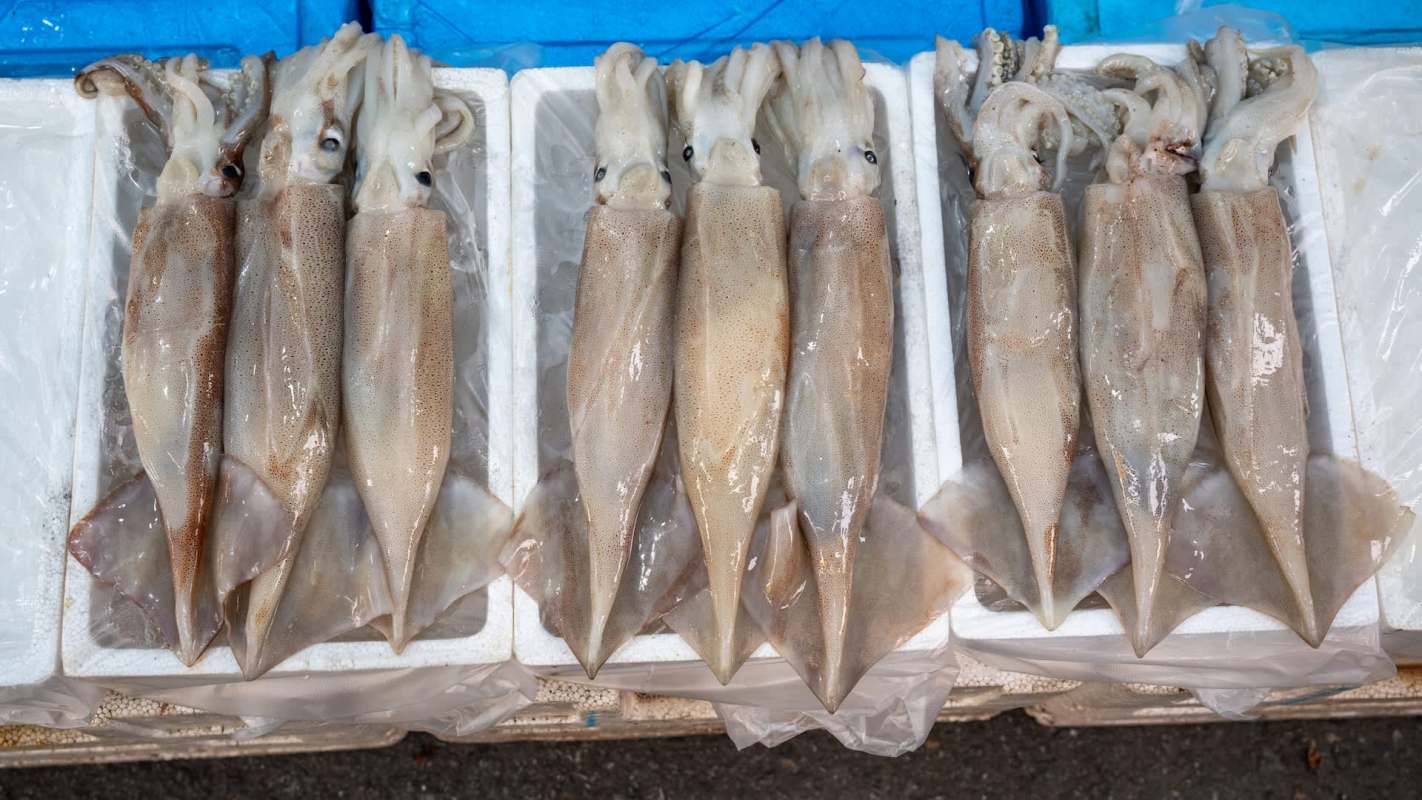
Warming waters are threatening South Korea's once-affordable staple: squid.
Here's what to know
According to Mongabay, the Korea Agro-Fisheries & Food Trade Corp. reported that the price of a medium-sized fresh local squid increased by over 40% from 2022 to 2026. National statistics show the country's squid catch is just one-sixteenth of its 2002 level.
South Korea's leading fisheries caught less than 10% of the 1999 peak of approximately 225,122 tons between 2023 and 2025. Depending on pollution outcomes, South Korean waters could feature zero catches of Pacific flying squid as early as 2043 or as late as 2048, per a study published in Communications Earth & Environment.
Researchers at Busan's Pukyong National University linked the declining catches to warming seas, marine heat waves, and changing ecological conditions. Surface waters surrounding the Korean Peninsula have warmed 0.7 degrees Celsius (1.26 degrees Fahrenheit) over a decade — more than double the worldwide average increase.
More background
Jung Suk-geun, a professor of marine life science at Jeju National University, told Mongabay that squid fisheries on South Korea's eastern Ulleung Island "have completely gone bankrupt."
Along the eastern coast, fishers have abandoned their facilities despite many still owing debts, Jung said.
TCD Picks » Quince Spotlight
💡These best-sellers from Quince deliver affordable, sustainable luxury for all




Experts believe Pacific flying squid are generally moving northward as warming waters change where they can thrive. Jung described how catches began declining in Taiwan, followed by Japan's Pacific coast, the Korea Strait, and then South Korea's eastern coast.
Cold-water walleye pollock and sailfin sandfish have also virtually disappeared from the East Sea, or the Sea of Japan, according to Jung. Meanwhile, catches of Japanese amberjack, a warm-water fish that eats squid, have increased.
What's being done?
The Seoul Economic Daily reported that South Korea's government has sought more permits to fish in distant foreign waters, including off Brazil and Argentina. Continued imports, meanwhile, have not kept squid prices from rising.
Government subsidies have also supported fishers along the eastern coast, though some have still abandoned their facilities. The pressure extends to processors and coastal businesses that depend on squid supplies.
Kim Kyung-hoi, the study's corresponding author and an ocean engineering professor at Pukyong National University, called for more research to track squid populations in the East Sea. His team's analysis paired ocean temperature, current, wind, and Pacific climate data with fishing records covering 1993 to 2025.
"I think this study highlights that climate change is a real threat not only to marine ecosystems but also to our dinner tables," Kim Tae-won, a professor in Inha University's Department of Ocean Sciences, said, per Mongabay.
Where can I learn more?
Warming waters are changing what fishers can catch far beyond South Korea.
• Globally, squid populations are booming, with overfishing potentially playing a larger role than warming.
• In Seoul, October temperatures reached 30.1 C, breaking a 111-year record before a sharp plunge.
• Around Britain, marine heat waves are driving native fish northward as sunfish numbers surge.
• On Massachusetts' North Shore, diggers and scientists are investigating collapsing soft-shell clam populations.
• In California's Sacramento River, heat could kill 1 in 5 Chinook salmon eggs, biologists warn.

Get TCD's free newsletters for easy tips, smart advice, and a chance to earn $5,000 toward home upgrades. To see more stories like this one, change your Google preferences here.
Cool Picks







