


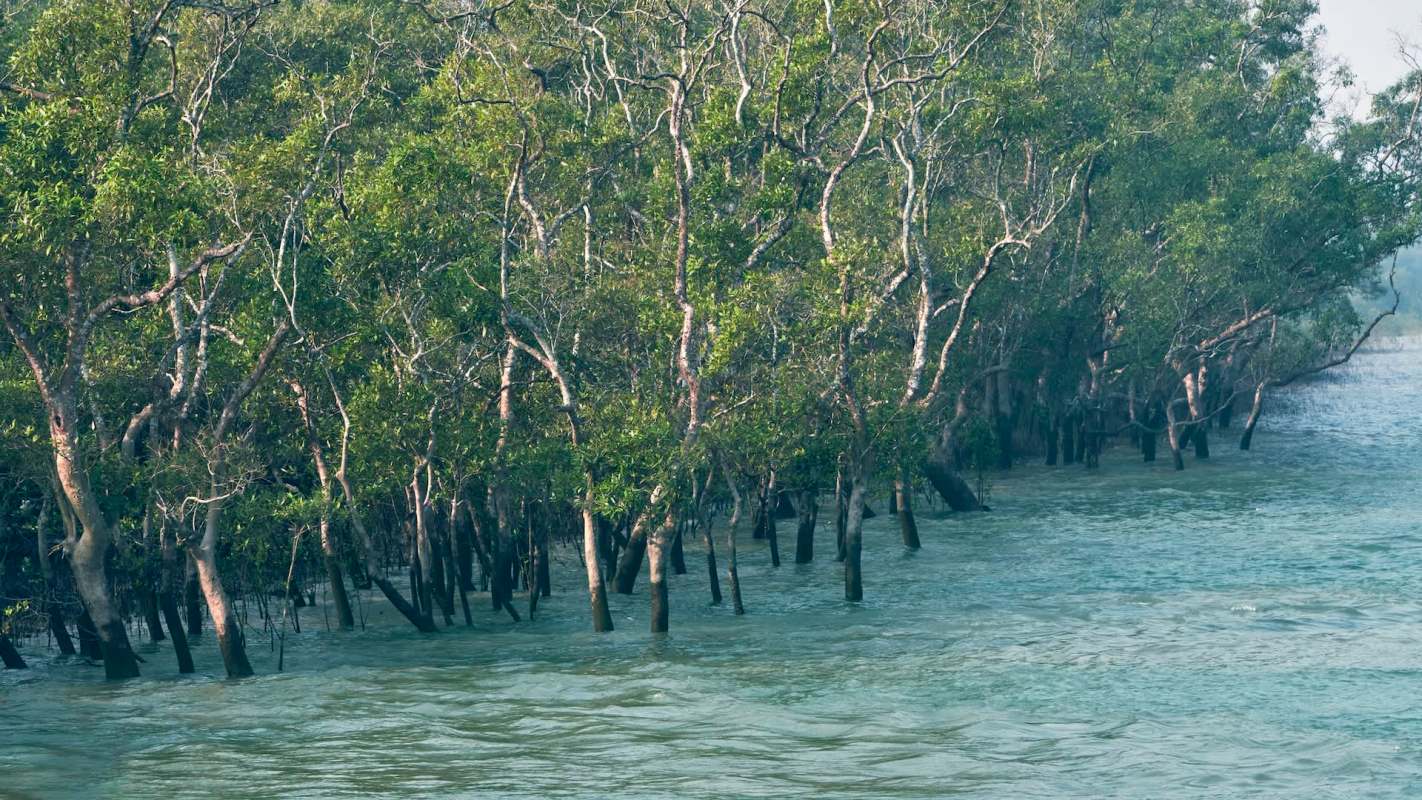
A critical Asian ecosystem is facing the increasing threat of sea level rise, putting a huge number of already vulnerable people and animals at risk.
What's happening?
As reported by Down to Earth, the Sundarbans has faced some of the highest rates of sea level rise around the world. With an annual increase of about 3.9 millimeters, the waters around the massive mangrove forest are rising at more than twice the global average. This has cast doubt on the long-term viability of the entire region.
Located on the delta of the Ganges, Brahmaputra, and Meghna rivers in the Bay of Bengal, the biodiverse region spans Bangladesh and India. Altogether, the area is home to over 4.5 million people.
Designated as a UNESCO World Heritage Site, the Sundarbans is home to numerous species, including the Royal Bengal tiger, saltwater crocodiles, and a diverse array of birds and fish. The forest — some portions now sinking by 3 centimeters per year, according to Down to Earth — has served as a crucial storm barrier and a source of food and income.
Why is sea level rise in the Sundarbans concerning?
While the Sundarbans has been vitally important to both biodiversity and the over four million people who call the area home, rising sea levels may be transforming the mangrove forest into more of a hazard.
In part due to climate-related hardships, a lack of local employment opportunities has forced many men to migrate to provide for their families, while women often stay behind, Down to Earth reported. Many of those women turn to collecting juvenile prawns from the rivers and creeks as their main source of income, which can bring its own risks.
TCD Picks » Quince Spotlight
💡These best-sellers from Quince deliver affordable, sustainable luxury for all




Their work can involve prolonged hours in waist-deep saltwater, leading to health problems such as skin conditions and urinary tract infections, according to the World Bank. A study conducted by the South Asia Consortium for Interdisciplinary Water Resources Studies indicated that a high number of women in the Sundarbans experience menstrual and reproductive disorders, likely related to extended exposure to saltwater.
What's being done?
As an extensive mangrove forest, the Sundarbans acts as a natural barrier, protecting coastal areas and millions of people from tidal surges. But as noted by Down to Earth, the effectiveness of that defense is quickly withering.
The islands of Suparibhanga, Lohachara, Kabasgadi, and South Talpatti have already been completely lost to rising waters. Several other islands in the region are experiencing similar impacts.
Since 1969, the size of Ghoramara Island has been halved. Its population has dwindled from 25,000 to 3,000 in about the same timespan. The need for support for displaced residents, and especially for marginalized community members — including low-income women experiencing serious health issues — will only grow as waters continue to rise.
|
Do you worry about having toxic forever chemicals in your home?
Click your choice to see results and speak your mind. |
 Majorly 😥
 To stem that tide, so to speak, many countries have sought to greatly reduce heat-trapping pollution, the leading cause of the global temperature increase that is melting glaciers and driving waters higher.
In the meantime, governments and communities are also adapting to sea level rise by engineering structures to hold waters back and utilizing protective natural barriers — including mangroves.

Join our free newsletter for good news and useful tips, and don't miss this cool list of easy ways to help yourself while helping the planet.







