


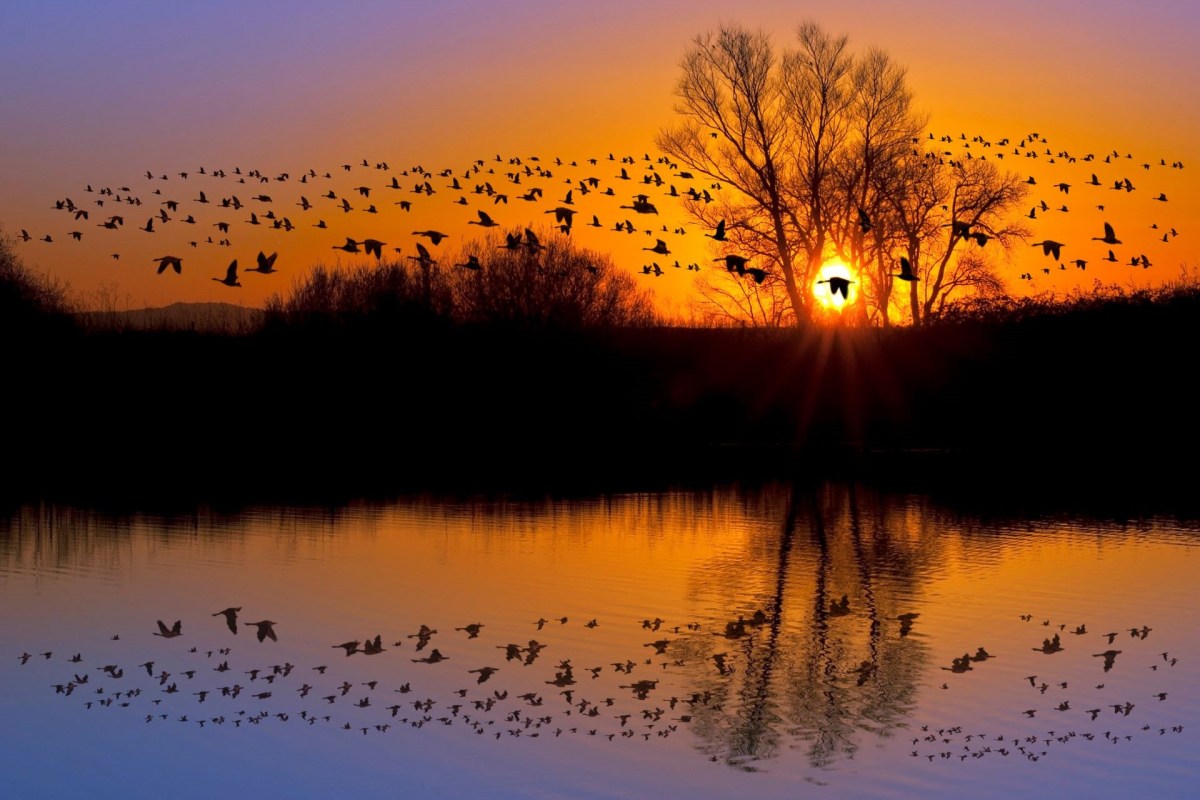
In 2009, a group of birders in Southeastern Arizona spotted a bird that seemed to be far out of its range. Now, one of them is investigating these avian vagrants, trying to find out the why and how of their range changes: Are they simply lost, or are they really pioneers?
What's happening?
A news release from the University of Illinois Urbana-Champaign describes the day that researcher Benjamin Van Doren encountered a brown-backed solitaire — normally found in mountain forests of Mexico and Central America — in Arizona.
"We knew it didn't belong," he said.
Now, he's leading research about birds that "don't belong," otherwise known as vagrants.
For a new study, he and his team looked at the isotopic signatures in the feathers of six species of American warblers found at the Farallon Islands National Wildlife Refuge near San Francisco, which has been an important location for such vagrancy studies.
The university explains that the isotopic signature of a bird's home range gets stuck in its body tissues, including feathers, when it consumes food and water.
TCD Picks » Quince Spotlight
💡These best-sellers from Quince deliver affordable, sustainable luxury for all




The study found that all of the warbler species originated from the western parts of their breeding ranges, which are found across Canada's large boreal forest. Meanwhile, the originating populations had fewer birds than other parts of their range.
While questions still remain, Van Doren hypothesizes that mirror-image misorientation, a theory that suggests that migratory birds can exhibit a faulty navigation system that causes them to fly in the exact opposite direction of their intended route, was responsible for sending these birds southwest instead of the intended southeast. He also noted that the birds may be finding new places suitable for winter due to our planet's shifting climatic conditions.
"Vagrant birds could be the start of populations adapting to changing habitats and might actually be a critical part of the cycle of range expansion in migratory birds," he said. "You could think of these rare birds as possibly the vanguard of population change and geographic distribution change."
Why is this study important?
One possible consequence of vagrancy is the end of a bird's line, as it has no — or fewer — mating options.
|
Do you think we still have a lot to learn from ancient cultures? Click your choice to see results and speak your mind. |
 Definitely 👍
 Meanwhile, this study adds to previous research that tries to better explain why some birds end up far from their normal migratory ranges.
For instance, ornithologists explain that a warming planet is changing birds' migratory patterns. Audubon Vermont explains, "Temperature fluctuations are affecting the food birds depend on, the timing of their migration patterns and egg laying, and even the sizes and shapes of their bodies."
What's being done to better understand vagrancy?
Van Doren hopes that other ornithologists will explore the origins of vagrants to one day settle on a unifying theory of songbird vagrancy.
"These rare bird occurrences could just be lost birds that are not going to survive," he told UIUC. "But there is another perspective, that maybe they're not so 'lost.' Maybe they are explorers."

Get TCD's free newsletters for easy tips to save more, waste less, and make smarter choices — and earn up to $5,000 toward clean upgrades in TCD's exclusive Rewards Club.







