


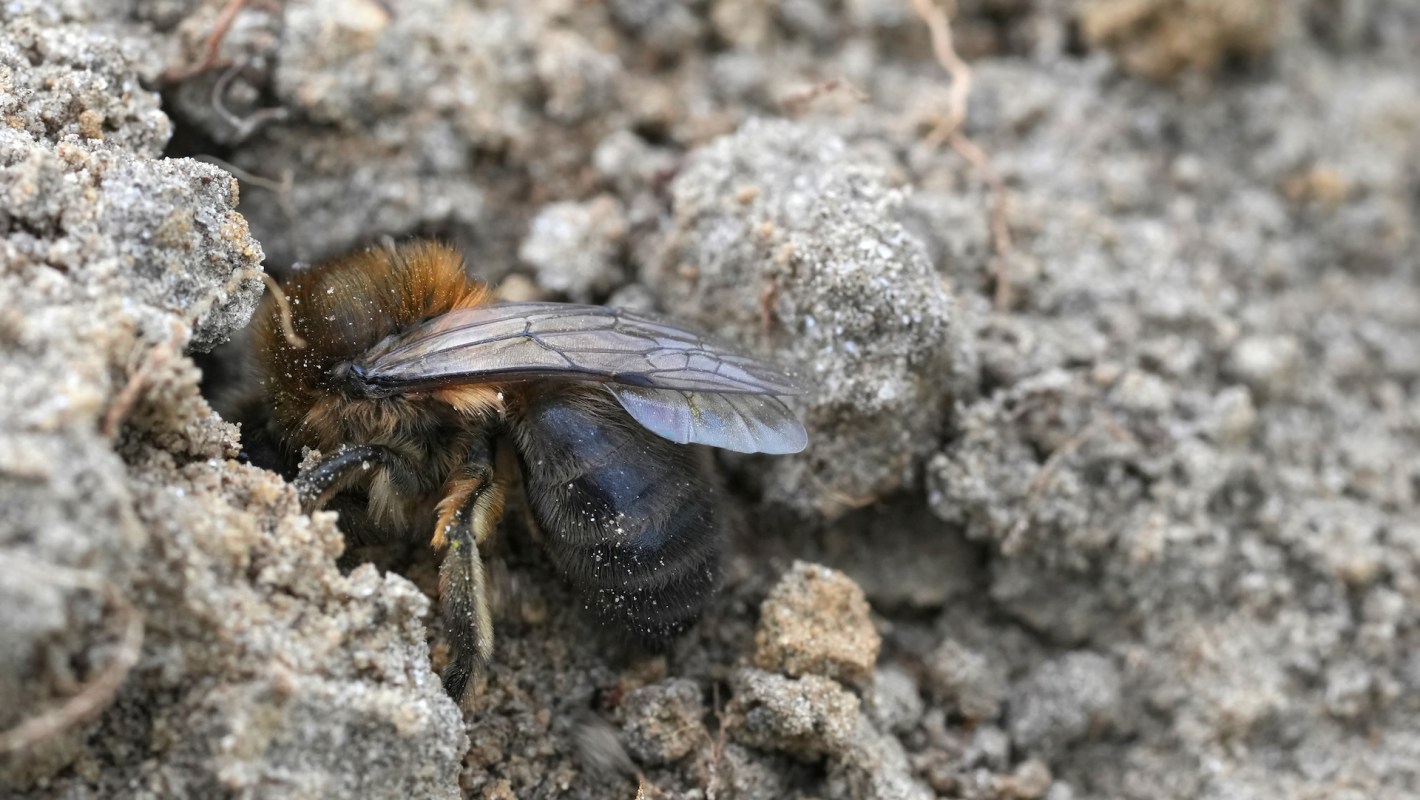
Researchers out of Cornell University have discovered one of the largest and oldest bee colonies ever recorded underneath a cemetery in New York.
What's happening?
Scientists and entomologists have known for nearly 90 years that bees have taken up residence in Ithaca's East Lawn Cemetery, but until recently, no good estimates existed for how many bees actually lived there, per Scientific American.
Now, in a new study published in the peer-reviewed journal Apidologie, Cornell researchers shared their findings on an enormous colony of miner bees.
In the spring months of 2023, across the 70,000 square foot cemetery, an estimated 5.56 million ground-nesting bees emerged to find food and mate, stunning the researchers.
Bryan Danforth, the senior author of the study and professor at Cornell, explained to Scientific American that he was "completely floored when we did the calculations."
"I have seen published estimates of bee aggregations in the hundreds of thousands," Danforth continued to say. "But I have never imagined that it would be 5.56 million bees."
TCD Picks » Quince Spotlight
💡These best-sellers from Quince deliver affordable, sustainable luxury for all




To explain just how enormous this population was, the study's authors note that this would be equivalent to finding between 140 to 270 honey bee hives, each with 20,000 to 40,000 bees, in just one hectare.
Why does studying bees matter?
This study highlighted the importance of cemeteries as habitats for miner bee populations and underscored that although ground-nesting bees represent the majority of bee species, they're understudied when compared to their hive-dwelling counterparts.
In the study, the scientists referenced past entomology research that cemeteries often serve as "sentinels of biodiversity where the dead protect the living" and that "cemeteries are increasingly viewed as biodiversity preserves for native plants and animals, especially in heavily urbanized environments."
Yet even though scientists understand that these animals are critical to supporting human food systems, ground-nesting bees face an onslaught of risks, such as habitat loss, pesticides, and even disease.
To help your local pollinators, consider rewilding your yard, using fewer pesticides, or even planting your local native plants.
|
Which of these savings plans for rooftop solar panels would be most appealing for you?
Click your choice to see results and earn rewards to spend on home upgrades. |
 Save $1,000 this year 💸
Get TCD's free newsletters for easy tips, smart advice, and a chance to earn $5,000 toward home upgrades. To see more stories like this one, change your Google preferences here.







