


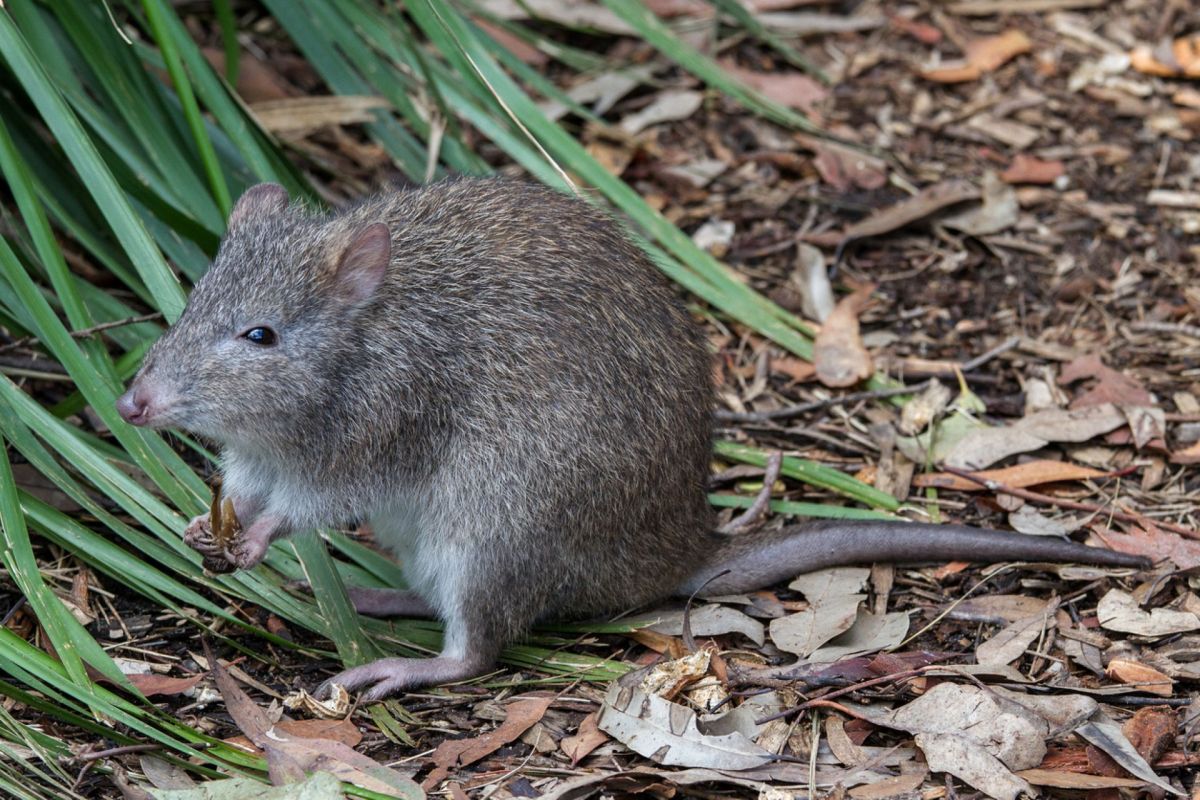
Saving one of the world's rarest marsupials may come down to an unlikely source: its poop.
Gilbert's potoroo was once thought extinct before being rediscovered in 1994. Since then, conservation teams have worked to pull this species back from the brink, but the challenge remains immense.
Researchers in Western Australia are studying Gilbert's potoroo scat for tiny DNA clues that could help conservationists find safe new homes for a species with fewer than 150 individuals left in the wild. Their research was published last year.
Scientists from Edith Cowan University and Western Australia's Department of Biodiversity, Conservation and Attractions are using environmental DNA (eDNA) metabarcoding to determine what Gilbert's potoroos are eating. Because the critically endangered marsupials are found only in Western Australia, learning more about their diet could help experts identify suitable sites for future translocations.
"We are looking to recover the species through translocations, which is moving organisms from one location to another to create an insurance population in case anything was to happen in their existing populations," Rebecca Quah, a Ph.D. student at ECU's School of Science, explained.
The method relies on fresh scat samples, allowing researchers to study the animals without disturbing them. That is especially important for a species this rare.
TCD Picks » Quince Spotlight
💡These best-sellers from Quince deliver affordable, sustainable luxury for all




"In doing that, one of the challenges was trying to determine what they are eating and where those resources can be found. Mycophagus — or fungi-eating mammal — diets are quite hard to study because a lot of fungi remain undescribed," Quah continued.
Quah said earlier diet work involved sorting through scat remains, and fungal spores were hard to pin down. By using DNA techniques instead, the team can build a much clearer picture of what these small marsupials eat and ultimately what they need to survive.
Researchers also compared the potoroo's diet with those of other fungi-eating mammals, including quokkas, quendas, and bush rats, and they found some overlap.
Based on those results, the researchers recommend focusing on areas where the potoroo's companion species still occur together, since that may indicate the right mix of food and habitat. That gives conservation teams a more practical way to narrow their search for suitable mainland locations.
In 2015, a bushfire wiped out about 90% of the core potoroo habitat in Two Peoples Bay, where the only natural population lives. That kind of risk is why scientists are trying to establish more "insurance populations" in new locations. If fire, disease, or another disaster strikes one site, the species stands a better chance of surviving elsewhere.
Protecting species such as Gilbert's potoroo is not just about saving one animal. It is also about preserving the natural systems that local communities depend on and value, and keeping entire ecosystems functioning.
"The search for new translocation sites is an important next step in the recovery of Gilbert's potoroo from near-extinction," Dr. Tony Friend said.
This work builds on earlier recovery efforts. Captive breeding was attempted after the species' rediscovery, but it proved difficult, partly because the animals are selective about what they eat.
Wild-to-wild translocations have emerged as a more promising strategy, and backup populations now exist on Bald Island and inside a fenced area at Waychinicup National Park.
The study offers another example of how noninvasive science can support wildlife recovery, helping conservationists protect a species on the edge without adding further stress to its survival.

Get TCD's free newsletters for easy tips, smart advice, and a chance to earn $5,000 toward home upgrades. To see more stories like this one, change your Google preferences here.







