


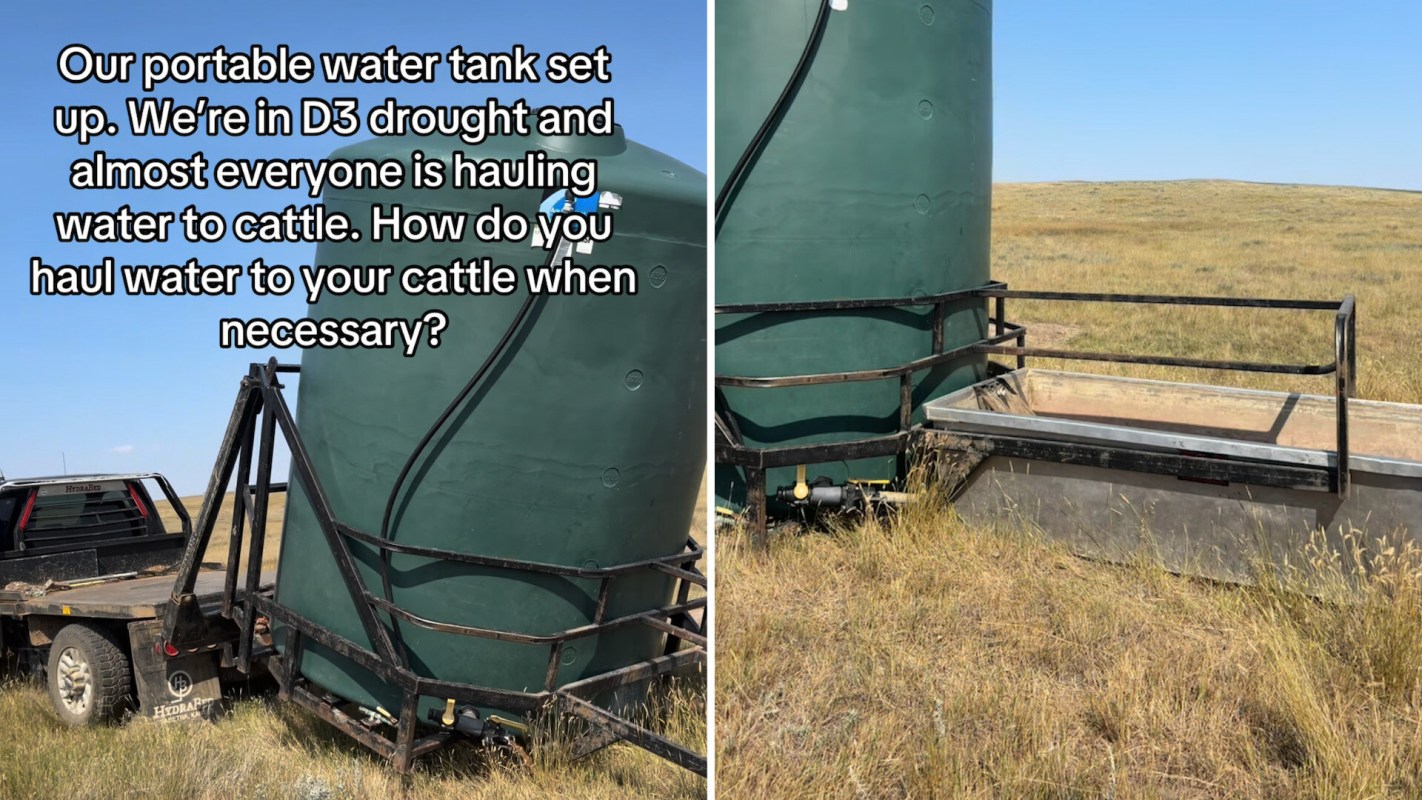
When drought tightens its grip, even a water tank that looks improvised can become essential equipment. In eastern Montana, a rancher gave viewers a close look at the kind of workaround families are relying on to keep cattle watered as dry conditions drag on.
Here's what to know
A TikTok video by @shay_ranchwife_sahm features a portable tank used to haul water to livestock. "Yes this is as sketchy as it looks," the caption reads, "but it gets the job done when we need a quick way to get water to cattle."
@shay_ranchwife_sahm Yes this is as sketchy as it looks 😂 but it gets the job done when we need a quick way to get water to cattle. We have a family in our community who builds these portable tanks. We are in D3 drought in Eastern MT. What are the conditions like where you are and how are you getting by? #drought #rancher #cattle #water #ranchwife ♬ original sound - She's_thatgirl💕💕carolyn
She said they were dealing with severe dryness, stating, "We are in D3 drought in Eastern MT," and noted, "We have a family in our community who builds these portable tanks."
One commenter wrote, "Hauling water here in Arkansas. Praying for all of us to get some rain! Ponds are going dry and grass is dying."
Another described a much larger system: "Pump water up 320' from the creek and then over a mile to CRP. 2500 gal storage tank that gravity feeds to (4) 1000 gal troughs on floats. Hauling sucks."
"2-1000 gallon tanks on a 1965 2 ton making 2 trips a day," a third said of their system.
TCD Picks » Quince Spotlight
💡These best-sellers from Quince deliver affordable, sustainable luxury for all




More background
The video captures the daily labor required to keep animals alive when ponds, creeks, and pasture moisture begin to fail.
For cattle producers, water is not optional, and delays can quickly become costly. If natural sources dry up, someone has to replace that supply with pumps, tanks, trucks, hoses, storage, and time. That can mean more fuel use, more wear on equipment, and more hours spent on emergency logistics instead of routine ranch work.
There is also a feed problem behind the water issue. When grass dies off or stops growing, ranchers may need to start supplemental feeding earlier than planned, increasing costs just as water becomes harder to access.
What can be done?
Drought often forces people into fast, practical fixes. Here, that meant relying on a portable tank built by a family in the community to handle an immediate livestock-water need, even if the equipment looked rough around the edges.
Drought resilience usually comes down to infrastructure and planning. More dependable pipelines, tanks, wells, storage, and backup pumping systems can reduce the need for emergency hauling. Community knowledge sharing can matter, too, especially when neighbors compare what is and isn't working.
"It's so scary," one commenter wrote. "I'm from central Montana in western North Dakota now. but I don't think I have ever seen it this bad. my dad said same thing. the pastures at home are just crunchy. gunna be feeding early and lots of mineral."
Where can I learn more?
The OP's video hits on a drought story unfolding across the West. As water supplies shrink, stock tanks dry up, pasture deteriorates, and cattle operations are pushed into expensive, high-stakes decisions.
• In Arizona, drought dried up cattle drinking tanks and pushed San Carlos Apache ranchers into emergency conditions.
• In Wyoming and Nebraska, no grass and no water forced ranchers to sell cattle as market prices surged.
• In Emery County, Utah, water dropped to 6% of normal as ranchers scrambled to save livestock and crops.
Each of these stories shows how quickly a water shortage can turn into a herd-management crisis. That is why even a rough portable tank can make a real difference when livestock need water that day.

Get TCD's free newsletters for easy tips, smart advice, and a chance to earn $5,000 toward home upgrades. To see more stories like this one, change your Google preferences here.







