


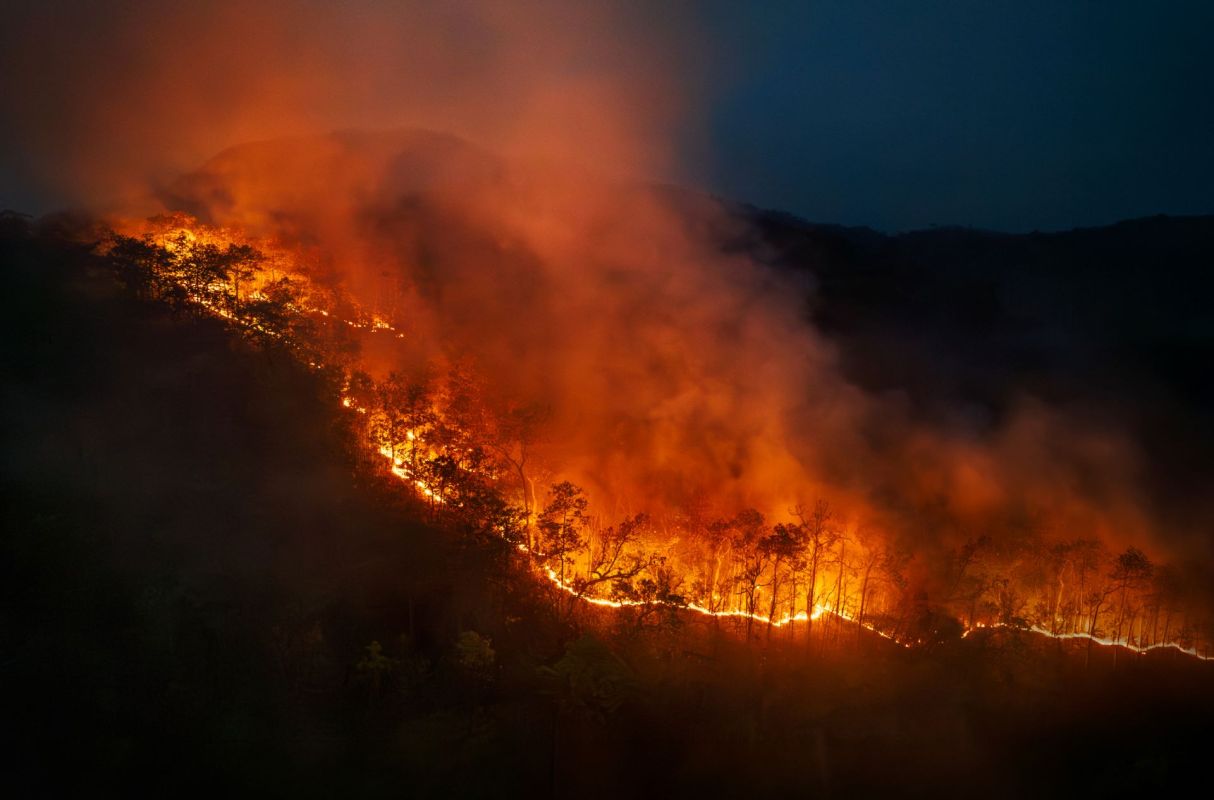
A wildfire commander is warning that the United States may be caught in a dangerous cycle and that, to get out of it, it might have to roll back firefighting efforts.
Counterintuitively, experts say, fighting today's fires could be making the fires of tomorrow worse, Grist reported.
Here's what to know
Dan Dallas, an incident commander for the U.S. Forest Service and the agency's director of renewable resources for the Rocky Mountain region, had an epiphany while fighting a California wildfire, according to Grist.
With mild, rainy weather, Dallas, the local forest supervisor, and the Karuk Tribe chose not to suppress every part of the blaze right away, allowing some fire to move across the forest floor. As the fire burned, it consumed the fuel that had built up because of years of wildfire suppression.
That experience sharpened Dallas' concern that repeatedly putting out fires can simply delay the danger.
"Finally, I figured out all I'm doing is deferring risk to this place," he said, per Grist. "I'm going to come back and protect it again."
TCD Picks » Quince Spotlight
💡These best-sellers from Quince deliver affordable, sustainable luxury for all




Many experts support policies that would allow forests to undergo controlled burns on a regular basis. Wildfires are an important part of forests' natural lifecycles, and burning built-up fuel such as dried brush and dead trees reduces the risk of a large fire.
Despite this, the Trump administration has moved back toward a "full suppression" strategy that looks to extinguish all fires as soon as possible, including ones that are not threatening lives or property, per Grist.
By putting out every fire, agencies can leave brush, trees, and other fuel on the landscape, increasing the risk of future megafires.
More background
Researchers who study wildfires have cautioned about this pattern for years.
A 2015 Forest Service futures report concluded that "the existing fire suppression approach will fail across the whole range of plausible future conditions," according to Grist.
Firefighting agencies contain the vast majority of fires, but the small number that escape containment can be extraordinarily destructive.
Matt Hurteau, a University of New Mexico forest ecologist, told Grist that federal crews stop over 98% of wildfires. However, this success allows fuels to accumulate until hot, dry, windy weather produces a blaze no one can control.
The result can be repeated protection of the same neighborhoods as the underlying hazard gets worse.
"We keep going back to the same places, and it's more often that the fires are more severe," Dallas told Grist.
What's being done?
Many fire scientists say the goal should not be zero fires but fires that are managed more effectively.
This strategy includes prescribed burns, fuel reduction work, and allowing some naturally sparked fires to burn, particularly when at a safe distance from communities.
"No two ways about it. Science will tell you, you need more fire on the landscape," Adam Mendonca, the Forest Service's deputy director of Fire and Aviation Management, told Grist.
Experts say prescribed burning is not happening at the scale required. The Forest Service carried out roughly 1.2 million acres of prescribed burns in 2025; in 2024, that figure was 2.2 million acres.
Limited staffing and funding are major barriers.
Emergency money can flow quickly to suppression, while preventive work depends on budgets and is often assigned to the same personnel who are used to fight active fires.
Making homes more fire-resistant can help, but residents still depend on agencies to protect them from out-of-control megafires.
"Our system is taxed beyond capacity to respond," Dallas said, per Grist. "It's already falling apart."
Where can I learn more?
These stories look at how California and other states are wrestling with the reality that stopping every fire can leave communities facing even bigger risks.
• Lawmakers battled over an overhaul of wildfire response as residents resisted new mitigation zones.
• Homeowners pushed back as proposed fire prevention regulations were set to reshape landscaping.
• After the Park Fire, scientists warned contamination could threaten drinking supplies.
• Wildfire losses have driven insurance costs upward even for homeowners in Iowa.

Get TCD's free newsletters for easy tips, smart advice, and a chance to earn $5,000 toward home upgrades. To see more stories like this one, change your Google preferences here.







