


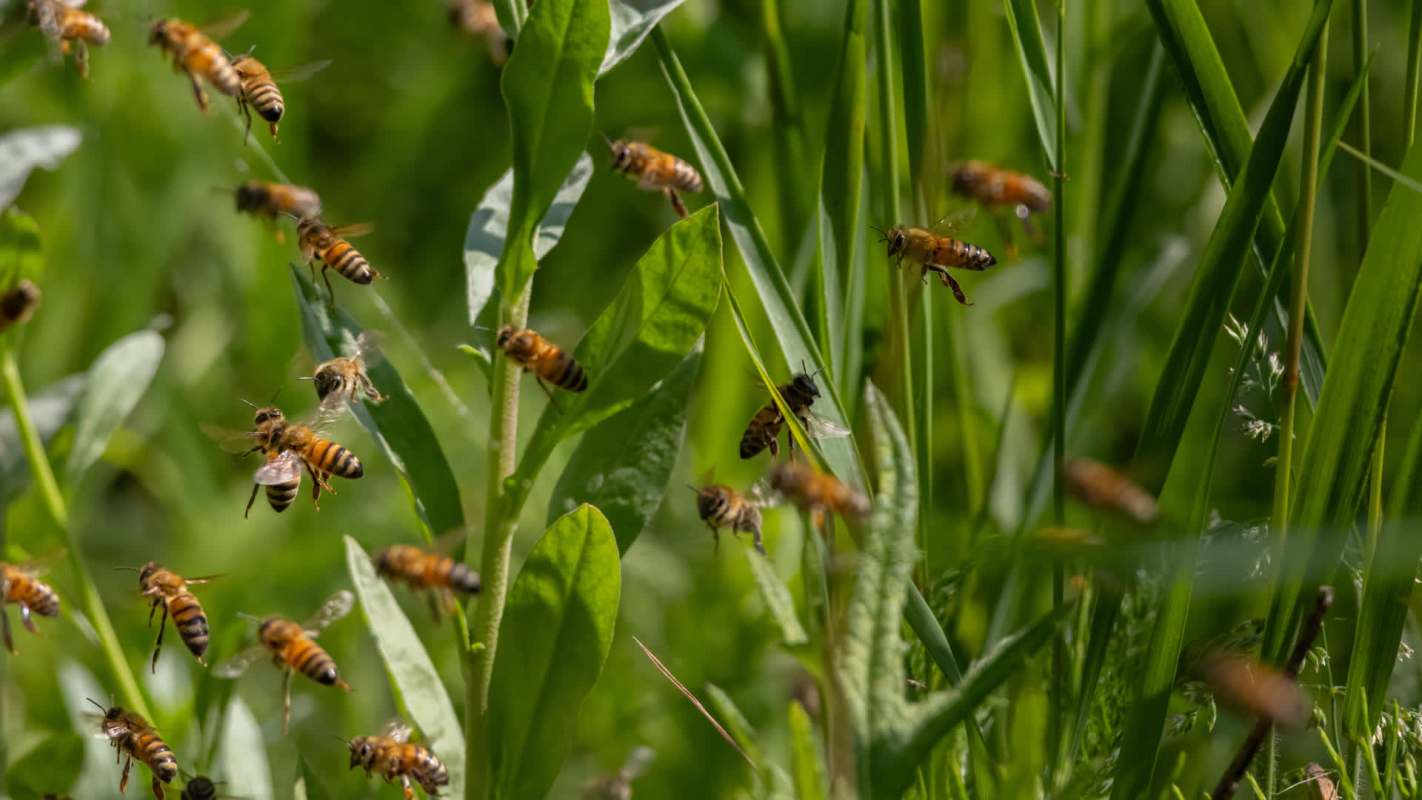
One of the world's most important pollinators may have an even more remarkable skill than scientists once realized: A team led by the University of Tennessee, Knoxville, has found that nearly 90% of the bee species it tested appear to be magnetic.
The discovery, recently published in Science Advances, is notable not only because it reveals a hidden trait in bees, but also because it could eventually help researchers better protect the insects that support food systems, home gardens, and wild ecosystems.
The work started when UT researchers Anne Murray, a research assistant professor in ecology and evolutionary biology, and Dustin Gilbert, an associate professor of materials science and engineering, began comparing notes across their different specialties.
According to a report discussing the study's findings on Phys.org, Murray knew that honeybees had been shown decades ago to sense Earth's magnetic field. Gilbert studies magnetism and nanotechnology. Together, they decided to take a much broader look.
At the time, only five bee species had ever been identified as having that ability. Over the next six years, Murray, Gilbert, and fellow UT researcher Laura Russo tested more than 120 bee species from around the world. Their conclusion was that magnetism is far more common in bees than previously understood.
That matters because bees do essential work in nature. They pollinate crops, backyard gardens, and native plants, helping keep ecosystems healthy.
TCD Picks » Quince Spotlight
💡These best-sellers from Quince deliver affordable, sustainable luxury for all




A better understanding of how bees navigate, forage, and return home could help scientists develop stronger conservation strategies at a time when many pollinator populations face pressure from habitat loss, pesticides, and climate-related disruption.
Researchers call this ability "magnetoreception," or the capacity to detect Earth's magnetic field. In many animals, it is linked to navigation.
Honeybees, for instance, are known for their waggle dance, a movement-based signal that helps other bees locate food sources. Earlier research suggested that magnetism might support that communication process, but the new study indicates the phenomenon extends far beyond honeybees, including solitary species that do not dance at all.
That was one of the study's biggest surprises. The UT team initially suspected that magnetism might show up mainly in highly social bees. Instead, it appeared broadly across both social and solitary species. The researchers also found that larger bees and more social bees tended to show stronger magnetic signals, though no single lifestyle factor fully explained the pattern.
To explore the question further, the scientists expanded their investigation beyond bees and into wasps, which are close evolutionary relatives. After testing nearly 300 wasp species, they found that roughly 90% of them were magnetic as well, suggesting this sensory ability may trace back much deeper in the insect family tree than previously thought.
For most people, findings like these may seem abstract at first, but they could have practical value.
If scientists can determine how bees use magnetic cues in the real world — whether for short-range navigation, locating nests, or orienting while foraging — that knowledge could inform how landscapes, farms, and pollinator habitats are managed. It could also help explain why some environments are better for bees than others.
That is especially relevant for communities that rely on pollinator-supported crops and for home gardeners trying to create healthier outdoor spaces. Even small changes can make a meaningful difference for bees. Research like this gives scientists another piece of the puzzle in understanding what these insects need to thrive.
The most encouraging part may be how much remains unknown. Rather than closing the book on bee behavior, the study opens up a new line of inquiry into a sense that appears to have helped insects survive for millions of years.
"It just was so unexpected," Murray said. "What has been the most surprising thing is there are so many and so much variety. We just weren't expecting that."
For Gilbert, the biggest takeaway is how much this hidden sense may still shape the natural world: "While the prevailing theory is that insects use vision to navigate, our data suggests that magnetism may also play a crucial role, probably in short-range navigation. But we still don't know for sure why they use magnetic fields and why it seems to have persisted for 150 million years."

Get TCD's free newsletters for easy tips, smart advice, and a chance to earn $5,000 toward home upgrades. To see more stories like this one, change your Google preferences here.







