


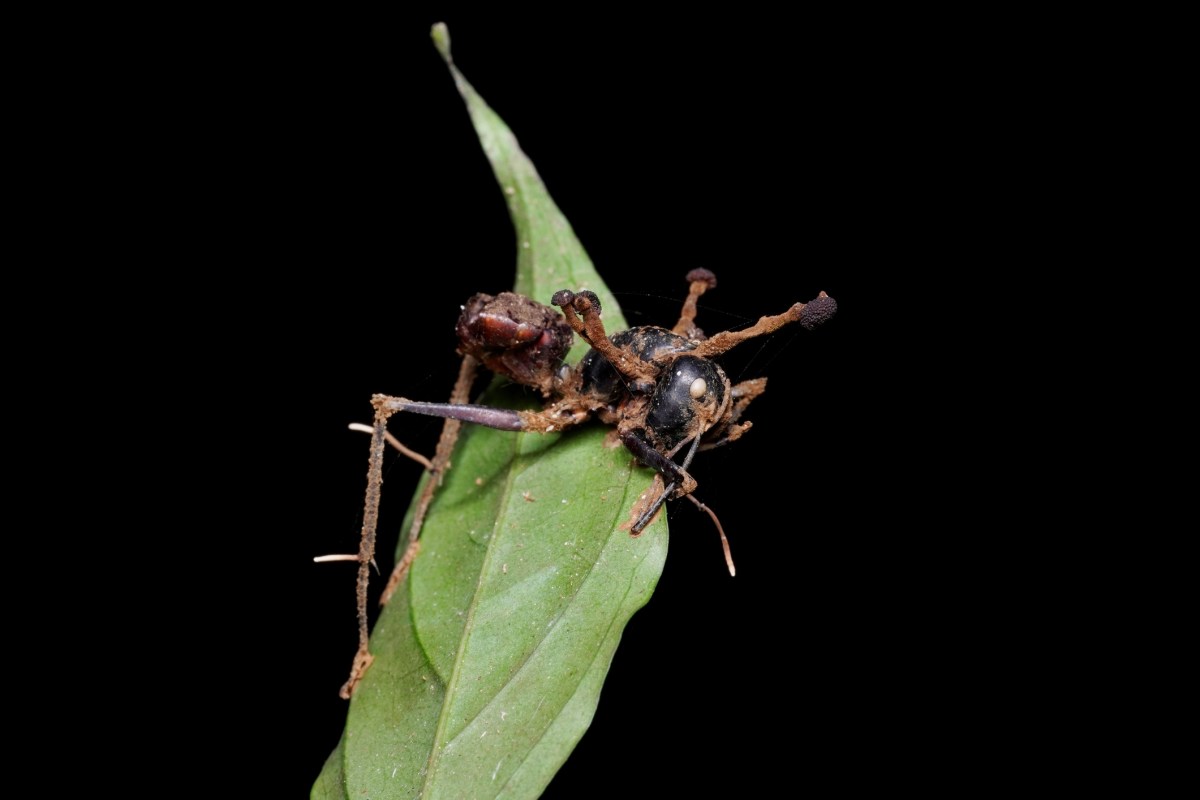
A study in Brazil's Amazon rainforest found the so-called zombie-ant fungus in mosses, even in samples taken far from clusters of dead, infected ants known as ant graveyards.
The finding suggests that Ophiocordyceps may not exist only as an ant-infecting parasite and could also spend part of its life cycle as an endophyte, living inside plants without causing disease, according to IFLScience.
Here's what to know
Published in IMA Fungus, the study focused on DNA from moss samples collected in the Adolpho Ducke Forest Reserve in Manaus.
The researchers identified Ophiocordyceps in moss gathered away from vegetation, where infected ants are usually found after making their final "death bite."
Study author Tales Alves-Júnior of the Instituto Nacional de Pesquisas da Amazônia described the research team's findings.
"We detected Ophiocordyceps, along with other entomopathogenic genera, in every moss sample collected away from the ant graveyards. That is, in our control sample."
TCD Picks » Quince Spotlight
💡These best-sellers from Quince deliver affordable, sustainable luxury for all




"Therefore, the fungus is present in mosses that no infected ant ever bit," he added.
That means the moss may not have acquired the fungus only because an infected ant latched onto it there. Instead, the findings suggested that Ophiocordyceps was already living in the plant before the insect arrived.
Researchers already had strong evidence that Ophiocordyceps can alter insect behavior.
The new element is this apparent plant phase in the Amazon, which broadens understanding of how the fungus persists and spreads in the wild.
More background
The headline-grabbing "zombie" label can make this fungus sound more threatening than it actually is.
In reality, Ophiocordyceps species are highly specialized insect parasites, and this study focused on ecological relationships in the rainforest, not on any danger to humans.
Research from cooler regions has shown that some insect-pathogenic fungi can live inside plants without harming them. What made this result especially notable is that it appeared to be the first reported Amazon example of that endophytic stage.
There was another unusual detail.
In 2018, co-author João Paulo Machado de Araújo of the University of Copenhagen and colleagues detailed multiple new species from that locality, including O. monacidis, whose fruiting body is similar to the sporophyte of Octoblepharum moss.
That was the same moss where zombie ants are often found and where the fungus was detected living internally.
Taken together, those details suggest the plant may be more than just a passive surface — it could be part of a tightly coordinated ecological system linking fungus, insect, and moss.
What's being done?
Researchers now want to determine whether the moss helps direct where infected ants bite.
"The behavior manipulation might involve not only the EPF and the host insect, but other factors linked to the plant they bite upon manipulation, and their associated mycobiome," said Machado de Araújo.
That question could matter beyond rainforest ecology.
Better understanding how insect-pathogenic fungi interact with plants may help biocontrol research aimed at reducing crop pests with more targeted, nature-based tools.
Discoveries like this can sharpen scientists' understanding of natural pest control while showing that forests still harbor relationships researchers are only beginning to grasp.
"It is possible that these plants containing the endophytic stage of the fungus are attracting its EPF counterpart in the insect to bite onto specific locations," Machado de Araújo noted.
"If we can prove it, it would be a groundbreaking discovery that can help us to understand possible applications of these fungi as biocontrol of crop pests, for example."
Where can I learn more?
This study is part of a larger effort to understand the unusual ways fungi, insects, plants, and disease intersect.
Other researchers are tracking how fungal threats spread through forests and how habitat and climate shifts can alter where insect-related risks arise.
• On Long Island, officials found laurel wilt leaping unexpectedly through trees once thought to be less vulnerable.
• Public health researchers warned that mosquito-friendly yard habitats can intensify disease risks around homes.
• In mountain regions, warming has pushed malaria-carrying insects uphill, expanding exposure at higher altitudes.
These stories highlight the same core idea: hidden life stages and shifting habitats can matter far beyond a single Amazon fungus.
Knowing where organisms persist, spread, and interact can change how scientists think about ecosystem health, disease risk, and biological control.

Get TCD's free newsletters for easy tips, smart advice, and a chance to earn $5,000 toward home upgrades. To see more stories like this one, change your Google preferences here.






