


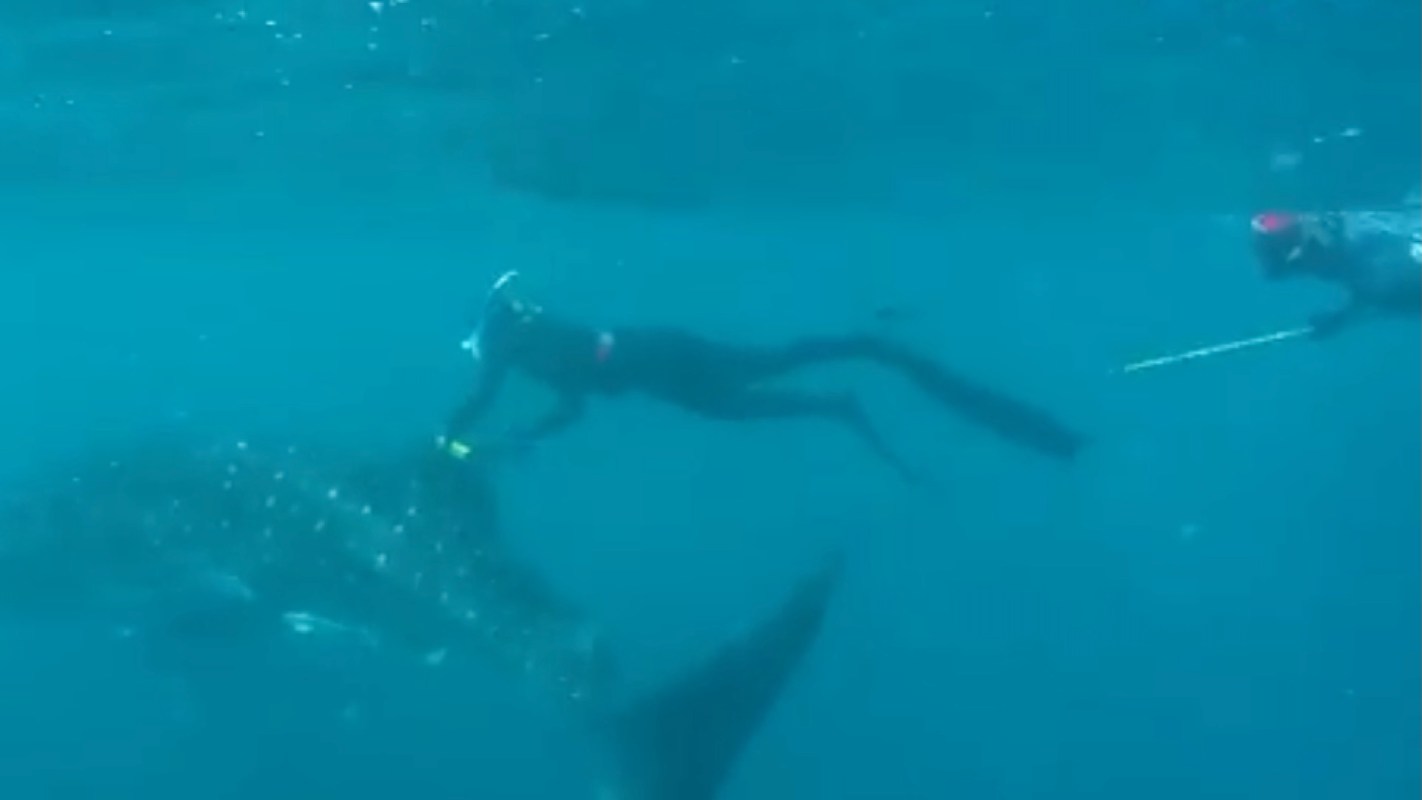
Researchers are sharing new discoveries about the world's largest fish after attaching cameras to whale sharks in order to capture their behavior deep below the sea surface.
What's happening?
According to The New Daily, summarizing a study published in Marine Biology, after reviewing the footage, researchers discovered whale sharks at Ningaloo Reef in Western Australia used a wider set of feeding tactics than previously understood, including foraging as deep as 230 feet (70 meters).
To capture the new videos, researchers temporarily fitted juvenile whale sharks with camera tags. After 24 hours, the cameras detached and were retrieved after, The New Daily reported.
They also reviewed more than 100 scientific papers alongside the new footage, creating the biggest whale shark behavior catalog to date and identifying 36 distinct behaviors.
According to The New Daily, Christine Barry, a Ph.D. candidate in marine movement ecology at Murdoch University and the Australian Institute of Marine Science, and Luciana C. Ferreira, a research scientist at the Australian Institute of Marine Science, said the project helped answer a long-standing question: "What do whale sharks do when no one is watching?"
Why does it matter?
Whale sharks live in tropical waters, where food can be patchy and scarce. As climate change continues to alter ocean conditions, understanding how these animals find enough to eat could become increasingly important to protecting them.
TCD Picks » Quince Spotlight
💡These best-sellers from Quince deliver affordable, sustainable luxury for all




It also calls into question the longstanding assumption that whale sharks do most of their feeding at the surface.
Instead, the researchers found that the animals often conserve energy with lower-effort feeding tactics, becoming more active when they run into dense prey patches such as krill swarms.
Barry and Ferreira summed up the behavior with a vivid comparison, as reported by The New Daily: "It's like snacking from the pantry while you decide what you're going to cook for dinner." Based on what the researchers observed, they added, "They are the ultimate snackers of the sea."
That flexibility may help explain how whale sharks manage to survive in challenging feeding environments. It also points to the need to protect the full water column — not just the ocean's surface.
Healthy marine ecosystems support fisheries, tourism, and coastal communities, meaning better science about a flagship species such as the whale shark can have benefits that extend well beyond a single animal.
What's being done?
The tagging method itself is a major step, offering something standard tracking devices cannot: a direct visual record of specific behaviors underwater.
That could help researchers and conservation managers better understand where whale sharks feed, how they use habitat, and which parts of marine environments may need stronger protection.
The study focused on one aggregation of juvenile whale sharks, so scientists said using more tags at gathering sites around the world could reveal even more behaviors. That kind of information could improve marine conservation planning as ocean conditions continue to shift.
Whale sharks are part of marine systems that help sustain biodiversity and local economies, especially in coastal regions where wildlife tourism supports jobs and businesses.

Get TCD's free newsletters for easy tips, smart advice, and a chance to earn $5,000 toward home upgrades. To see more stories like this one, change your Google preferences here.






