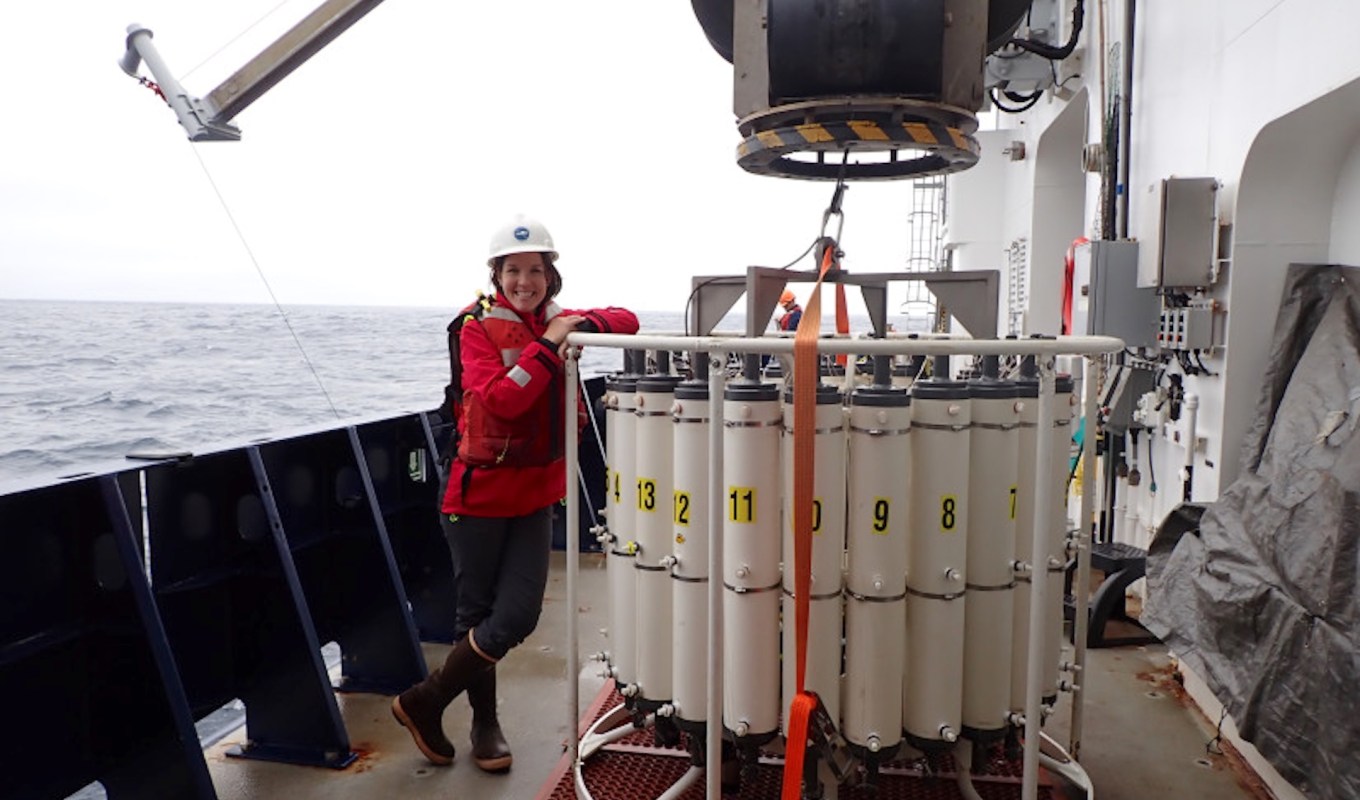
A jar of seawater may not look like much, but scientists studying the California coast found it can hold a surprisingly detailed snapshot of ocean life.
DNA traces from microbes and plankton in seawater can be used to estimate nearby whale numbers, offering a potentially faster way to track whale populations.
Here's what to know
As Earth.com reported, a study published in the journal PLOS One found that researchers from Scripps Oceanography at UC San Diego and Cal Poly San Luis Obispo used genetic material from tiny organisms to predict the density of blue, fin, and humpback whales off California.
Using data collected from 2014 to 2020, the team paired seawater samples taken at stations between San Diego and Morro Bay with whale sightings logged during California Cooperative Oceanic Fisheries Investigations cruises at those same locations. They then examined marker genes linked to bacteria, plankton, and other microscopic organisms.
Compared with standard forecasting methods, the models performed 53% better on average and narrowed population estimates to about a single whale across 386 square miles. Groups of DNA sequences explained 81% to 99% of the variation in estimated whale density.
Counting whales is notoriously difficult because they travel long distances, remain underwater for extended periods, and can still be missed by ships, aircraft, tags, and acoustic monitoring.
TCD Picks » Quince Spotlight
💡These best-sellers from Quince deliver affordable, sustainable luxury for all




More background
More accurate whale forecasts could help prevent fatal ship strikes, one of the biggest threats facing large whales.
That could assist managers when deciding whether to slow ships or reroute them before collisions occur. A 2024 study in the journal Science found that shipping traffic overlaps with 92% of the ranges of blue, fin, humpback, and sperm whales, while protections were in place in fewer than 7% of the highest-risk areas.
Whale populations can also serve as a sign of ocean health, with implications for fisheries, coastal tourism, and communities that rely on marine ecosystems. A faster, cheaper way to track whales could therefore help shape decisions about how shared ocean space is managed.
The researchers linked whale presence to 148 taxonomic groups. Some were already known as prey, parasites, or skin microbes, while many had not previously been associated with whales.
What can be done?
The researchers made their software available so other scientists can try the method in new regions or apply it to other animals that are hard to track, including sharks and large open-ocean fish, according to Earth.com.
The technique could also be integrated into existing monitoring systems. The California Cooperative Oceanic Fisheries Investigations, the world's oldest marine ecosystem monitoring program, has operated since 1949, so the framework for collecting water samples and matching them to field observations is already in place. As sequencing costs continue to drop, environmental DNA may become a more practical option for agencies and researchers.
Individuals can also contribute to whale monitoring. Sightings reported through Whale Alert can help mariners and managers respond in real time, and whale watchers can upload photos to Happywhale, where tail-fluke images are matched against known individuals and the records can then be shared with researchers.
"The concept of this project was to try and find an indirect signal," Cal Poly statistics professor Trevor Ruiz said, per Earth.com.
Where can I learn more?
California's seawater-DNA findings are part of a bigger effort to track whales beyond shipboard sightings alone. Other reporting has followed researchers who map migrations, sample whale breath, and use feeding behavior to read ecological change in very different marine environments.
• Across the North Atlantic, scientists mapped right whale migrations over a vast, ship-threatened range.
• In the Arctic, drones sampled whales' breath to monitor morbillivirus and other emerging health threats.
• Diet patterns have revealed rapid environmental changes shaping whale feeding grounds.
Viewed side by side, the studies make clear why indirect signals are becoming central to whale science.

Get TCD's free newsletters for easy tips, smart advice, and a chance to earn $5,000 toward home upgrades. To see more stories like this one, change your Google preferences here.