


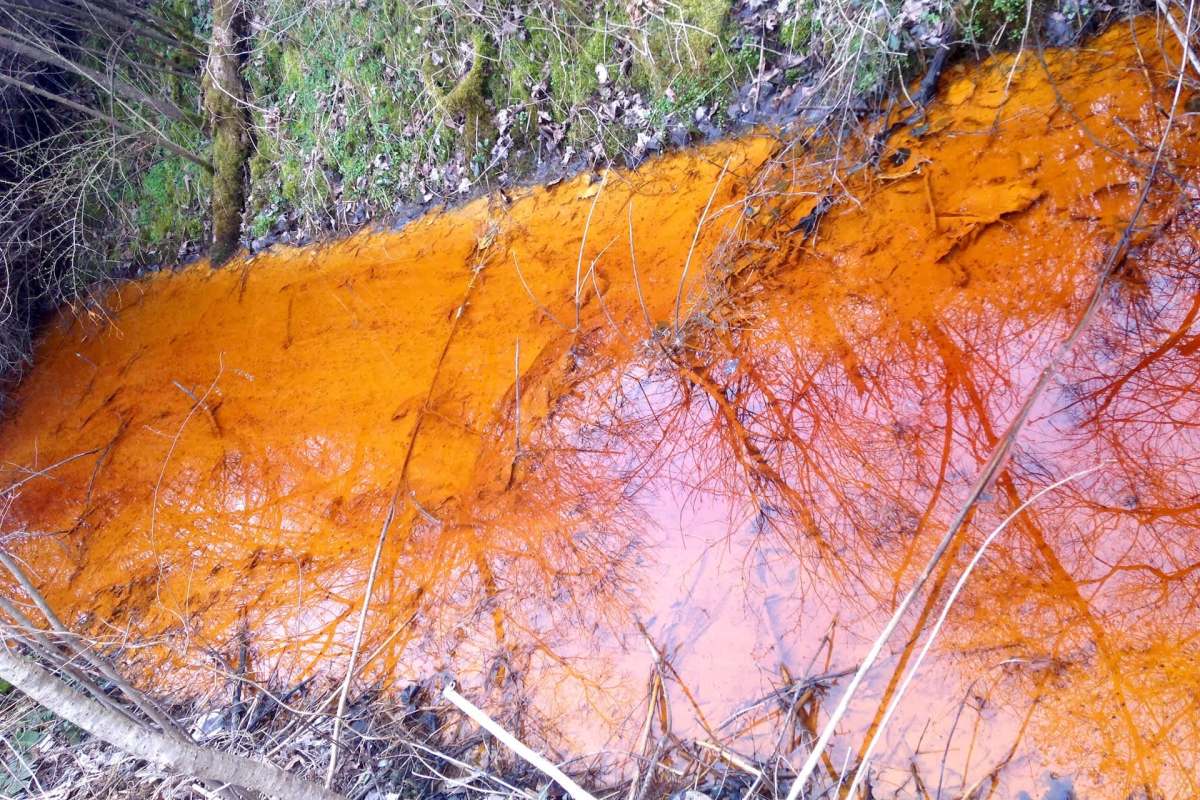
When a creek in Mingo County, West Virginia, turned orange in April, residents were initially told the discoloration was tied to Norfolk Southern drainage work.
Now, state records suggest emergency officials had advance notice that abandoned mine runoff was also part of the problem before the public received that fuller explanation.
Here's what to know
According to WOWK 13 News, Mingo County's Office of Emergency Management initially stated, "Mingo County Office of Emergency Management is aware of red-colored water observed in the Ragland area. This discoloration is connected to ditch and drainage work currently being performed by Norfolk Southern Railroad along the rail line."
The statement added that crews used straw bales, absorbent booms, silt fencing, and a vacuum truck to control the runoff.
Documents obtained through a Freedom of Information Act request added another source to the picture. Those West Virginia Department of Environmental Protection records identified the discharge as runoff from an adjacent abandoned "pre-law" mine, 13 News found.
According to a May 8 memorandum, Troy Carpenter, an environmental operations engineer at Norfolk Southern, had already contacted the state spill hotline on April 22 before planned work at 921 Rockhouse Fork Road.
TCD Picks » Quince Spotlight
💡These best-sellers from Quince deliver affordable, sustainable luxury for all




The memo says Carpenter said, "They are reporting due to water coming out of abandoned mines, this had occurred during a similar project on 3/7/17, and wanted to give a heads-up as to not cause another violation. This project will be occurring on Monday 4/27/26, at approximately 08:00."
In June, Norfolk Southern gave 13 News the same explanation, saying, "Hi Savannah – Making sure you know/recall from a few weeks ago that the runoff was originating from an abandoned mine located adjacent to the railroad there." The company also said it alerted WVDEP ahead of the maintenance work and remained in contact with county emergency officials throughout the project.
More background
Residents told reporters the incident did not look like an isolated one.
That sentiment was reflected in what people nearby said as they watched the creek. Mingo County resident James Fouch said, "Stuff like this has happened around here a few years back, and you can't stop it when it happens." Another resident, Clayburn Varney, offered a more direct assessment while looking at the creek: "It's coming from the mines."
Sampling showed a major difference between upstream water and the source area on April 29: total iron measured 51.3 milligrams per liter at the source and 0.627 milligrams per liter upstream.
The same testing found total suspended solids at 504 milligrams per liter at the source, compared with just 6 milligrams per liter upstream. The source pH was 5.80, below the memorandum's cited recommended range of 6.0 to 9.0.
Investigators described Rockhouse Fork on April 29 as extremely turbid and distinctly orange.
Conditions had improved somewhat by May 5, when the streambed could again be seen, but the report also said pools contained sediment deposits 6 to 12 inches deep. Orange discoloration remained visible about a mile downstream in Pigeon Creek.
What's being done?
WVDEP said it would keep monitoring both Rockhouse Fork and Pigeon Creek.
The agency's assessment said sampled locations still supported living macroinvertebrates on April 29, and investigators saw no fish deaths that day. On May 5, however, they documented several dead crayfish and two fish gulping air in deeper pools.
Norfolk Southern said it is "installing protective measures, including sediment controls and measures aimed at preventing erosion" to reduce additional runoff problems linked to abandoned mine drainage moving onto railroad property. The emergency response also included the vacuum truck, booms, and silt fencing.
The incident sits alongside broader state enforcement over mine pollution. On August 7, 2026, WVDEP sued Lexington Coal Company, LLC, seeking $8,600,427.25 in alleged outstanding penalties and asking a court to require compliance with state mining and water pollution laws.
A WVDEP spokesperson told 13 News that some of those penalties involve violations in Mingo County near Ragland, though Lexington denied many of the allegations in its September 14 response.
Residents are still waiting for fuller answers about why the public was not initially told more. Fouch said, "It's a great place to live, but there needs to be a change around here."
Where can I learn more?
These stories look at many of the same issues raised by the Ragland Creek incident. They cover sewage releases, coal ash cleanup fights, spill-reporting changes, and other contamination problems affecting rivers and groundwater.
• In Connecticut, residents warned that dumped wastewater into the river could threaten public health.
• In Colorado, critics said a second coal ash dump may be tainting groundwater near Xcel.
• In Kansas, a new policy changed which spills get reported, alarming residents seeking faster notice.
• Along the Hudson River, a ruling allowed radioactive waste onto beaches, deepening fears over contamination.
• In Montana's Flathead watershed, scientists found "forever chemicals" at every site they tested.

Get TCD's free newsletters for easy tips, smart advice, and a chance to earn $5,000 toward home upgrades. To see more stories like this one, change your Google preferences here.






