


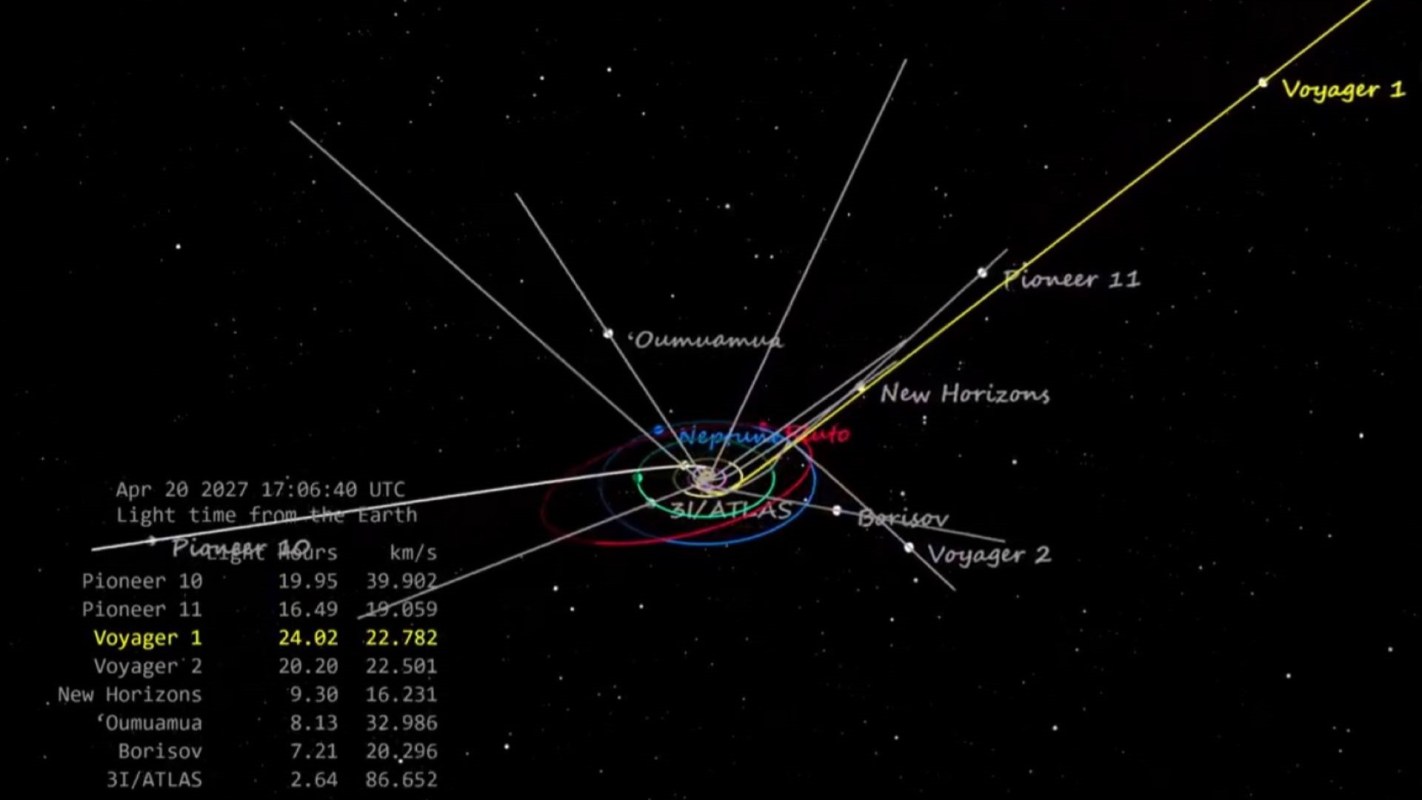
A simple greeting to Voyager 1 will involve a two-day wait for a reply when the spacecraft reaches a new distance milestone on Nov. 18, the Daily Galaxy reports.
Engineers are also investigating why the nearly 50-year-old spacecraft briefly stopped communicating.
Here's what to know
NASA expects Voyager 1 to be approximately 16.09 billion miles from Earth on Nov. 18.
At that point, it would become the first human-made object a full day's light travel from Earth.
Happy November! This month Voyager 1 will become the first spacecraft to reach 1 light day from Earth. 🔭 #astro https://t.co/ZDZmXINoPB
— Tony Dunn (@tony873004) November 1, 2026
A command and reply will require at least 48 hours in transit, plus the time Voyager 1 takes to process the instruction. Radio signals travel at the speed of light, so each leg of the exchange will last 24 hours.
Suzanne Dodd, Voyager project manager at NASA's Jet Propulsion Laboratory, offered an example.
TCD Picks » Quince Spotlight
💡These best-sellers from Quince deliver affordable, sustainable luxury for all




"If you want to say 'hello' to Voyager, you send your message and then you go home and you wait two days before you finally get a response," she said.
More background
Voyager 1's original mission was to explore the outer solar system, including flybys of Jupiter and Saturn.
It launched on Sept. 5, 1977.
The Sun's magnetic fields and charged particles form a protective region that Voyager 1 has left behind. The probe continues collecting scientific data in interstellar space.
Moving at about 38,000 mph relative to the Sun, Voyager 1 has traveled farther from Earth than any other spacecraft. Maintaining contact across that vast distance requires keeping its antenna pointed toward home.
On Oct. 18 and 19, NASA's Deep Space Network received no radio transmission from the probe during two planned contacts about a day apart.
The network relies on large antenna complexes at sites in California, Spain, and Australia to maintain spacecraft communications as Earth turns.
During the missed contacts, engineers had no confirmation of Voyager 1's condition.
What's being done?
Contact resumed on Oct. 20, about two days into the outage, allowing NASA engineers to send commands to investigate what had happened.
Their investigation found that a group of thrusters on the spacecraft had stopped working, prompting a switch to backups. These thrusters control Voyager 1's orientation, helping keep its communications antenna aimed at Earth.
The switch was associated with the probe's onboard fault protection system, which can react to unusual conditions on its own without waiting for commands from Earth.
These safeguards can steady the probe, turn on spare equipment, and pause certain operations.
Still, NASA's Nov. 3 account left the cause of the signal loss unresolved.
Engineers were working to understand the sequence of events behind the protective response and communications interruption, with nearly a day's signal travel separating each troubleshooting step.
Kareem Badaruddin, Voyager mission manager at NASA's Jet Propulsion Laboratory, addressed the brief interruption.
"This is the first time we've seen the spacecraft do something like this, but we are also at a point in the mission where we have to expect the unexpected. We're relieved to be back in contact with Voyager 1 and are eager to understand what happened."
Where can I learn more?
Voyager 1's distance makes communication a challenge, while space activity closer to Earth brings a different set of concerns. These stories cover orbital debris, commercial spaceflight, and solar storm risks to power grids.
• A Chinese satellite's breakup left 43 fragments in orbit that may persist for centuries.
• Virgin Galactic is selling $750,000 tickets for 90-minute flights as it targets a 2027 comeback.
• A 1-in-250-year solar storm could leave 5 million without power in the United States.

Get TCD's free newsletters for easy tips, smart advice, and a chance to earn $5,000 toward home upgrades. To see more stories like this one, change your Google preferences here.






