


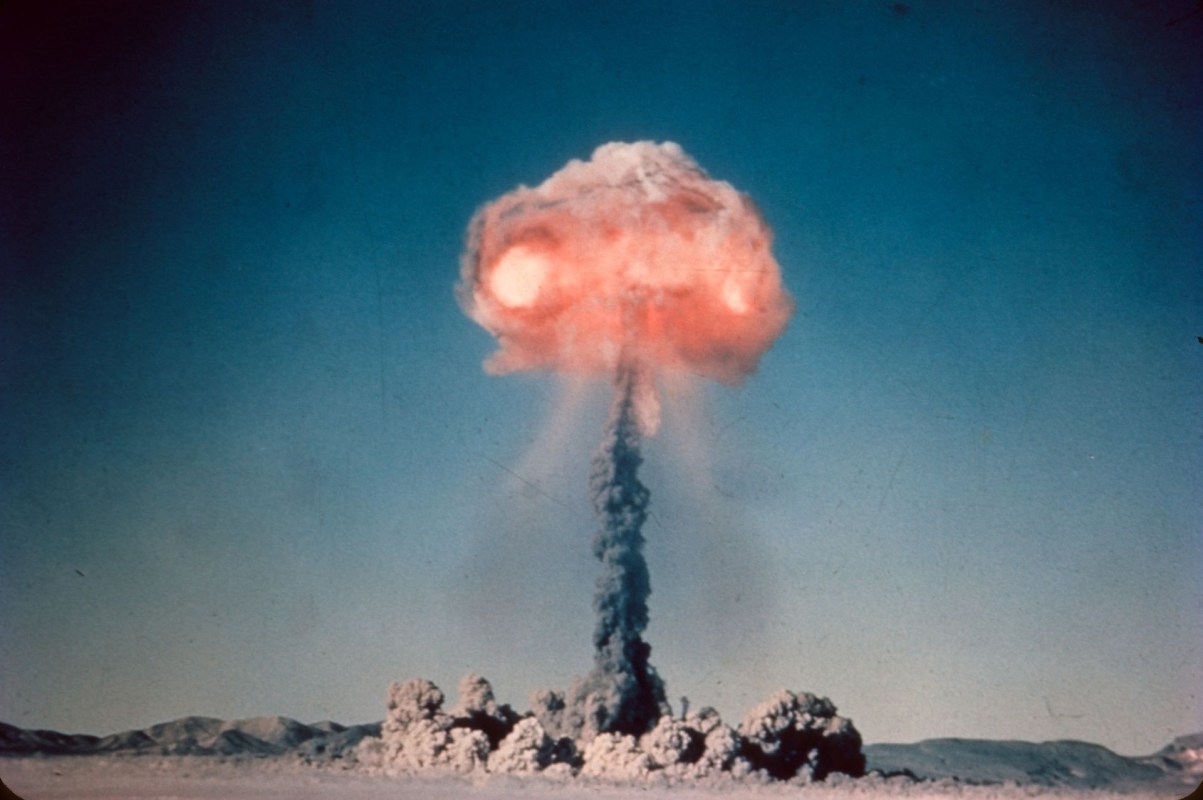
A Utah family's search for answers after a mother's death led to an alarming discovery and is helping launch new research into the long-term effects of nuclear weapons testing.
Scientists want to know whether radioactive exposure from decades ago can still be detected in the body and linked to long-term illness.
The effort began after Salt Lake City visual artist Cara Despain sent a bone fragment from her mother, Bonnie Despain, for testing and learned it contained an extraordinary level of radioactive cesium, according to KUER.
Here's what to know
Bonnie Despain spent her childhood in Newcastle, Utah, about 130 miles from the Nevada Test Site. In the postwar years, the U.S. carried out 100 aboveground nuclear tests there, and people exposed to the fallout became known as downwinders.
When Bonnie Despain died at 81 from ALS, a rare neuromuscular disease, Cara Despain contributed tissue for ALS research. She also provided a bone sample after cremation to Aaron Specht, a Purdue University professor who studies radiation safety and environmental health.
Because radioactive cesium is a byproduct of nuclear fission and is highly toxic to humans, the test result immediately stood out. Despain said Specht "was shocked to find the highest levels of cesium he's ever seen or been aware of measured in a human sample."
TCD Picks » Quince Spotlight
💡These best-sellers from Quince deliver affordable, sustainable luxury for all




The finding helped set in motion a new University of Utah study examining long-term radiation exposure and whether it may be connected to health conditions beyond the cancers that have received the most attention.
More background
To University of Utah atmospheric science professor Daniel Mendoza, research in this area has been overdue.
"What's interesting is that this whole phenomenon has really been understudied," he said. "I think that this is really important for many reasons, particularly to understand the public health implications."
Researchers are also racing the clock. The U.S. stopped atmospheric nuclear testing in 1963, so many downwinders are now elderly or have already died. Mendoza said the team pushed to get approvals in place because "We worked really quickly as soon as we decided to coalesce as a group to try to get approvals because this is an intrusive study. We want to make sure that we capture as much of the population available as we can."
What's being done?
The researchers are asking for fingernail samples from people who lived in Utah, New Mexico, Nevada, or Arizona between 1951 and 1962. Unlike bone fragments, fingernails can be collected from living participants and may still hold evidence of past radiation exposure.
Naomi Riches, a professor in the University of Utah's medical school in obstetrics & gynecology, said the project is trying to answer a basic question: "One of the big things that we would like to get out of this is just an understanding of how these old exposures are impacting both health and whether or not those radioactive signatures still exist in the body."
A major blind spot, Riches said, is the possibility of reproductive effects.
"I think there's a lot of anecdotal stories where you hear about someone that years later they have either problems with conceiving or continuing a pregnancy," she said. "It's definitely worth exploring."
The researchers have reportedly already found more than a dozen respondents from their efforts to find other people for the study so far, per KUER. Researchers hope to collect 300 samples and produce preliminary findings.
For Despain, the possible significance extends beyond her family's loss. "Because we don't know what we're going to find, I think it could crack the door to a lot of other studies in science that could maybe draw lines to other illnesses that people have frankly been curious about for a long time."
Where can I learn more?
Despain's case raises a question about how long environmental exposure stays with a person and what kinds of health effects might surface years later. The articles below look at that question from a few angles, from factory pollution in Dallas to neighborhood conditions and contamination found in remote places.
• In West Dallas, residents say health risks from factory pollution have worsened alongside GAF operations.
• In greener neighborhoods, children showed stronger bone density over time as their surroundings changed.
• On Mount Toubkal, scientists found microplastics contaminating high-altitude soil once thought relatively untouched.
Each offers a different look at how closely health is tied to the environments people move through every day.

Get TCD's free newsletters for easy tips, smart advice, and a chance to earn $5,000 toward home upgrades. To see more stories like this one, change your Google preferences here.






