


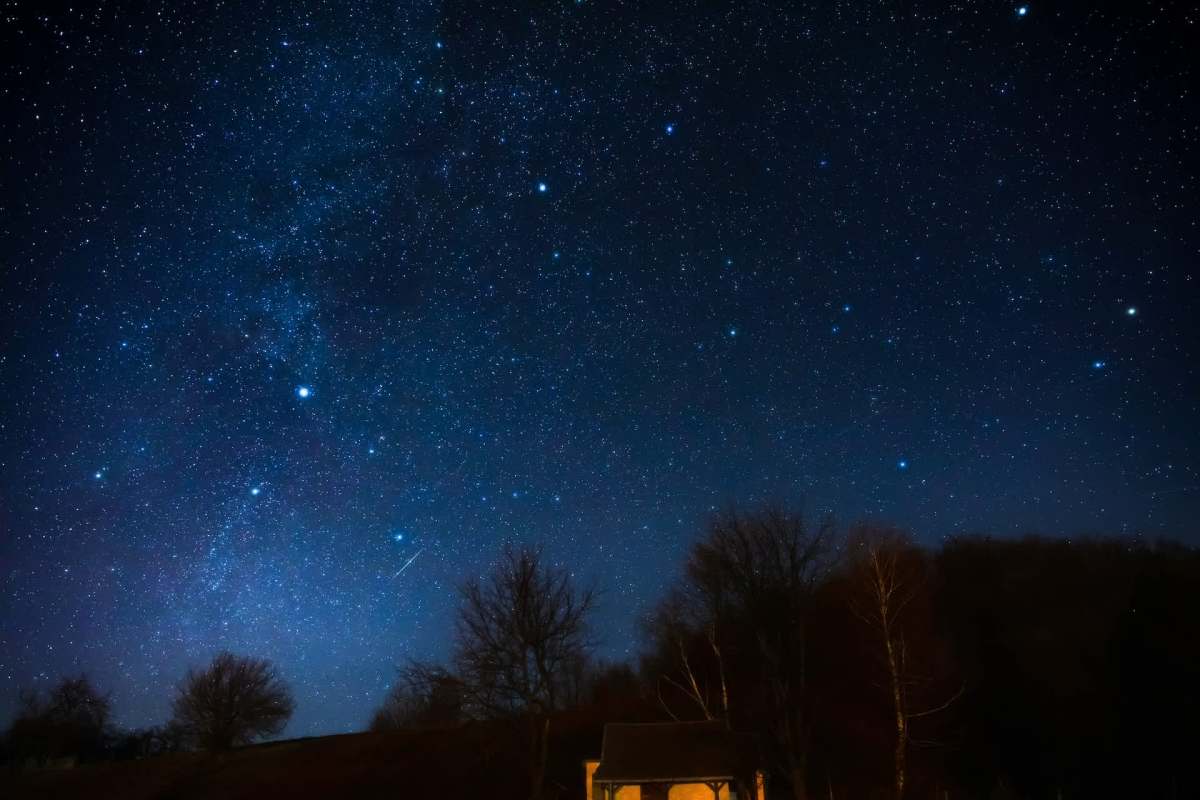
A typical U.K. town has more than 700 satellites orbiting above it at any given moment during the night, a new analysis found, underscoring the growing presence of spacecraft overhead. Skyward observers in populated areas may see comparable numbers of stars and sunlit satellites, even though only some spacecraft catch enough sunlight to become visible.
Here's what to know
According to Space.com, engineering firm Accu Components based its analysis on the trajectories of 15,833 active satellites orbiting below 1,200 miles. The researchers used U.S. Space Force monitoring data available through CelesTrak.
The team estimated that, on average, 105 satellites overhead would be illuminated by the sun. Its calculations, based on data from October 12 and 18, put the total above a typical U.K. town's completely unobstructed horizon at 710 at any moment during the night.
Satellite visibility can vary substantially between dusk, midnight, and dawn. Spacecraft do not produce their own light, so seeing them requires sunlight to reach them while the ground below is dark.
According to Space.com, the researchers found that satellite traffic was similarly heavy across mid-latitude regions, including much of Europe and the United States. They singled out latitudes of 40–50 degrees in either hemisphere as particularly busy.
More background
Satellite numbers have risen sharply in recent years, particularly since Elon Musk's SpaceX started deploying its Starlink internet constellation. Companies have envisioned launching hundreds of thousands — possibly millions — of additional satellites over the decades ahead.
TCD Picks » Quince Spotlight
💡These best-sellers from Quince deliver affordable, sustainable luxury for all




That expansion has been particularly concerning for astronomers, whose observations could be disrupted when spacecraft pass through the fields of view of ground-based telescopes.
Satellites leave streaks across astronomical images, and their reflected light also increases the sky's overall brightness. These factors threaten observations of distant stars and galaxies that help researchers understand the universe's history.
So-called "light pollution" already has dramatically limited the visibility of the nighttime sky in certain areas. According to OwnStarMap, as cited by Space.com, only a few dozen stars may be seen without optical aids in heavily light-polluted cities such as London or New York. Smaller towns and suburbs, meanwhile, can offer views of a few hundred.
However, these numbers still pale in comparison with the viewability from remote countryside or isolated mountain ranges. Under those darker conditions, observers can spot a few thousand stars without optical aids, per Space.com.
What can be done?
Accu Components' analysis showed how publicly accessible satellite-monitoring data can let researchers track the rapidly changing night sky. Using records from CelesTrak, the team calculated both the number of spacecraft overhead and how many were catching sunlight, giving both researchers and the public a better understanding of the scope of the changes taking place.
"For a typical U.K. town, around 300 satellites are catching the sunlight in the first hour or so after dark," said an Accu Components spokesperson, per Space.com. "That falls to fewer than 20 around midnight, then climbs back to around 300 before dawn."

Get TCD's free newsletters for easy tips, smart advice, and a chance to earn $5,000 toward home upgrades. To see more stories like this one, change your Google preferences here.






