


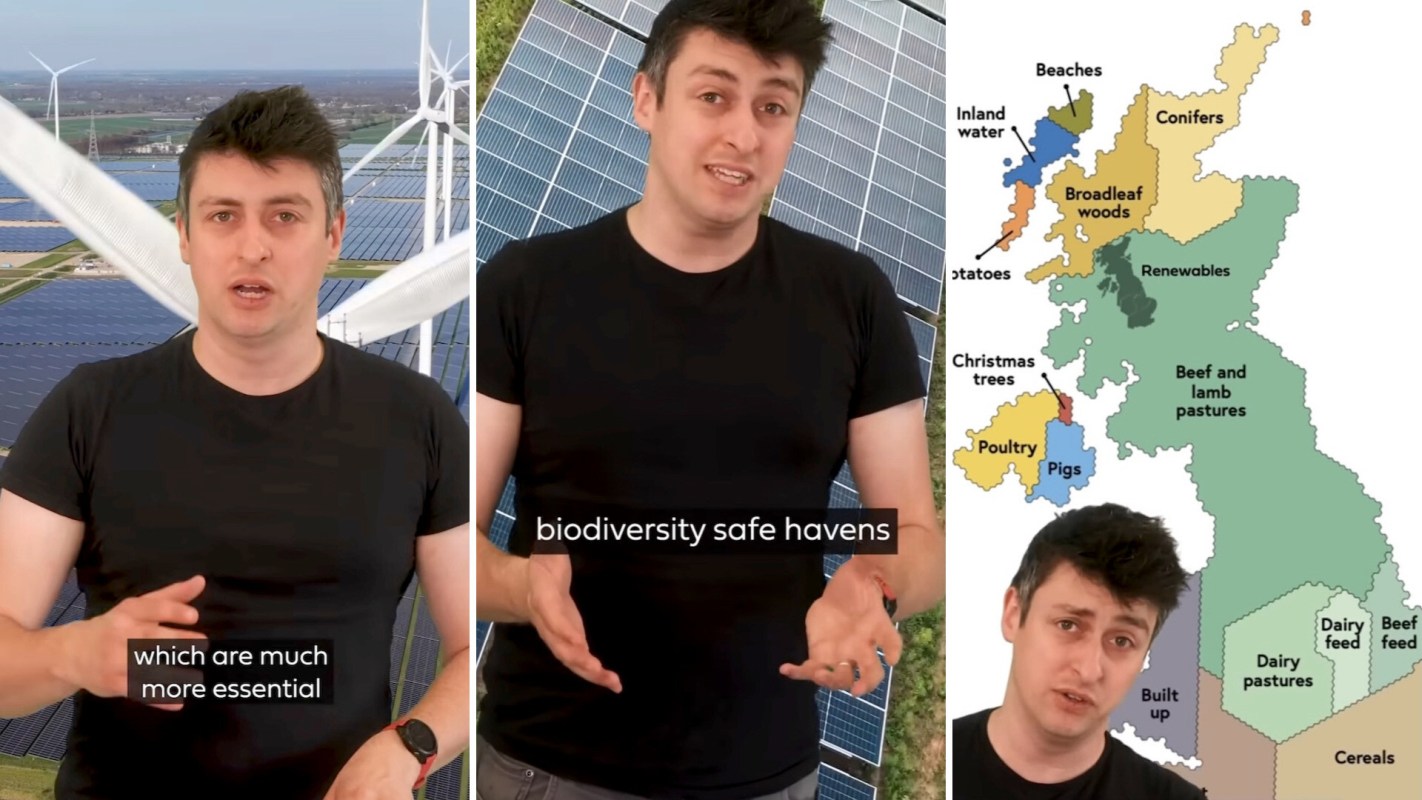
One of the most persistent arguments against wind and solar is that they will take up land that would otherwise be used as farmland. But a recent explainer from a U.K. climate scientist suggests the numbers tell a very different story.
What's happening?
In a recent YouTube video, climate scientist and content creator Dr. Simon Clark examined how much land renewables actually use in the United Kingdom and compared that footprint with far more familiar land uses.
To make the scale tangible, Clark compared renewables such as solar panels and wind turbines with land uses that most people rarely question. Citing Carbon Brief, he said solar currently covers around 81 square miles (210 square kilometers) in the U.K., while golf courses occupy 485 square miles (1,256 square kilometers). He also noted that agriculture already covers about 70% of the country, with much of that land tied to livestock production.
He noted that future expansion would remain small on a national scale. Even with more onshore wind included, renewable development by 2035 would amount to about the same area as the country's golf courses. His 2050 estimate was about 598 square miles (1,550 square kilometers), which would still be less than 1% of the U.K.'s land area.
The video has already drawn hundreds of thousands of views and thousands of likes.
Why does it matter?
Fears about land use can slow projects that help keep electricity flowing, cut planet-heating pollution, and eventually lower energy costs for households and businesses.
TCD Picks » Quince Spotlight
💡These best-sellers from Quince deliver affordable, sustainable luxury for all




Clark also emphasized that renewable projects do not always crowd out other uses on the same land. At Whitelee Wind Farm, for example, turbines coexist with a peat bog, and many other wind sites continue operating alongside working farmland.
Solar can also be placed in already developed areas, including rooftops and parking lots. And when panels are installed on open land, the space beneath and between them can support more biodiversity than heavily managed agricultural fields, which benefits birds, insects, and nearby ecosystems.
Clark said the farmland tradeoff looks far smaller even under the harshest assumption. If all projected renewable build-outs came at the expense of agricultural land — which he said it likely would not — then roughly 2% of farmland would disappear, according to Clark, much of it potentially lower-efficiency livestock pasture rather than prime cropland.
What's being done?
A practical approach is to place renewables in locations that can serve multiple functions. That includes wind turbines on grazing land and solar installations on buildings, sheds, parking lots, and other developed areas, while still supporting farming or habitat.
That can mean a steadier income stream in an industry that often faces volatile prices and rising costs.
In the video's comments, one person wrote: "As someone who grew up on a family farm I would even go so far as to argue renewables are a lifeline for this way of producing food, farming livestock on a small scale is getting less and less financially sustainable, but put some solar panels on the roof of a shed and put a wind turbine up on top of the windy hill (which we have done) and your income is diversified and a lot more reliable."
That kind of setup can mean more local power generation, lower energy expenses, and less reliance on polluting fuels that can harm public health.
Clark summed it up nicely: "The truth is, they're not a big threat to our farmland because they don't take up that much land."

Get TCD's free newsletters for easy tips, smart advice, and a chance to earn $5,000 toward home upgrades. To see more stories like this one, change your Google preferences here.






