


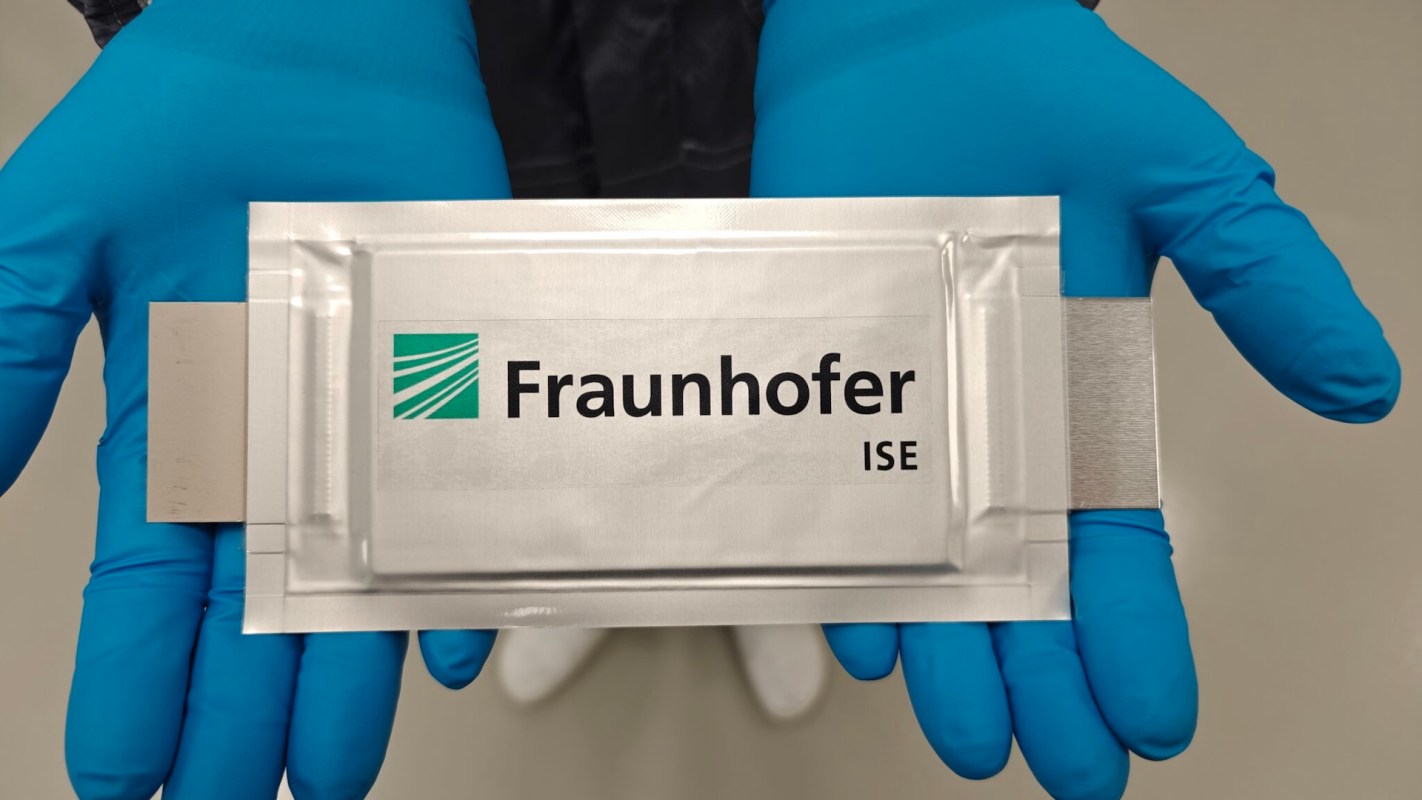
A Germany-led research team says a relatively simple battery redesign could pack more power into the same-sized cell, helping batteries run longer or store more energy without making packs bigger.
Here's what to know
According to PV Magazine, the method uses much thicker electrodes and could boost cell-level energy density by 10% to 15% while keeping weight unchanged.
A consortium led by Germany's Fraunhofer Institute for Solar Energy Systems (Fraunhofer ISE) carried out the project. The researchers tried the design in lithium-ion, sodium-ion, and zinc-ion cells, and they also produced prototype lithium-ion pouch cells.
The approach is to cut back on internal components that do not store energy so more of the cell can be filled with materials that do.
Oliver Fitz, group leader for battery cell technology at Fraunhofer ISE, said the team increased electrode coating thickness from the usual 0.0039 inches (100 µm) to 0.0079 inches (200 µm) and as much as 0.0315 inches (800 µm).
In many current batteries, current-collector layers help move electricity through the cell, but they also take up space and add weight. Using fewer of those layers could increase storage capacity without making the battery heavier.
TCD Picks » Quince Spotlight
💡These best-sellers from Quince deliver affordable, sustainable luxury for all




Fraunhofer ISE said the resulting battery cells are PFAS-free and made without toxic solvents. PFAS, short for per- and polyfluoroalkyl substances, describes a broad class of synthetic chemicals known for lingering in the environment and often being called "forever chemicals."
More background
Fraunhofer ISE said, "The new cell architecture was developed with future mass production in mind: A potential electrode production line exhibits significantly lower process complexity compared to a state-of-the-art wet-coating system. As a result, capital costs are significantly lower. Operating costs are also lower because it requires less space and energy. This technology thus opens up the possibility, particularly for small and medium-sized enterprises, to establish their own battery cell production facilities in Germany."
More energy-dense batteries could support backup storage for homes, businesses, and city infrastructure. Stronger stationary storage can help smooth out solar and wind power, handle demand spikes, and improve resilience during blackouts and severe weather events.
Because the team applied the design in sodium-ion and zinc-ion cells as well, the findings suggest possible uses across multiple battery chemistries, including systems intended for stationary storage.
What's being done?
The team developed the thicker-electrode design through three projects: "VORAN – Innovative Sodium-Ion Battery Storage for Stationary and Mobile Applications," "INFAB – Zinc-Ion Batteries for Stationary Energy Storage – Manufacturing and Assembly," and "WinZIB2 – Globally Deployable, Innovative Zinc-Ion Battery System," according to PV Magazine.
Project partners include ACP systems, Helmut Hechinger, the University of Stuttgart photovoltaics institute, and Karlsruhe Institute of Technology/Helmholtz Institute Ulm.
Andreas Bett, director of Fraunhofer ISE, said, "In a climate-neutral energy system with fluctuating energy sources like solar and wind, stationary battery storage is an integral component for covering morning and evening electricity peaks. Germany would be well advised to build up manufacturing capacity to meet the growing demand for batteries and thereby create value within the country. If we can contribute to that, we'd be very happy."
Where can I learn more?
Battery researchers are taking several different paths to pack more energy into cells while keeping costs and performance in check. Here are a few examples where teams are rethinking battery chemistry, materials, and cell design for uses ranging from cars to grid storage.
• At Argonne, scientists created a lithium-sulfur additive that improved energy density and overall battery performance.
• In China, researchers made a solid-state battery advance for electronics and electric vehicles.
• In Norway, NTNU developers tested a lithium-sulfur coating to strengthen performance for electric vehicles.
Fraunhofer ISE's thicker-electrode approach is one piece of a much larger push to build denser, cheaper, and more flexible batteries. Read alongside that work, these articles give a better sense of how fast the field is changing.

Get TCD's free newsletters for easy tips, smart advice, and a chance to earn $5,000 toward home upgrades. To see more stories like this one, change your Google preferences here.






