


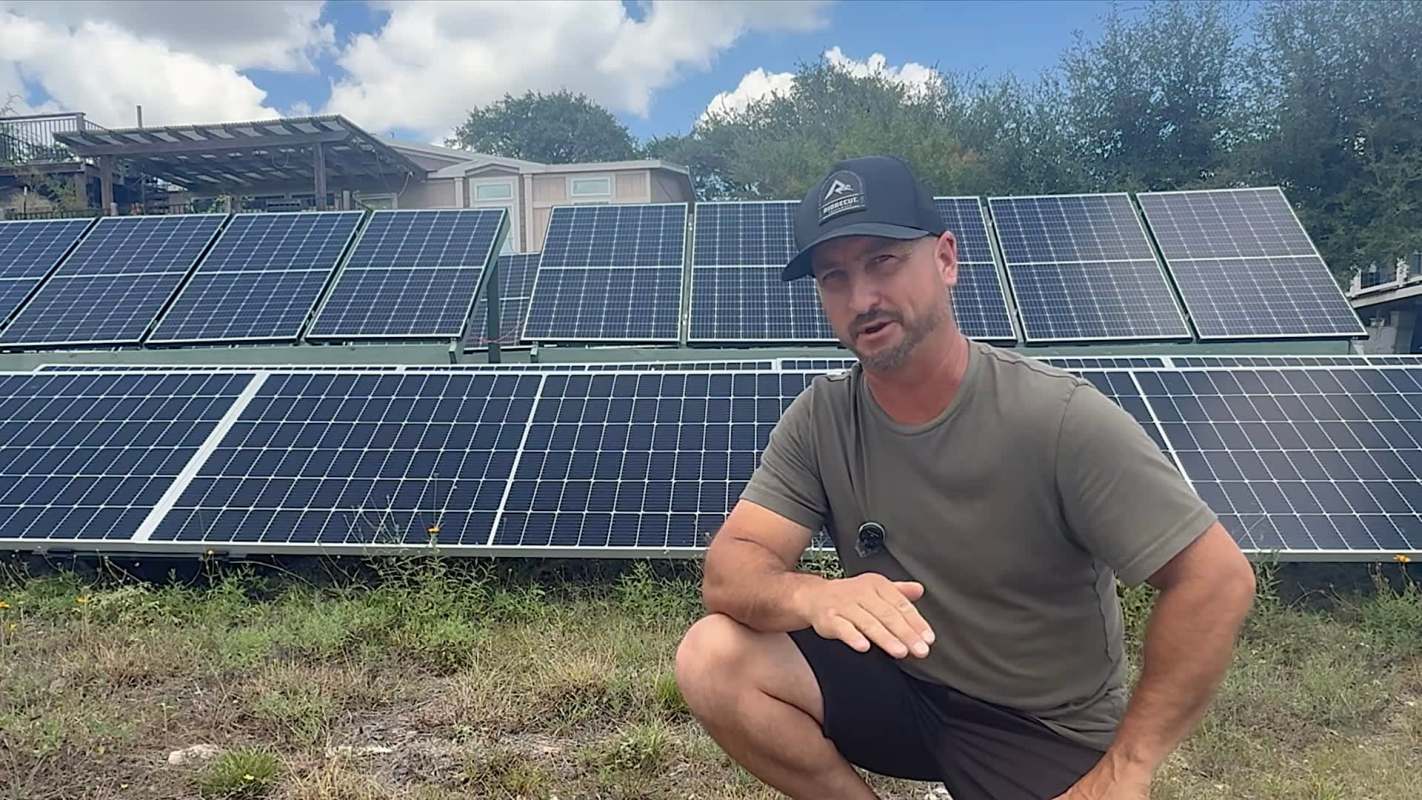
A Texas homeowner is offering a close look at what whole-home solar with battery storage looks like hour by hour — and it turns out to be less about flashy gadgets than careful energy management.
For anyone wondering whether rooftop solar panels and batteries can really support day-to-day life, his answer is mostly yes — even during brutal summer heat.
Here's what to know
The system UnpluggedTexan (@unpluggedtexan) outlined in a YouTube video powers his Central Texas four-bedroom, 2,000-square-foot home with 60 solar panels totaling 19.2 kilowatts, 30 kilowatt-hours of EG4 LL48 rack batteries, and a Sol-Ark 15K hybrid inverter.
Rather than defaulting to utility power, he configured the setup to run on solar generation and battery storage first, with the home drawing from the grid only after the batteries drop below 20%.
He said August is the hardest stretch because overnight cooling can empty the batteries before sunrise. "I remain off-grid probably about 90 to 95% of the time," he said, though August cooling demand can force him to buy "about 30 to 50 cents of power usage" before sunrise.
His biggest loads are pushed into the sunniest part of the day — EV charging, laundry, and water heating — while the early hours are more conservative, with bedroom mini-splits shut off and breakfast or workspace cooling delayed until solar output strengthens.
TCD Picks » Quince Spotlight
💡These best-sellers from Quince deliver affordable, sustainable luxury for all




More background
He estimated that the materials cost about $35,000 and said a similar setup, possibly with a little more capacity, could be assembled for around $25,000 in parts.
The video also emphasizes that he is not cutting comfort to lower power bills: with temperatures rising above 100°F, he runs several air-conditioning units during the day and eases back at night, leaving more battery charge for overnight use.
A solar-plus-battery system that can operate independently for long stretches may help households save money while also adding resilience if the grid goes down.
"Good info. These HOT summer days draw down my 60kwh batteries really fast," one commenter wrote.
What can be done?
A practical first step is understanding when the home uses the most power.
Even without going fully off-grid, shifting energy-hungry tasks into sunny hours can make solar panels and batteries much more effective.
In the video, he said a determined DIYer could probably complete much of a project like this, but warned that a professional may be better suited to the final electrical connections because the setup includes 240-volt household service and panel voltages close to 500 volts.
By charging in the afternoon and discharging overnight, batteries help smooth out demand, reduce grid purchases, and make electric appliances more practical.
Where can I learn more?
Plenty of other homeowners have shared how their systems perform in very different conditions — from city neighborhoods to blackout-prone areas to snowy climates. Their experiences add useful context on off-grid living, backup power, and how solar can still deliver outside ideal summer conditions.
• An urban homeowner used solar kits and a heat pump to cut bills and grid reliance.
• In Australia, a 20kW solar setup turned blackouts invisible and even earned bill credits.
• In snowy country, an off-grid owner showed solar panels still generate even under winter cover.
For readers weighing batteries, backup power, or load shifting, these stories offer a useful real-world comparison.

Get TCD's free newsletters for easy tips, smart advice, and a chance to earn $5,000 toward home upgrades. To see more stories like this one, change your Google preferences here.






