


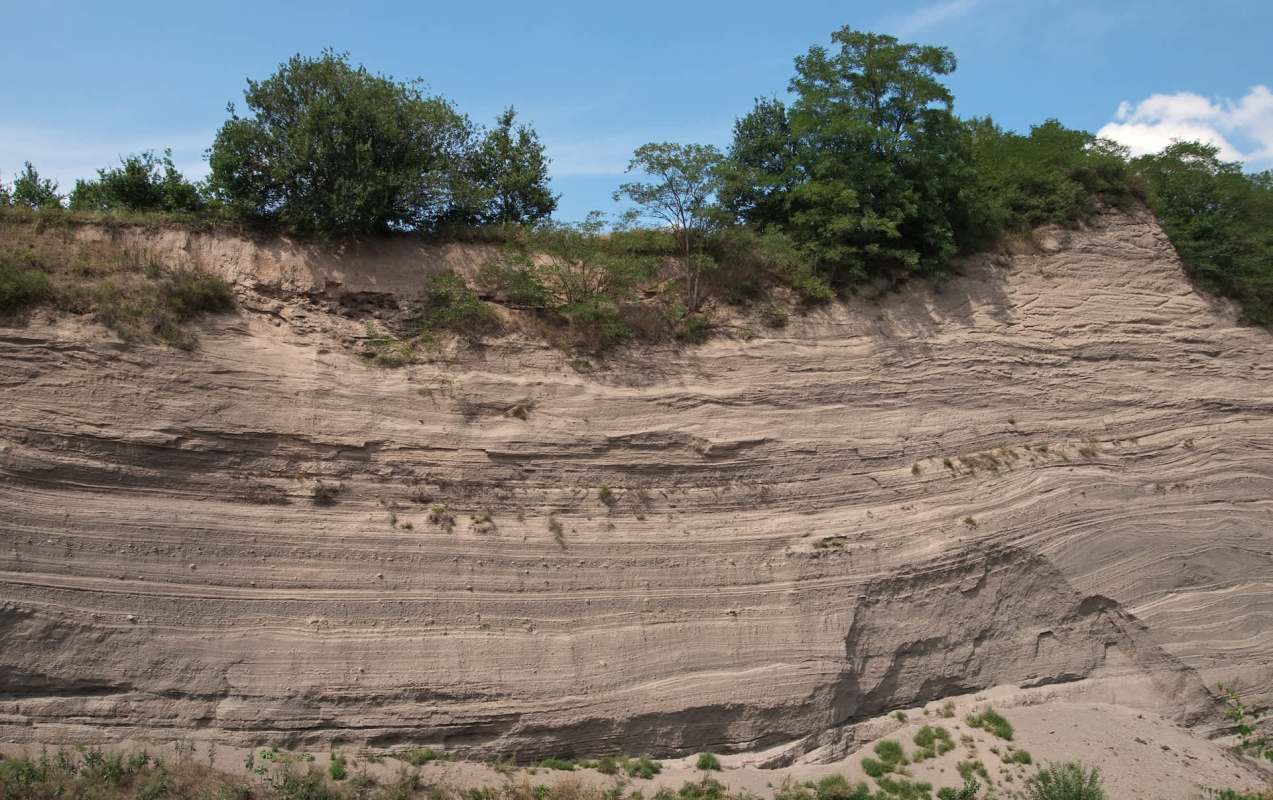
Researchers say a buried supervolcano beneath England's east coast likely erupted 454 million years ago, spreading ash across much of Northern Europe.
Here's what to know
In findings published by GSA Bulletin, scientists linked the Kinnekulle tephra to a deeply buried volcanic system beneath the Wash estuary on England's east coast, Gizmodo reported. The ash layer has been found across Scandinavia, the Baltics, Belarus, and Poland.
To reach that conclusion, researchers reexamined tiny zircon crystals recovered from boreholes in Lincolnshire and Norfolk, about 40 miles apart. Because zircon contains uranium that slowly decays into lead, the crystals can serve as highly precise clocks for dating ancient magma.
The results showed that both English samples formed 454.4 million years ago. That closely matches an age estimate for the Kinnekulle tephra in the Oslo Region, tying the buried English volcanic deposits and the Scandinavian ash layer to the same eruption.
"It's only now that we've got these precise ages we can make these bold statements and assertions," Tim Pharaoh, principal author and geophysicist at the British Geological Survey, told the BBC, per Gizmodo.
More background
Geologists have been trying to identify where the Kinnekulle tephra originated. This study points to an answer.
TCD Picks » Quince Spotlight
💡These best-sellers from Quince deliver affordable, sustainable luxury for all




Researchers estimate the eruption blasted tens to hundreds of cubic miles of material into the stratosphere, with a force comparable to several thousand hydrogen bombs.
No volcano is visible at the surface there. Researchers say the likely source lies deep below the Wash and nearby low-lying terrain, within what they call the Wash Igneous Complex.
England is not typically associated with supervolcanoes, and this one is believed to be long extinct, meaning researchers do not consider it capable of erupting.
What's being done?
Researchers are continuing to investigate the buried caldera system.
The team applied modern dating techniques to the collected material, extracting zircon crystals for the study.
By comparing English zircon ages with Scandinavian ash deposits, researchers at the BGS and University of Oslo connected clues that had remained separate.
"It's extremely satisfying to come up with this very precise result," Pharaoh told the BBC, according to Gizmodo.
Where can I learn more?
Piecing together buried geology often means working from scattered clues — zircon crystals, volcanoes sealed under ice, or ancient sites hidden for millennia.
Similar scientific endeavors show how landscapes can preserve evidence of dramatic past activity.
• In Antarctica, scientists warn hidden volcanoes beneath the ice may stir as melt accelerates.
• In the eastern Pyrenees, archaeologists found dozens of ancient fires pointing to high-altitude copper mining.
• On England's Suffolk coast, archaeologists unearthed a rare Neolithic enclosure dating to about 3800 B.C.
These researchers pulled deep history from clues buried in ice, soil, and sediment. Alongside evidence of the Wash eruption, they underscore how long landscapes can keep even major events out of sight.

Get TCD's free newsletters for easy tips, smart advice, and a chance to earn $5,000 toward home upgrades. To see more stories like this one, change your Google preferences here.






