


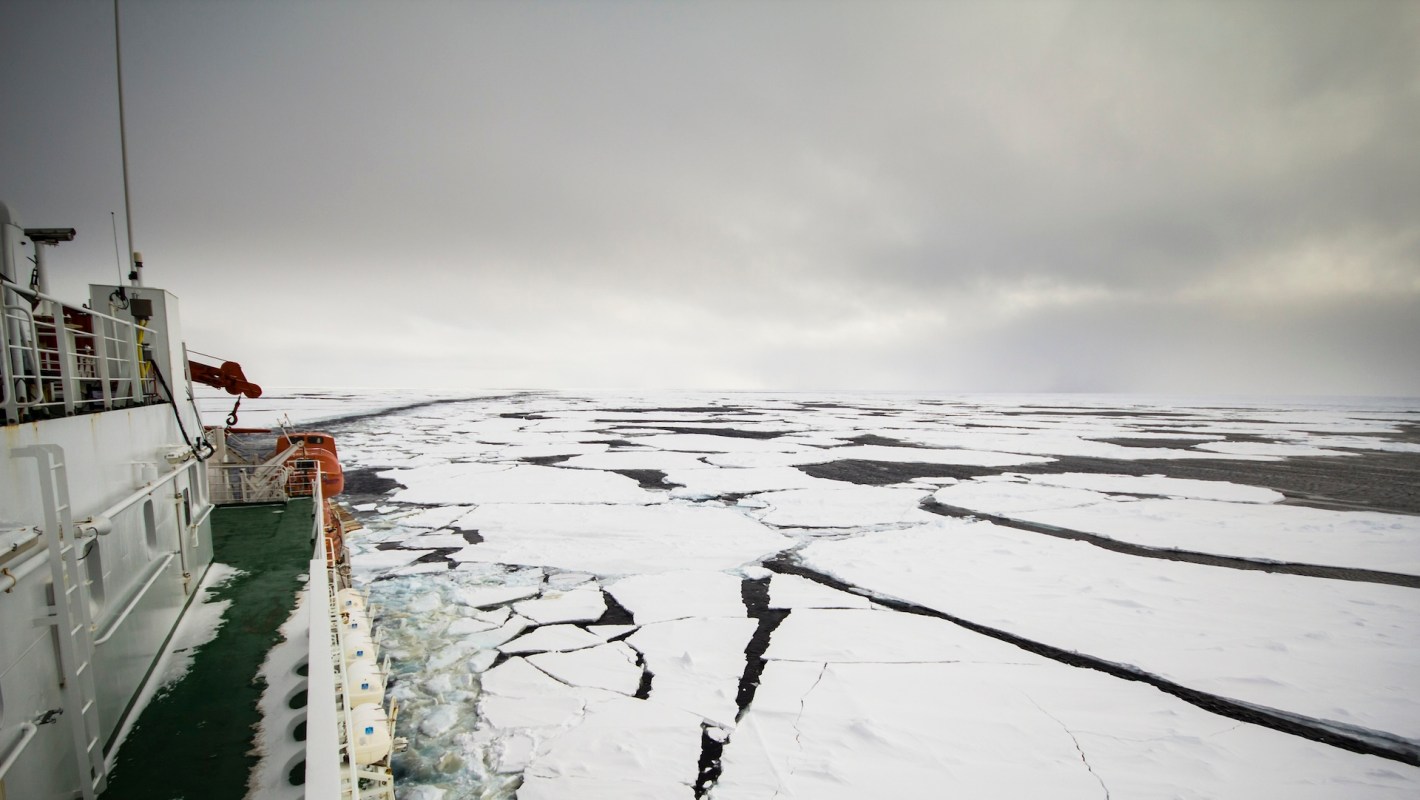
Measurements from an Antarctic expedition have highlighted a stubborn problem in climate modeling: some leading simulations make low clouds over the Southern Ocean too common, yet still do not deliver enough heat to the surface below.
That matters because the Southern Ocean strongly influences the planet's climate system — and as SciTechDaily reported, even modest mistakes in that area can affect projections of warming, sea ice change, and regional weather.
Here's what to know
The findings came from a study published by Assistant Professor Kazutoshi Sato, Professor Jun Inoue, and Hitoshi Matsui.
It appeared in the journal Geophysical Research Letters on July 31.
Researchers used observations gathered aboard the Japanese research icebreaker R/V Shirase during JARE64, Japan's 64th Antarctic research expedition.
As the ship traveled in December 2022 and March 2023, its instruments continuously recorded cloud characteristics, atmospheric temperature and humidity, surface radiation, and aerosols — tiny particles in the air that can influence cloud formation.
TCD Picks » Quince Spotlight
💡These best-sellers from Quince deliver affordable, sustainable luxury for all




The team evaluated those observations against ERA5 and MERRA-2, two major atmospheric reanalysis datasets, as well as the CAM-ATRAS climate model.
Overall, all three captured broad Southern Ocean cloud patterns, but ERA5 and MERRA-2 showed low clouds more frequently than the shipboard measurements did.
Even so, all three underestimated downward longwave radiation, or the heat emitted by clouds and the atmosphere back toward the surface.
The study traced that shortfall to simulated clouds containing too much ice, reducing their heat emission, along with model temperatures that were colder than what the instruments observed.
More background
In climate models, clouds affect more than incoming sunlight.
They also absorb and release heat — so accuracy depends not only on how many clouds are present but also on whether those clouds are made up of liquid droplets or ice.
That problem is particularly pronounced over Antarctica and the Southern Ocean, where direct observations are sparse, and weather conditions are difficult for models to reproduce.
When simulations miss the mark in this region, they can skew the surface energy budget — the balance between energy entering and leaving the surface — affecting temperature, sea ice, and broader climate behavior.
"Numerical models have been reported to exhibit poor skill in reproducing clouds," Inoue explained.
"In particular, over the Southern Ocean and Antarctica, where cloud representation remains especially challenging, cloud-related biases have been shown to increase errors in the surface energy budget through biases in the radiative budget."
What's being done?
The study indicates that better simulations will require improved treatment of cloud phase, atmospheric temperature, and the interactions between aerosols and clouds.
The researchers also examined whether elevated aerosol levels could explain the mismatch. Because ERA5 and MERRA-2 showed higher aerosol concentrations than the ship measured, they increased Southern Hemisphere aerosol emissions in CAM-ATRAS.
That change produced more low clouds, but it only slightly altered surface radiation.
The results suggest that reducing persistent cold biases will require better observations across Antarctica and the Southern Ocean, especially temperature measurements.
Sato also highlighted an opportunity: making greater use of existing observations in forecasting systems, including data from the PANSY radar at Japan's Syowa Station, that are not typically used in numerical weather prediction systems.
"Because observations over Antarctica remain sparse, numerical models still contain substantial uncertainties in their representation of the Antarctic atmosphere," Sato began.
"Therefore, incorporating existing but currently underutilized observations into numerical models may provide an effective solution. For example, assimilating observations from the PANSY radar at Japan's Syowa Station, which are not yet routinely used in numerical weather prediction systems, could help reduce model biases and improve forecast accuracy."
Where can I learn more?
These stories cover how clouds influence warming, why polar sea ice matters, and what Antarctic temperature shifts could mean.
• Across the atmosphere, how clouds shape warming depends on altitude, thickness, and type.
• At the poles, the cooling power of sea ice may be weakening faster than expected.
• Near Antarctica, a climatic ripple effect is emerging as Tasman Sea waters warm.
• In Antarctica's Dry Valleys, troubling effects of a heatwave reached even cold-adapted invertebrates.

Get TCD's free newsletters for easy tips, smart advice, and a chance to earn $5,000 toward home upgrades. To see more stories like this one, change your Google preferences here.






