


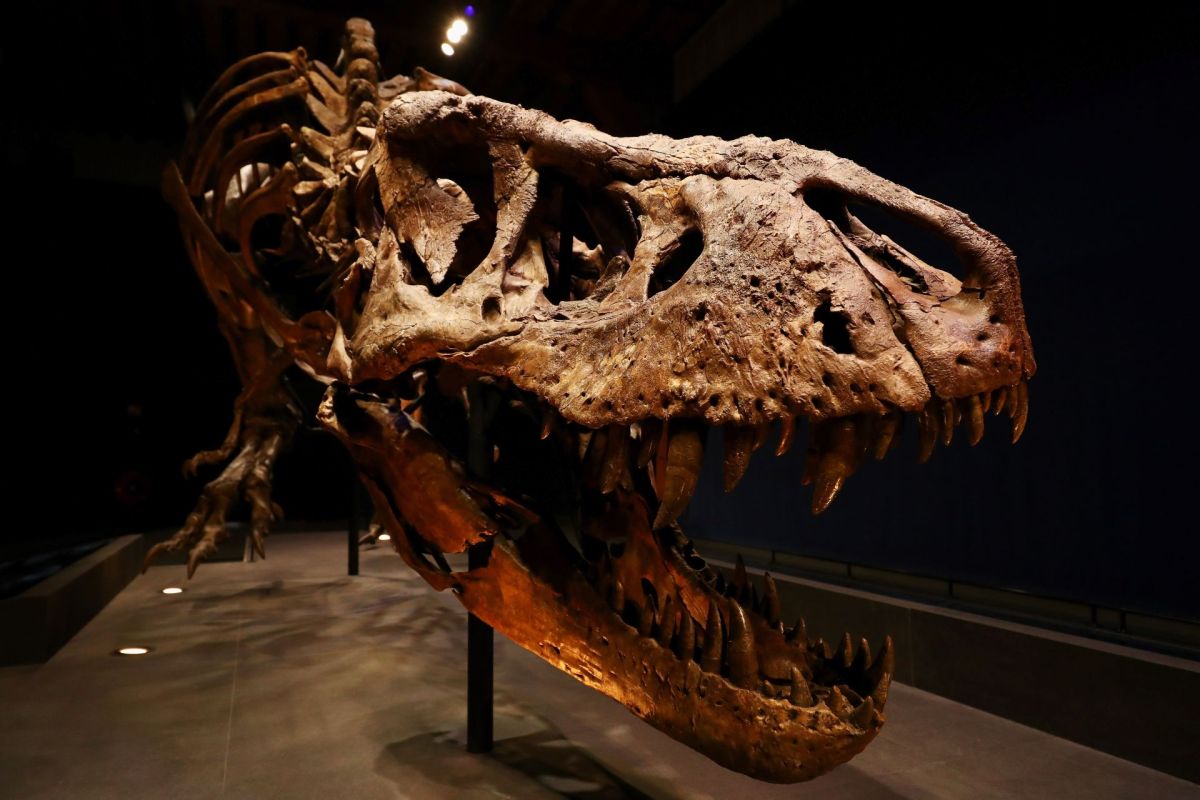
As Sotheby's prepared to auction off a giant T. rex skeleton in New York, scientists warned that the fossils ending up in a private collection could harm future research efforts.
What happened?
The T. rex skeleton, named Gus after the late South Dakota rancher Gary "Gus" Licking, whose land the bones were found on, was set to be auctioned off Tuesday.
According to CNN, Sotheby's has set an estimate for Gus at up to $30 million, though blockbuster fossil auctions can climb far above their opening projections. On Wednesday, NPR reported that a "mystery bidder" purchased Gus for a record $50.1 million.
Gus is about 61% complete by bone count and nearly 80% by mass. Sotheby's says the specimen is 38 feet long, 12.5 feet tall, and made up of 183 fossil bone elements, with a notably well-preserved skull, per CNN.
Sotheby's also says the fossil preserves bite marks and healed injuries, features that could increase its scientific importance.
Stuart Sumida, a biology professor at California State University, San Bernardino, and president of the Society of Vertebrate Paleontology, warned CNN: "If this specimen goes to a private individual, it may or may not ever be seen by the public again."
TCD Picks » Quince Spotlight
💡These best-sellers from Quince deliver affordable, sustainable luxury for all




Sumida went on to say, "Not only that, it will never be subjected to actual proper scientific study – no reputable journal in the world will publish a scientific study based on something that's not held in the public trust."
Why does it matter?
Scientists regard fossils like Gus as irreplaceably detailed evidence of earlier life on Earth, so when such specimens leave public institutions, both researchers and museum visitors can lose access to them permanently.
That can slow scientific progress and public education at the same time. Scientists say major specimens help answer questions about evolution, extinction, ecosystems, and even how life responds to environmental change over long stretches of time. If fossils are locked away, building that knowledge becomes much harder.
The loss of access also affects communities, students, and families who rely on museums as an affordable way to engage with science.
"Our hope is that the new owner recognizes the extraordinary scientific and educational value of Gus the T. rex and that they aim to keep it in the public trust by immediately donating it to an accredited natural history museum," said Kristi Curry Rogers, president-elect of the Society of Vertebrate Paleontology, in a statement Tuesday, according to NPR.

Get TCD's free newsletters for easy tips, smart advice, and a chance to earn $5,000 toward home upgrades. To see more stories like this one, change your Google preferences here.






