


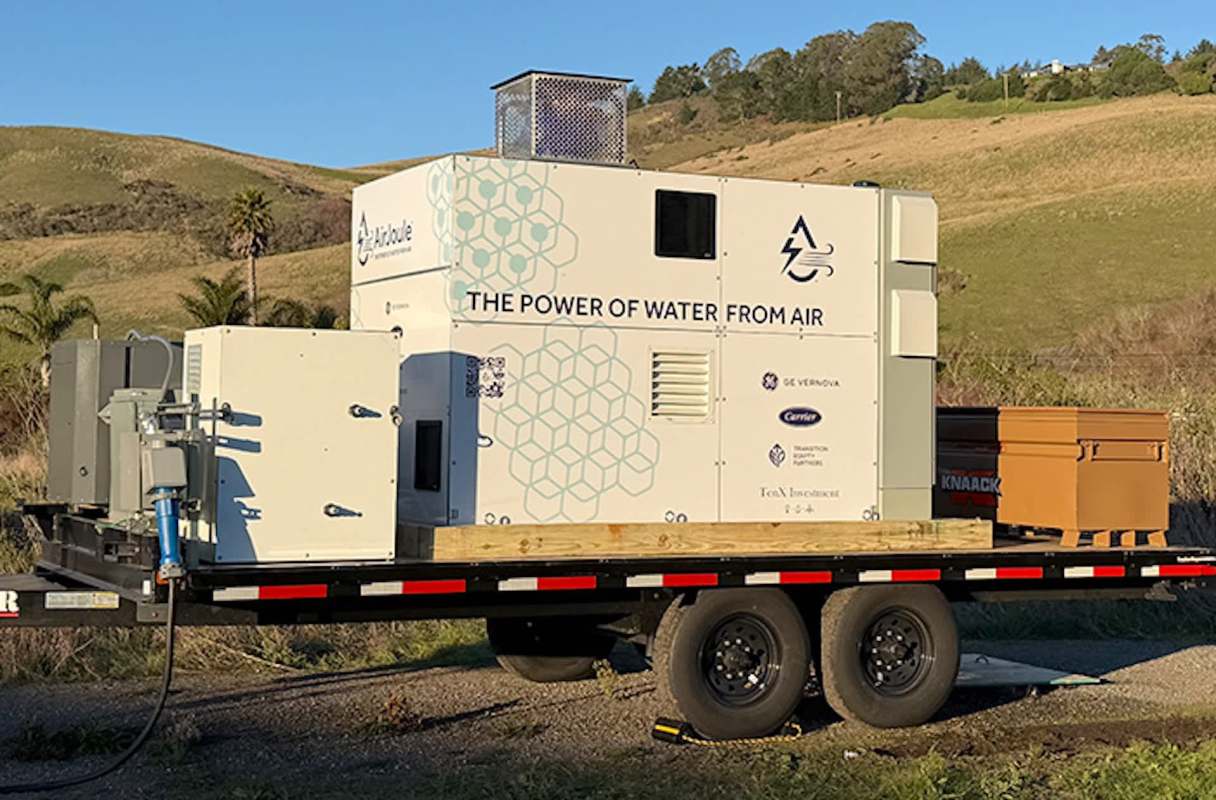
An unassuming, container-shaped unit in a Delaware industrial park is built for a striking task: pulling water out of humid air. The system is designed to capture that moisture and turn it into water.
AirJoule's newly introduced machine, called Prime, can make as much as 528 gallons (2,000 liters) of water per day. It also removes humidity from the surrounding air, and it could offer an intriguing option for places dealing with growing water needs and rising energy demand.
What happened?
Technical.ly reported that AirJoule LLC unveiled Prime at its facility in Newark, Delaware, where it was introduced as the company's largest atmospheric water generator so far.
Roughly the size of two parking spaces, the machine pulls moisture from humid air. It reportedly uses low-grade heat from sources such as data centers and industrial equipment to turn that moisture into distilled water.
According to the company, that approach allows Prime to produce water where it is needed instead of depending entirely on standard water supplies. Technical.ly reported that this could make it useful for warehouses, food-processing plants, and other facilities that already have to deal with high levels of humidity.
The technology originated at Pacific Northwest National Laboratory under the U.S. Department of Energy. It is now being brought to market by AirJoule LLC, a joint venture between AirJoule Technologies and GE Vernova.
TCD Picks » Quince Spotlight
💡These best-sellers from Quince deliver affordable, sustainable luxury for all




Kunjan Khambhati, AirJoule LLC vice president of operations and supply chain, told the publication that two more units were already being built for demonstrations and customer trials. Those efforts are meant to help the company refine the system before wider commercial deployment.
Why does it matter?
The company is positioning Prime as a way to address both water scarcity concerns and energy efficiency.
Technical.ly reported that, unlike many conventional dehumidifiers that work by condensing air directly, the system uses a moisture-absorbing material. It also draws on waste heat emitted by data centers, putting that energy to productive use instead of letting it go to waste.
As AI and cloud computing drive more data-center expansion, concerns are growing over how much electricity and water those facilities use. Producing water on-site with reclaimed heat could ease some pressure on local water systems while improving how a building operates overall.
The technology could also help control humidity in industrial and food-storage spaces, which may support steadier supply chains.
Technical.ly reported that while industrial settings appear to be the clearest early applications, the water can also be treated or remineralized for drinking, creating possible uses in disaster relief, military operations, and places without dependable water access.
Prime's output depends heavily on local conditions like temperature, humidity, and available heat, meaning results may vary depending on site location.
What are people saying?
Bryan Barton, president of the joint venture, described the unveiling as an early milestone, saying, "Today is not the finish line. Today is the starting line."
Delaware Gov. Matt Meyer acknowledged public concerns surrounding water-hungry data centers but struck an optimistic tone: "These are problems to be solved."
Khambhati also made clear the system is still evolving, saying, "Our system is a little beefy right now. We need to make sure they start losing weight."

Get TCD's free newsletters for easy tips, smart advice, and a chance to earn $5,000 toward home upgrades. To see more stories like this one, change your Google preferences here.






