


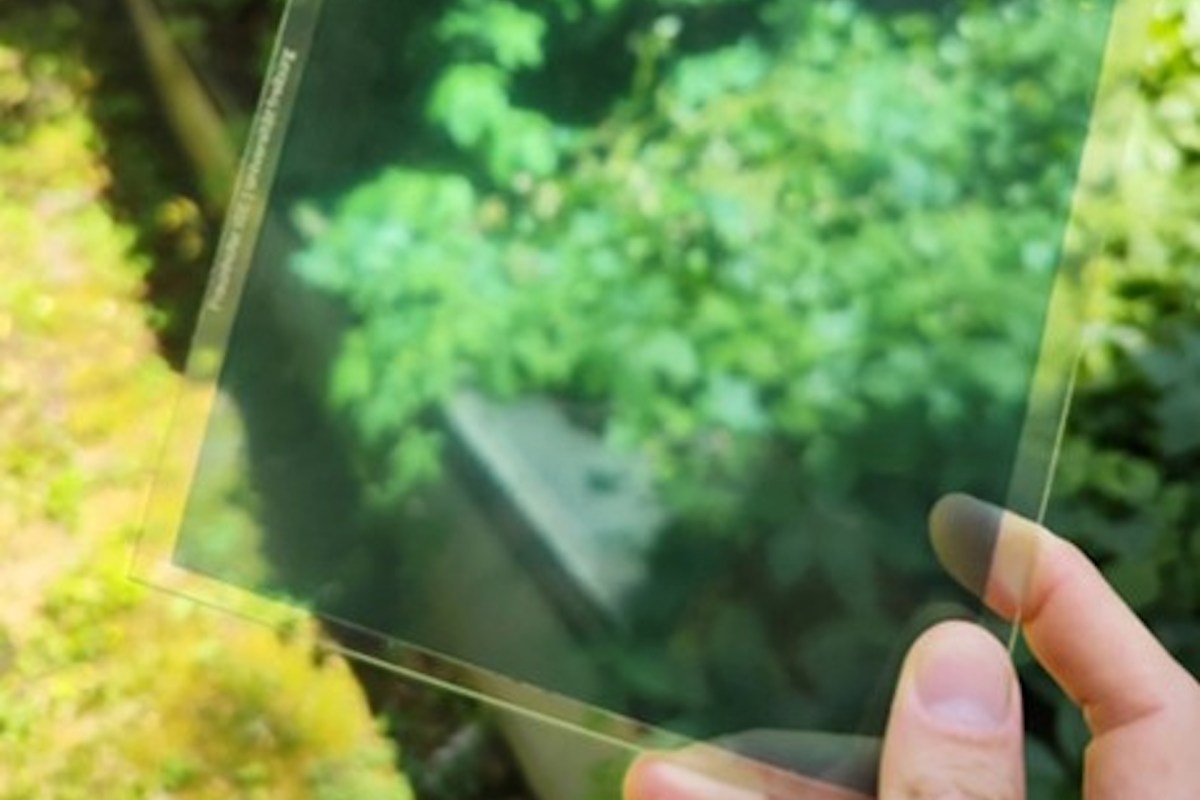
German and Austrian scientists said transparent solar has passed a key scaling test, with larger semitransparent organic modules maintaining performance far better than this type of technology often does when moved beyond tiny formats.
The devices can function like glass, potentially helping buildings generate electricity without shutting out daylight.
Here's what to know
Working across Fraunhofer ISE in Germany, the University of Freiburg, and the University of Innsbruck in Austria, the researchers produced semitransparent organic photovoltaic modules spanning 32.6 square inches (210.25 square centimeters) and recorded a power conversion efficiency of 9.3%.
According to pv magazine, the top module paired an average visible transmittance of 43.2% with a 4.0% light utilization efficiency, a measure that reflects both transparency and electricity generation.
Corresponding author Uli Würfel noted that semitransparent organic PVs have typically posted their strongest results only in very small laboratory cells.
"The novelty of our development lies in the innovative cell stack, and further, the successful upscaling to modules on areas larger than 200 cm2," Würfel said. "Positively surprising was the fact that we could advance from small-area spin-coated cells to slot-die coated modules on these larger areas of more than 200 cm2 almost without any loss in performance."
TCD Picks » Quince Spotlight
💡These best-sellers from Quince deliver affordable, sustainable luxury for all




More background
The modules rely on a structure that pairs a metal-free top electrode with a back electrode that reflects near-infrared light. They were made using slot-die coating, a process generally regarded as more suitable for large-scale manufacturing than delicate, small-batch lab methods.
If semitransparent solar can be produced reliably at larger sizes, it may become easier to turn windows, facades, skylights, and other glass-heavy surfaces into sources of electricity. For cities and companies, that could open the door to lower energy bills without requiring additional land for power generation.
Because semitransparent solar materials are designed to preserve natural light, they could help keep indoor spaces brighter while allowing building surfaces to double as energy-generating assets.
For smaller flexible modules, the researchers reported 7.9% efficiency, 4.1% average light utilization efficiency, and 52.1% average visible transmittance.
The study also included durability checks. Smaller rigid modules remained under continuous illumination for more than 1,000 hours, while flexible versions were bent up to 1,275 cycles around a 0.59-inch (15-millimeter) rod.
What's being done?
The researchers presented the findings in the journal Joule in a paper titled, "Toward scalable semitransparent organic photovoltaics: Slot-die-coated 210-cm2 modules with visible transmission of up to 50% and LUE up to 4%."
From here, the main challenge is to increase transparency further without giving up efficiency.
The team is also pursuing roll-to-roll manufacturing, which could eventually enable continuous production of solar films or modules on flexible substrates. If that works, it could lower costs and make the technology more attractive to builders, property owners, and companies seeking new clean energy options.
Würfel summed up the next phase this way: "The next steps are to enhance visual transmission further and to transfer these results to roll-to-roll manufacturing technology."
Where can I learn more?
This work is part of a wider effort to make organic solar more efficient, durable, and affordable at larger scales. Other coverage looks at how researchers are improving the plastic-based materials inside these cells and bringing the technology closer to real-world use.
• Scientists are turning organic solar cell tech into lightweight panels built from plastic-like materials.
• Using PTQ15, scientists have developed a record efficiency polymer solar material for cheaper panels.
Developments such as these help explain why scaling semitransparent organic modules matters beyond one lab result. Better materials, stronger efficiencies, and cheaper production could bring power-generating glass closer to use in real buildings.

Get TCD's free newsletters for easy tips, smart advice, and a chance to earn $5,000 toward home upgrades. To see more stories like this one, change your Google preferences here.






