


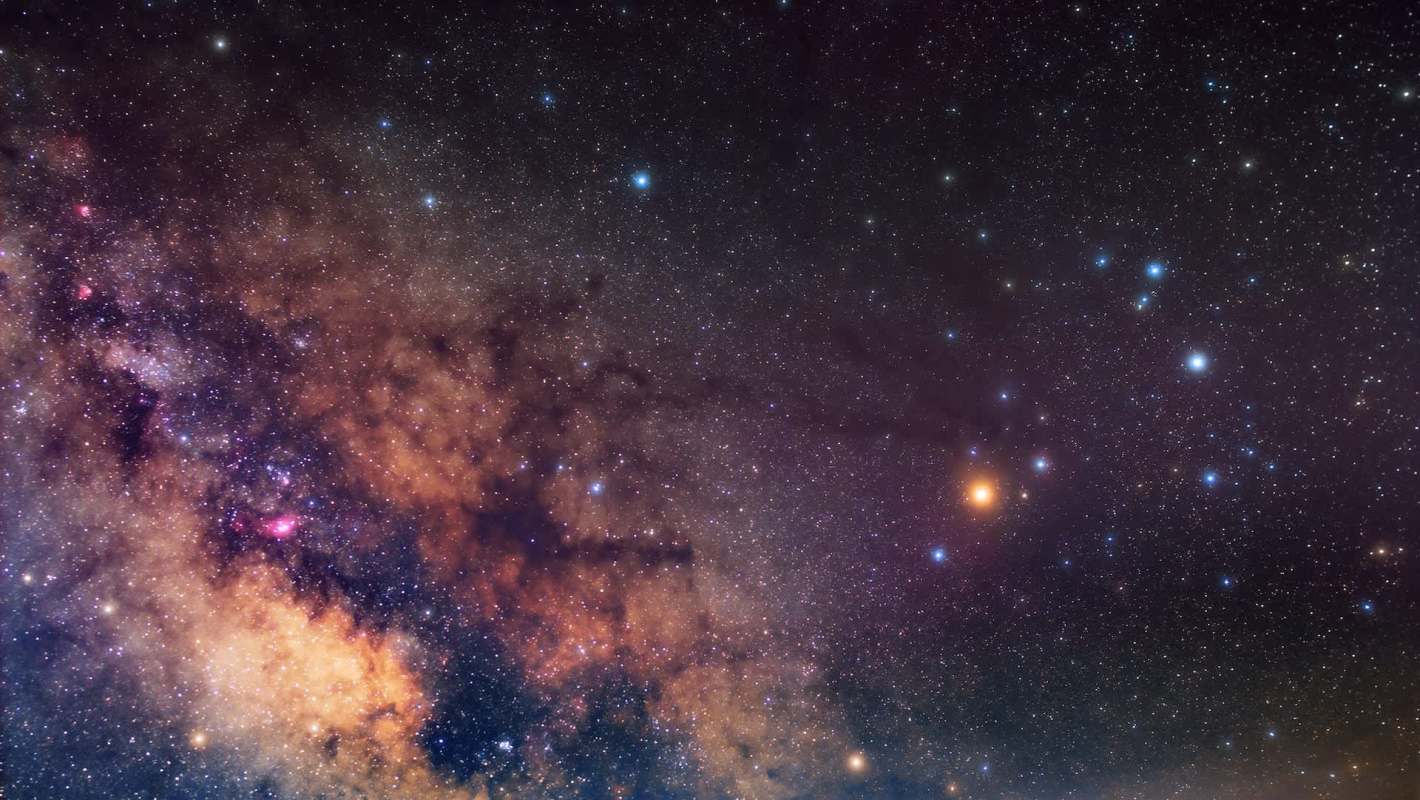
A newly tracked star racing around the Milky Way's central black hole at a staggering speed could help astronomers answer one of the biggest lingering questions about Sagittarius A*.
The star, called S301, swings so near Sagittarius A* that scientists think it could enable the first direct measurement of the black hole's spin.
Here's what to know
According to the European Southern Observatory, S301 hits about 15,500 miles per second (25,000 kilometers per second) at its nearest point to Sagittarius A*, which is a little over 8% of the speed of light. That puts it ahead of every other known star in the Milky Way in terms of speed.
It circles Sagittarius A* once every 8.7 years and, at its closest, gets to within about 12 times the distance between Earth and the Sun.
Felix Mang, a PhD student at the Max Planck Institute for Extraterrestrial Physics, said in the study, published in the journal Nature: "What is special about this star is that it's orbiting Sagittarius A* on a very tight orbit, taking just 8.7 years to complete it, and is approaching the black hole at a mere 12 times the distance of Earth to the Sun. That is unprecedented."
Under general relativity, a rotating black hole should drag and distort the spacetime around it. Those effects are easier to detect when something passes extremely close to the black hole.
TCD Picks » Quince Spotlight
💡These best-sellers from Quince deliver affordable, sustainable luxury for all




Reinhard Genzel, director at the Max Planck Institute for Extraterrestrial Physics and a founding member of the observing collaboration, said: "Decades of carefully tracking stars orbiting our galaxy's central black hole, Sagittarius A*, have led to this breakthrough discovery of a very promising star. Because it orbits so close to Sagittarius A*, S301 opens a new window to the fundamental properties of spacetime in this extreme black-hole environment."
More background
At the center of the Milky Way is Sagittarius A*, a black hole with a mass of about four million suns. Astronomers expect it to be spinning, but a direct measurement of that spin has not yet been possible.
S301 may offer that opportunity. At its nearest point, the star comes to about the same distance as the separation between the Sun and Saturn, closer than any other star yet observed near Sagittarius A*. That nearness could make it possible to see how the black hole's rotation alters the star's path.
S301 is about two billion times dimmer in the sky than Betelgeuse, so astronomers used the European Southern Observatory's Very Large Telescope Interferometer at Paranal Observatory in Chile, and the instrument called GRAVITY+, after an infrastructure upgrade isolated it from the crowded galactic center.
What's being done?
The next crucial stage is to follow S301 through more of its orbit. S301 was first spotted with GRAVITY+ in spring 2023, and researchers traced its path back to 2017, indicating that its latest close encounter with Sagittarius A* happened in early 2023.
The next major milestone will come during its next close pass in 2031. Continued observations with GRAVITY+ and later MICADO on the European Southern Observatory's upcoming Extremely Large Telescope will track its motion.
Observing at least two complete orbits should let astronomers determine the star's motion precisely enough to directly measure Sagittarius A*'s spin for the first time.
The star's origin may also offer clues about the violent conditions near the galactic center. Its trajectory points to a former binary system that the black hole tore apart, capturing S301 and flinging its companion outward, likely fast enough to leave the Milky Way entirely.
"With this star we hope to measure, within the next 10 years, the spin of the black hole," Mang said.
Stefan Gillessen, a researcher at the Max Planck Institute for Extraterrestrial Physics, said: "For the first time, we would actually be able to measure very directly the spin of a massive black hole, which would be a key test of Einstein's theory."
Where can I learn more?
Discoveries about Sagittarius A* are among the many exciting finds scientists are uncovering about space.
• ESA's Euclid mission found 31 ancient quasars, including two from the earliest known era.
• At Gemini North, astronomers captured the Crystal Ball Nebula sculpted by two hidden stars.
• In Taurus, astronomers spotted the hidden drift that may spark star birth.
• Using NASA's James Webb, astronomers detected methane on an interstellar visitor for the first time.

Get TCD's free newsletters for easy tips, smart advice, and a chance to earn $5,000 toward home upgrades. To see more stories like this one, change your Google preferences here.






