


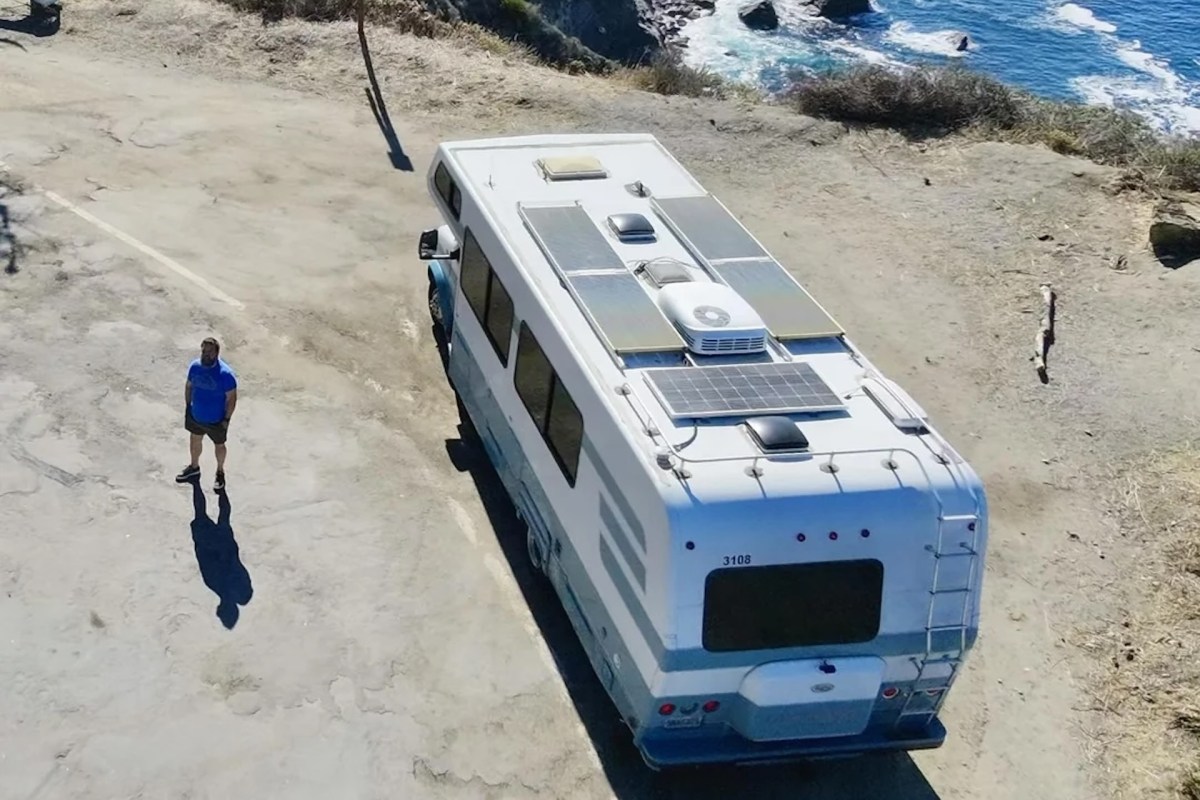
An RV owner's solar-powered camping setup faced a challenge at California's Pinnacles National Park, where hot weather and a shaded campsite left the batteries unable to power the air conditioning for more than about four hours.
Here's what to know
The owner shared the experience in Reddit's r/SolarDIY community, describing a setup with 970 watts of flat-mounted solar panels, a 314-amp-hour EcoWorthy house battery, and an Anker F3000 portable power station. An Anker bidirectional charger connects the two storage units.
A separate 400-watt portable panel offered little help at the sunless campsite. The owner reported arriving with the batteries roughly halfway depleted and experiencing daytime temperatures in the high 80s or low 90s.
Nighttime temperatures dropped to around 60 degrees, allowing the owner to rely on fans after switching off the air conditioning.
Responding to criticism about the solar array's size, the owner clarified why they had shared the experience. "Wasn't meant as a brag post - more of a reality check post. I had posted while doing the install and a couple people asked for some real world info after install."
More background
A Turbro Greenland heat pump ran from about 5 a.m. to 8 a.m. during the owner's stay at a Big Sur state park. That campsite was also fully shaded, but the weather was cool enough that air conditioning was unnecessary.
TCD Picks » Quince Spotlight
💡These best-sellers from Quince deliver affordable, sustainable luxury for all




The connection between the storage units had been set to send 200 watts from the house battery to the Anker. After the heat pump use, the Anker retained somewhere above 60% of its charge, compared with about 20% remaining in the house battery.
The owner ruled out mounting panels over the cab because that area flexes more. Along the roof's sides, other equipment left room for panels no wider than 27 inches.
What can be done?
The owner expected storage to exceed 11 kilowatt-hours with a second 314-amp-hour EcoWorthy battery. That was their preferred upgrade, with space available for the roughly $400 addition.
Replenishing the stored energy would remain necessary, even if the extra battery extended air-conditioning use.
A Transit van owner in the discussion reported up to 2,300 watts from alternator charging and about 750 watts from rooftop solar. Their setup combined 1,000 watts of roof-mounted panels, a 500-watt deployable array, and alternator charging.
The owner said Pinnacles didn't allow generators, so the backup generator they brought wasn't an option during the challenging stay.
For readers considering home solar rather than an RV installation, EnergySage lets you curate competitive bids from local installers without those installers obtaining your contact information unless you choose to work with one further.
"Big batteries are nice, they let me run the air conditioner all night long, but the hard part is having capacity to recharge them," the OP added.
Where can I learn more?
Shade, battery capacity, and equipment choices all affect how long an RV's solar setup can run the air conditioner. These stories follow off-grid cooling tests, battery replacements, and solar-panel decisions for homes and campers.
• A California and Arizona box-truck owner tested off-grid AC in 100-degree heat with 1,950 watts of solar.
• An RV owner replaced a failed portable power station with EcoFlow backup power for the entire 50A RV.
• A solar user battling fall shade topped 90% efficiency with help from portable panels.
• A homeowner asked whether two cheap solar panels could power a window air conditioner.
• A truck camper owner shopping for used solar panels asked about voltage and potential pitfalls.

Get TCD's free newsletters for easy tips, smart advice, and a chance to earn $5,000 toward home upgrades. To see more stories like this one, change your Google preferences here.






