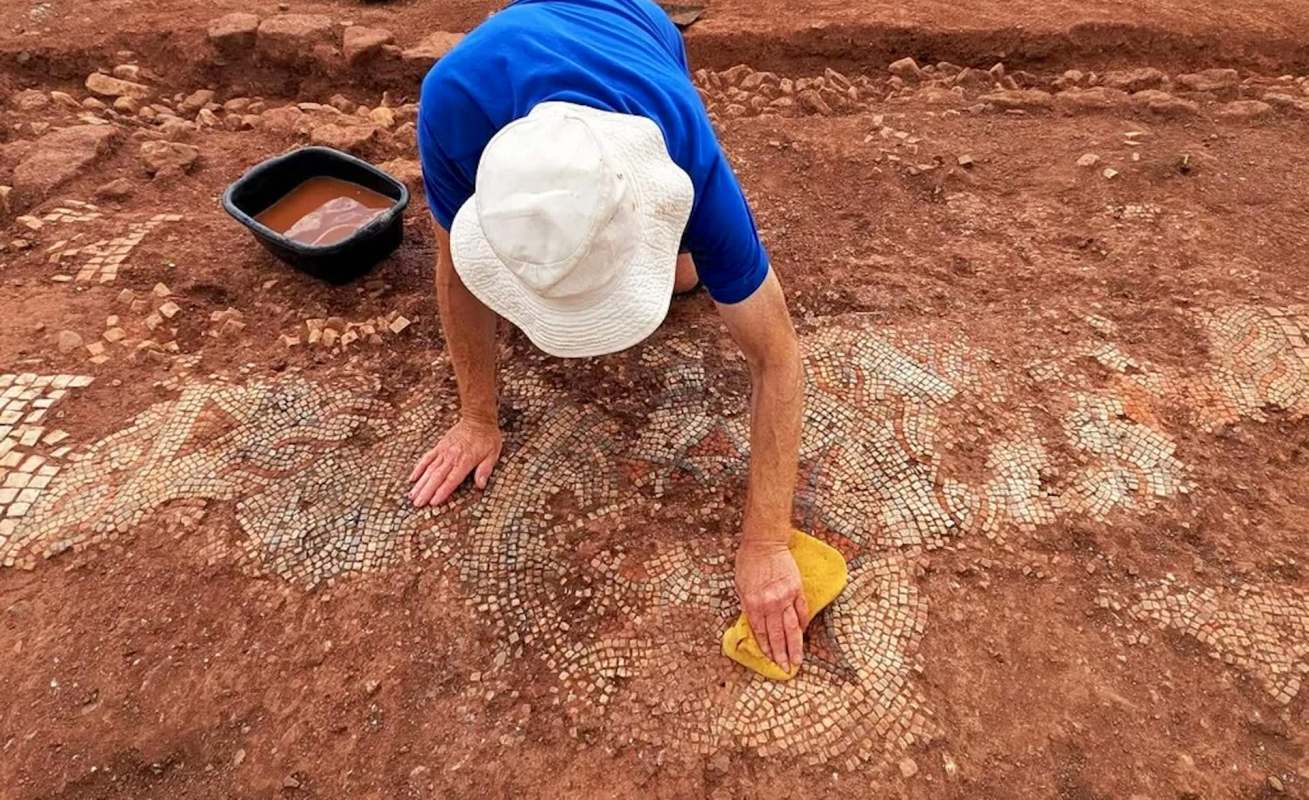
Two decades after a field survey in the U.K. uncovered a Roman-era coin buried beneath farmland, archaeologists are still revealing the site's hidden history. Their latest discovery is the remains of a Roman villa, including an elaborate mosaic floor that points to the wealth and significance of the ancient estate.
What happened?
According to Smithsonian Magazine, in southwestern England, excavators found a mosaic covering about 130 square feet that likely dates to the fourth century C.E.
The outlet reported that the pattern uses tiny multicolored stones and ceramics less than half an inch across to create an eight-petaled flower framed by an ornate border of two interwoven bands. Researchers note the find marks the westernmost known location of a polychrome mosaic in Roman-era Britain.
As reported by Smithsonian Magazine, in a statement, Bill Horner, county archaeologist and historic environment manager at Devon County Council, said: "This, and the other trappings of Roman civilization and evidence of affluence that have been found, show how much even this far-flung part of the province had been integrated into the Roman Empire."
Early discoveries at the site by Hill later led to geophysical surveys and test trenches, which showed that the farmland had once been home to a substantial villa complex.
Excavators also identified another building that may have served as a bathhouse, Smithsonian Magazine reported, with evidence of at least two cold plunge pools.
TCD Picks » Good Store Spotlight
Get 10% off your next purchase with code TCD10




Why does it matter?
"There is a narrow window of opportunity to conduct rescue excavations on this site," the University of Exeter said, as reported by Smithsonian Magazine, noting that the location could be at risk of further damage from future plowing.
If continued cultivation keeps breaking apart features such as mosaics, walls, and bath structures, those remains cannot be restored in their original context.
The discovery is also changing how experts view the western edge of Roman Britain.
Because lavish villas are uncommon in the region, one with a mosaic points to residents whose wealth would have been unusual for the area.
Archaeology students and volunteers are taking part in the excavation through a five-year project called Saving Halberton's Ancient Roman Environment.
According to Smithsonian Magazine, the effort brings together Devon County Council, the University of Exeter, Cotswold Archaeology, Tiverton Archaeological Group, and the Sampford Peverell Society. Organizers are trying both to protect what is left before more damage occurs and to involve the local community in the work of uncovering it.

Get TCD's free newsletters for easy tips, smart advice, and a chance to earn $5,000 toward home upgrades. To see more stories like this one, change your Google preferences here.