


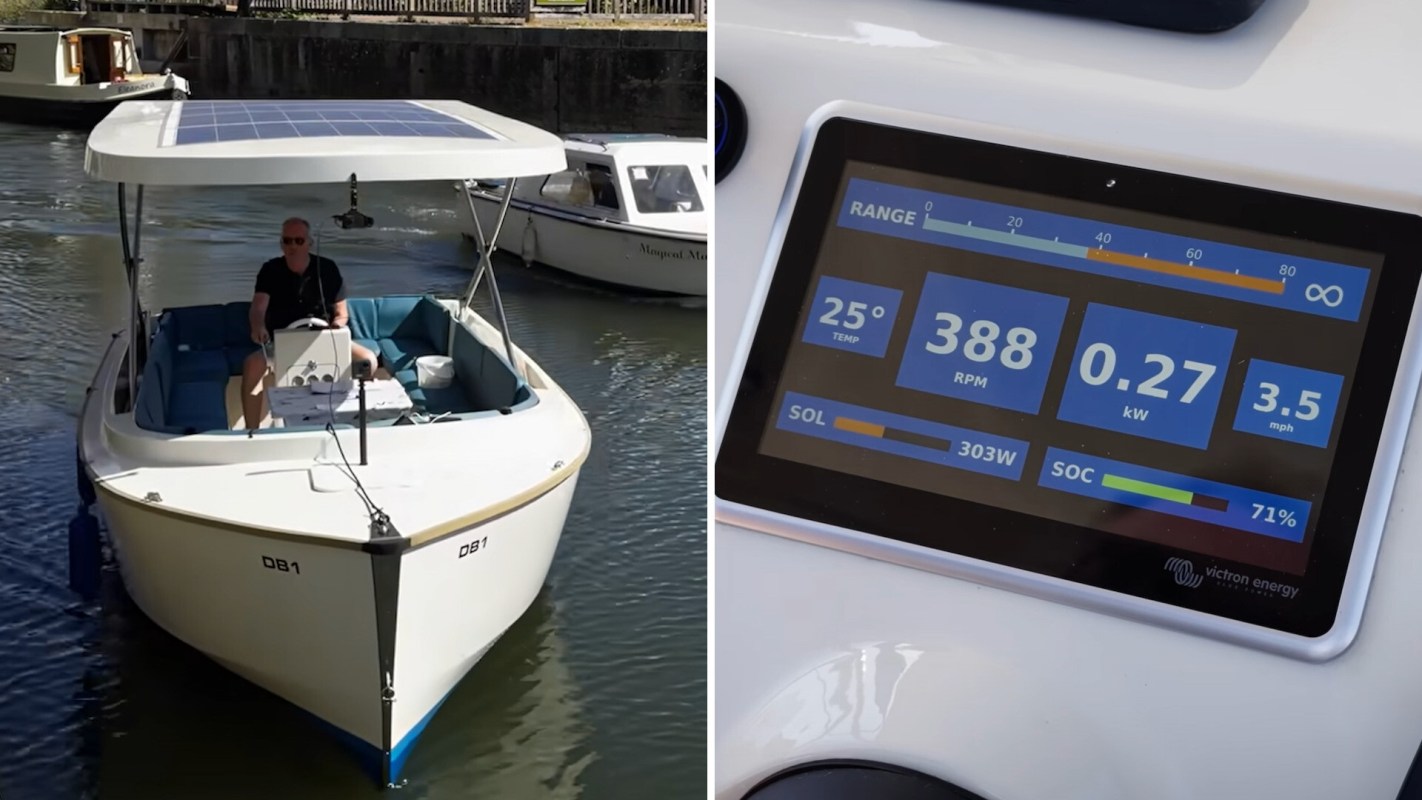
A prototype boat in the United Kingdom completed a striking real-world test of cleaner transportation: a six-day trip on the River Thames to London powered only by solar panels mounted on its roof.
For anyone who has ever imagined quieter, simpler days on the water, the journey offered a glimpse of what low-maintenance boating could look like.
Here's what to know
Part of the voyage appears in a YouTube video from David Johns of CruisingTheCut (@CruisingTheCut), who joined DB1 for one stretch of the journey and wrote, "I was kindly invited aboard DB1, an all-electric prototype day boat for part of its journey along the length of the Thames, powered purely by the sun."
Overall, the trip took six days and ran from Lechlade to London.
Designer Tim Knox also piloted the boat during the test, describing it this way: "My aim is not to charge en route from a plug-in source and to hopefully arrive with a 100% battery, proving that we did a whole journey on solar electric."
Beneath the front seat, DB1 carries a 5-kilowatt-hour battery, while the 19-foot prototype day boat has four flat solar panels on its roof that can generate about 750 watts in peak sun. At a gentle cruising pace, especially on downstream sections, the boat could be efficient enough to keep adding charge even while underway.
TCD Picks » Quince Spotlight
💡These best-sellers from Quince deliver affordable, sustainable luxury for all




Viewers were enthusiastic. One commenter wrote, "This seems like the perfect way to power that sort of boat. It's just so relaxing to be able to hear birdsong and people chatting on bank."
More background
The trip highlighted DB1 as a functioning vessel on the water, not just a polished mockup or display-only prototype.
Footage showed it moving through locks, sharing the river with other boats, and dealing with everyday compromises such as speed and weeds gathering around the propeller.
Knox also stressed the appeal of self-charging at rest. For the short recreational outings this kind of day boat is built for, he suggested owners may be able to rely on the boat to top itself up while moored, rather than needing dedicated charging points.
That could make cleaner boating more realistic for marinas, lake communities, and tourism operators looking to reduce operating costs.
He also described the design as easier for families to use, pointing to the quiet ride, the button-operated roof, and the absence of diesel smell as features that remove some of the usual boating hassle.
What's being done?
The Thames voyage was intended as a public demonstration that solar-electric boating can handle ordinary conditions when the use case fits the technology.
Instead of trying to replace every type of boat, DB1 targets social daytime cruising, where efficiency matters more than outright speed.
Knox said he sees the boat as an export product and noted that two units could fit inside a single shipping container. He also said later versions would likely be built from aluminum rather than the prototype's plywood-and-fiberglass construction.
Not every boater needs long-range, high-speed performance. For lake days, slow river cruising, or eco-tourism operations, a solar-powered craft could mean lower fueling costs, fewer maintenance headaches, and cleaner air around the dock.
As Knox put it, "It's lovely and quiet, there's no stink of diesel. And it's just a very, very sociable boat, it's a very comfortable boat."
Where can I learn more?
Solar-powered boating is gaining traction well beyond this Thames test run. These stories look at everything from community boats in the Amazon to luxury catamarans and charging docks.
• In the Amazon, the Alex Honnold Foundation is helping communities adopt solar-powered boats.
• Silent Yachts launched an all-solar catamaran with three decks and fully electric power.
• Faro's floating PowerDock offers off-grid charging for electric boats using solar power.

Get TCD's free newsletters for easy tips, smart advice, and a chance to earn $5,000 toward home upgrades. To see more stories like this one, change your Google preferences here.






