


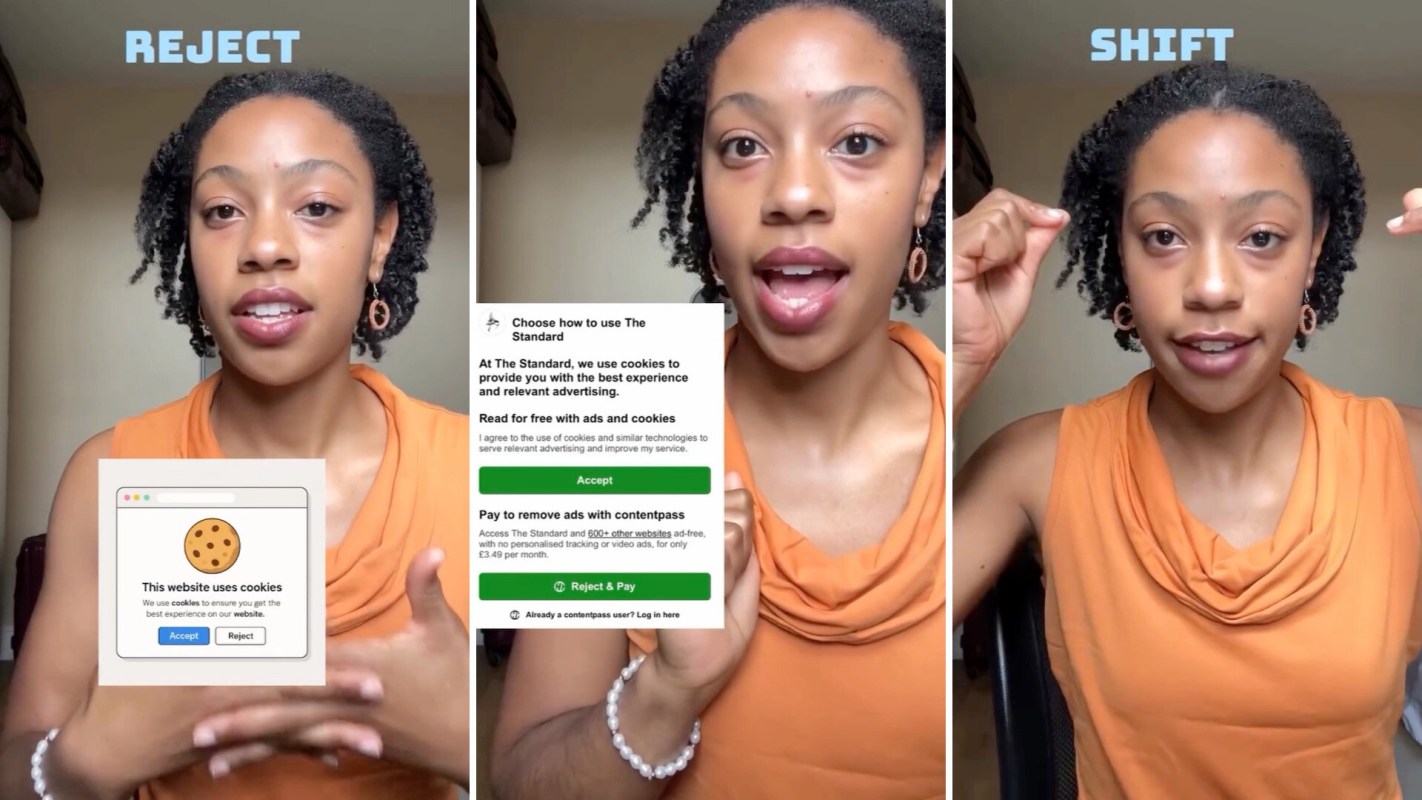
Paying extra to remove ads may no longer be just about convenience. For many digital services, it can also mean paying to limit how much of your personal information gets harvested, analyzed, and sold.
Here's what to know
In an Instagram post, Ayana Gray (@ayana.g123) of the Center for Democratic AI broke down what she dubbed the "new era of inescapable surveillance."
As Gray explained, there are now new mechanisms that make users have to pay to reject cookies on websites. In the past, those cookies could be rejected so that users could avoid having their usage and visit history tracked.
Gray then showed an image of a site that requires users to either accept ads and cookies, or pay to remove them and view the site. If that pattern is replicated, it could alter the dynamics of internet surveillance.
"We are now living in an era where it is so normal, expected, accepted for companies to collect your data, that surveillance becomes the default, and privacy becomes a luxury," she wrote in the caption.
She admitted that some may suggest that this has been happening for a while, but she highlighted the distinction.
TCD Picks » Quince Spotlight
💡These best-sellers from Quince deliver affordable, sustainable luxury for all




"Advertising and ad-free tiers in media are nothing new," she added in the caption. "The difference is that now it is not just about advertising, but about data collection, privacy, and surveillance."
More background
In the video, Gray continued to explain why the new normal is alarming. She said that having to pay for an experience free of targeted advertising is a different arrangement.
Gray argued that it all represents a shift in the cultural mindset and norms around privacy, surveillance, and data collection. Now, companies see your data as something they have the right to own and sell.
If internet users don't want that to be the case, they may begin to have to pay to change the equation. Even that drew some cynicism from Instagram commenters.
"I'm so cynical that I fully expect in a few years some investigative journalist will report on how even after paying ppl were still being tracked in the same ways the ppl who didn't pay, exposing how the companies just lied about it," a commenter wrote.
What can be done?
Readers were urged to follow Gray and the Instagram account of the Center for Democratic AI (@centerfordemocraticai), sign up for the Action Alerts newsletter, and consider donating to the Center.
Gray noted the Center has its own proposals for consumer protections in this new landscape that could help tilt the power balance back to consumers.
Commenters had their own ways to avoid surveillance, like one who suggested going old school and boosting public libraries.
"I saw a reel here on instagram where a woman pointed out that physical books come without surveillance," they wrote. "There is no one counting how many seconds you linger on a page and what topics you seem more interested in."
Where can I learn more?
Paying extra to keep your data out of advertisers' hands is part of a much bigger fight over how AI and digital platforms use their power, and how much trust they expect from the public. There are related pressure points, too, from security worries to fake content.
• Public backlash is growing as AI advancements raise security concerns alongside mounting privacy fears.
• The Chicago Sun-Times published a summer reading guide with recommendations for fake books that were AI-generated.
• At Hugging Face, engineers built a tool to track energy-hungry AI power use.
Digital systems are facing scrutiny that goes well beyond convenience. Privacy is starting to look like something companies can charge extra for.

Get TCD's free newsletters for easy tips, smart advice, and a chance to earn $5,000 toward home upgrades. To see more stories like this one, change your Google preferences here.






