


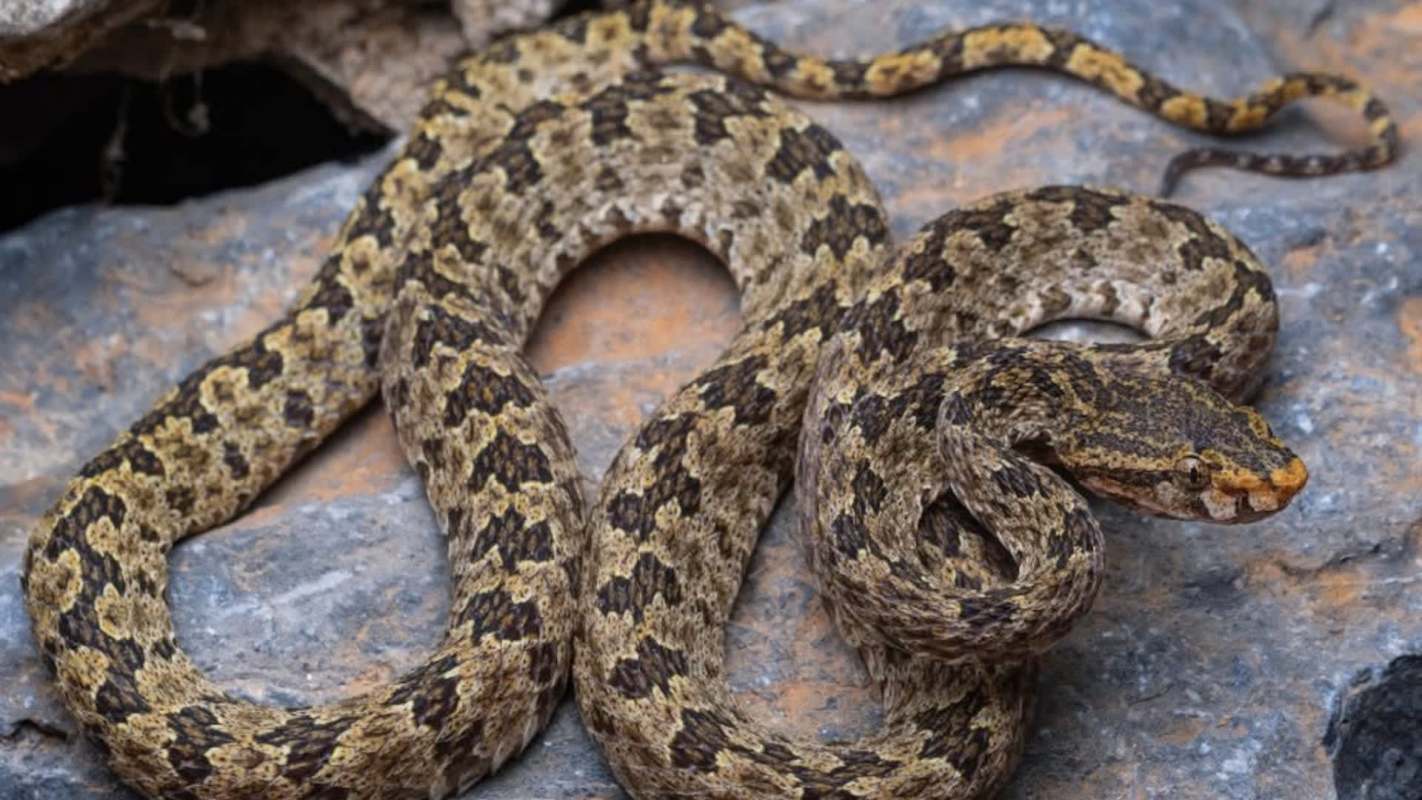
Researchers have confirmed a cave-dwelling pit viper in Laos as a species previously unknown to science. The newly described snake stands out for its yellow-orange snout, and researchers found it on cave walls and limestone formations in a karst landscape in Vientiane Province.
Here's what to know
A study in Herpetozoa reported that fieldwork in Vang Vieng District during October 2024 led researchers to classify the animal as a new species, Protobothrops flavirostris, according to Bioengineer.org. The species description rests on one adult female collected near Khan Kham Cave, plus photographs of three additional snakes seen in nearby caves.
With this addition, Laos has three documented Protobothrops species, while the genus totals 16 species worldwide. Protobothrops snakes, part of the Asian lance-headed pit viper group, are dangerously venomous and can pose a hazard to humans.
To test whether the snake was truly new, researchers relied heavily on DNA data. They examined 6,092 aligned base pairs across five mitochondrial genes and two nuclear genes, then used Maximum Likelihood and Bayesian Inference to place it within the genus.
Those analyses showed the Laos specimen represented a strongly distinct lineage whose nearest known relative was P. kelomohy, first reported from northwestern Thailand in 2020.
More background
All four recorded individuals were observed using cave surfaces, whether walls, stalactites, or exposed limestone rock.
TCD Picks » Quince Spotlight
💡These best-sellers from Quince deliver affordable, sustainable luxury for all




Encounters between people and wild animals can become more common as humans spend more time in animal habitats or alter those spaces, a dynamic explored in reporting on why wild animals attack humans.
Those cave surveys suggest the species had remained unrecognized even though it occurs close at hand.
The study suggests local communities were not entirely unfamiliar with the snake. Sightings were concentrated near the beginning and end of the rainy season, matching observations reported by local Hmong villagers.
Precise identification of venomous snakes also has practical value: when similar pit vipers share a region, it can help doctors and others avoid confusion after a bite.
What's being done?
Using snake hooks, the team captured the holotype, photographed it while it was alive, and deposited it in the National University of Laos collection in Vientiane.
Before fixing the specimen, researchers placed liver and heart samples in 96% ethanol, providing material for the genetic tests used to evaluate its distinctiveness.
That analysis showed the Laos population carried its own nuclear haplotypes absent from other sampled Protobothrops species with comparable sequence data.
Morphology also supported the lab findings. The adult female was 32.5 inches long and had particular scale counts, a dark brown-black head, prominent reddish-brown cross-like blotches, and vivid yellow on the snout and tail tip.
The researchers then compared the specimen with each of the 15 species already recognized in the genus. Along with its geographic isolation in Laos' limestone karsts, these differences supported recognizing a new species rather than a local variation of one already known to science.
Where can I learn more?
Snake discoveries across Asia show how much field surveys and DNA work are still changing what scientists know about venomous reptiles. These stories follow newly identified pit vipers, an unusual forest snake in India, and notable finds involving rare venomous species from Uzbekistan to China.
• In Myanmar, a pit viper that looked like two snakes proved to be distinct.
• In Pakistan's high mountains, DNA revealed three new species within a 160-year pit viper mystery.
• Under a forest log in India, researchers uncovered a bizarre new snake with pointed teeth.
• On Uzbekistan's steppe, a wild Caspian cobra carried deadly venom with cancer-fighting promise for scientists.
• In Fujian Province, scientists wandering a mountain forest made a secretive snake discovery rarely seen before.

Get TCD's free newsletters for easy tips, smart advice, and a chance to earn $5,000 toward home upgrades. To see more stories like this one, change your Google preferences here.






