


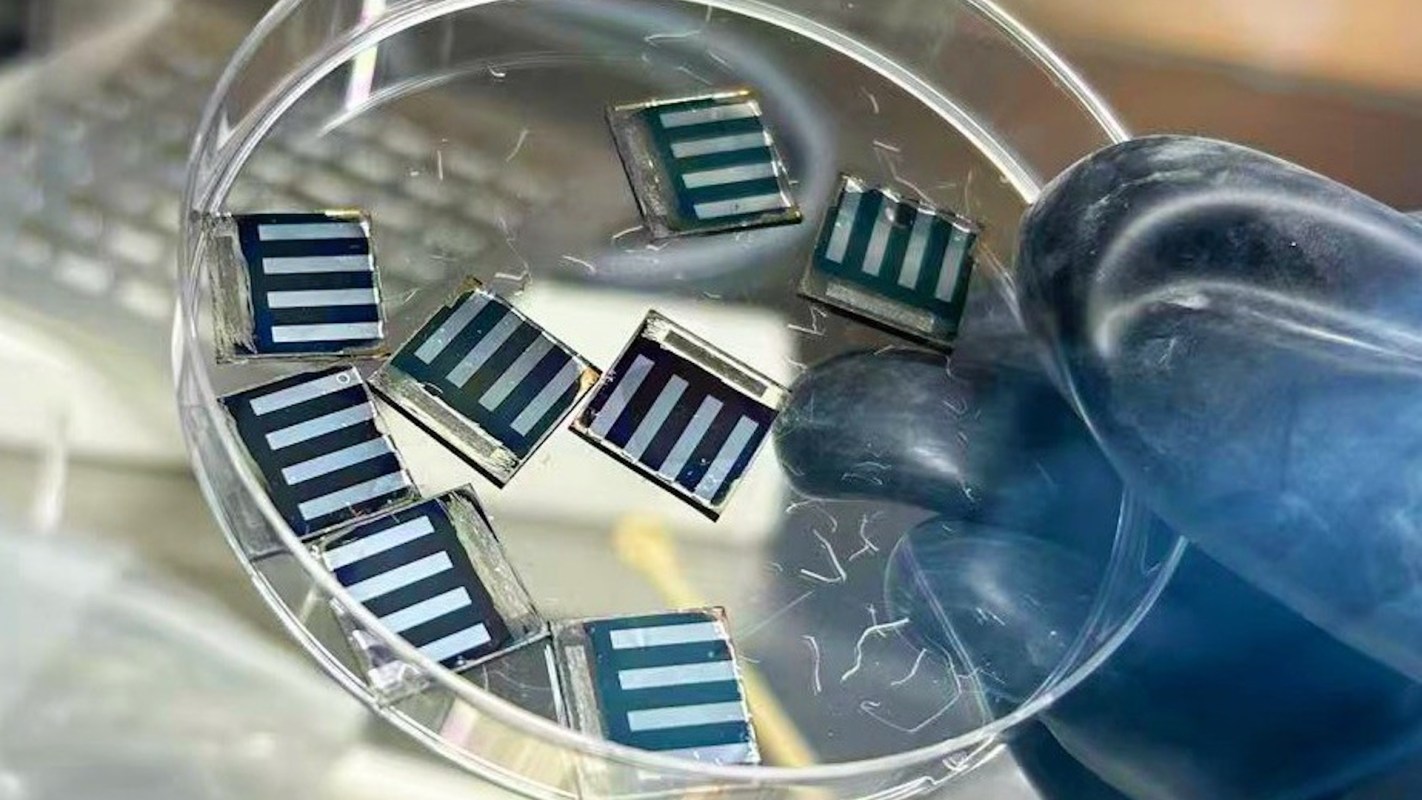
A simple molecular adjustment could help bring next-generation solar panels closer to broader real-world use, as an international team of researchers found that tweaking an ultrathin layer inside perovskite solar cells with a small asymmetric molecule delivered certified efficiencies above 25.6% while also improving stability over time.
Here's what to know
In inverted perovskite solar cells, one important component is the self-assembled monolayer, or SAM, an ultrathin film that moves positive charge. As pv magazine reported, the team created a symmetry-breaking co-assembly approach that combines the common symmetric SAM molecule MeO-2PACz with a simpler asymmetric molecule called DTCA.
According to corresponding author Tom Wu, the strategy was designed to deliver the benefits of asymmetry without depending on materials that are harder and more expensive to produce.
"Rather than synthesizing complex and costly asymmetric molecules, we achieve the benefits of molecular asymmetry by co-assembling a widely used symmetric SAM (MeO-2PACz) with a simple asymmetric conjugated molecule (DTCA)," Wu said. "This approach suppresses molecular self-aggregation, substantially increases surface coverage, and improves buried-interface quality."
Tests showed the combined layer was less prone to clumping and covered the surface more completely. Using a quantitative atomic force microscopy-infrared spectroscopy technique, the researchers measured surface coverage at 82.4% for the MeO-DTCA version, compared with 60.6% for MeO-2PACz alone.
Among the formulations the team examined, a 4:1 ratio worked best, and the devices posted certified efficiencies above 25.6%. The study, published in Nature Communications, involved researchers from China, Australia, the United Kingdom, South Korea, and Germany.
TCD Picks » Quince Spotlight
💡These best-sellers from Quince deliver affordable, sustainable luxury for all




More background
Perovskite solar cells have drawn intense interest because they could eventually make solar technology more efficient and potentially less expensive to manufacture. One of the biggest challenges has been improving the interfaces between layers, since defects can waste energy and shorten a device's lifespan.
The researchers said better surface coverage suppressed harmful chemical reactions under electrical stress and reduced non-radiative recombination losses. As a result, the devices reached power conversion efficiencies of 26.32% for a 0.012-square-inch (0.08-square-centimeter) cell and 25.34% for a 0.155-square-inch (1-square-centimeter) cell.
The team also reported that an encapsulated device retained 93% of its starting efficiency after 1,150 hours at its maximum power point.
What's being done?
Alongside the device results, the researchers described a way to directly quantify how well these ultrathin molecular coatings cover a surface. Wu said the team developed a quantitative atomic force microscopy-infrared spectroscopy method that measures SAM coverage at the nanoscale.
Looking ahead, the group hopes to use the measurement technique with many other molecular systems and expand the range of symmetry-breaking combinations it studies. The researchers also plan to apply the concept to large-area modules and tandem solar cells, which are widely seen as promising paths to even higher solar performance.
"This study opens several exciting directions for future research," concluded Wu. "The novel strategy is likely applicable to many other molecular systems, and we are interested in developing a broader library of symmetry-breaking molecular combinations and establishing design rules that link molecular symmetry, dipole moment, and surface coverage. Second, we aim to translate these molecular design principles to large-area modules and tandem solar cells. Finally, our quantitative AFM-IR methodology provides a new way to study ultrathin molecular layers in a quantitative approach, which could benefit not only photovoltaics but also other devices involving such molecular layers."
Where can I learn more?
Explore more stories on perovskite efficiency advances, tandem designs, new solar materials, and panel cooling.
• Scientists developed a breakthrough new material that could push perovskite solar modules toward commercialization.
• At KAUST, engineers built perovskite-silicon tandem cells that could make solar electricity cheaper.
• Scientists synthesized a tin perovskite material that significantly boosted next-generation solar-cell performance.
• Researchers created a record-efficiency polymer solar material that could lower futuristic panel costs.
• Engineers designed a seawater cooling system that made solar panels run more efficiently.

Get TCD's free newsletters for easy tips, smart advice, and a chance to earn $5,000 toward home upgrades. To see more stories like this one, change your Google preferences here.






