


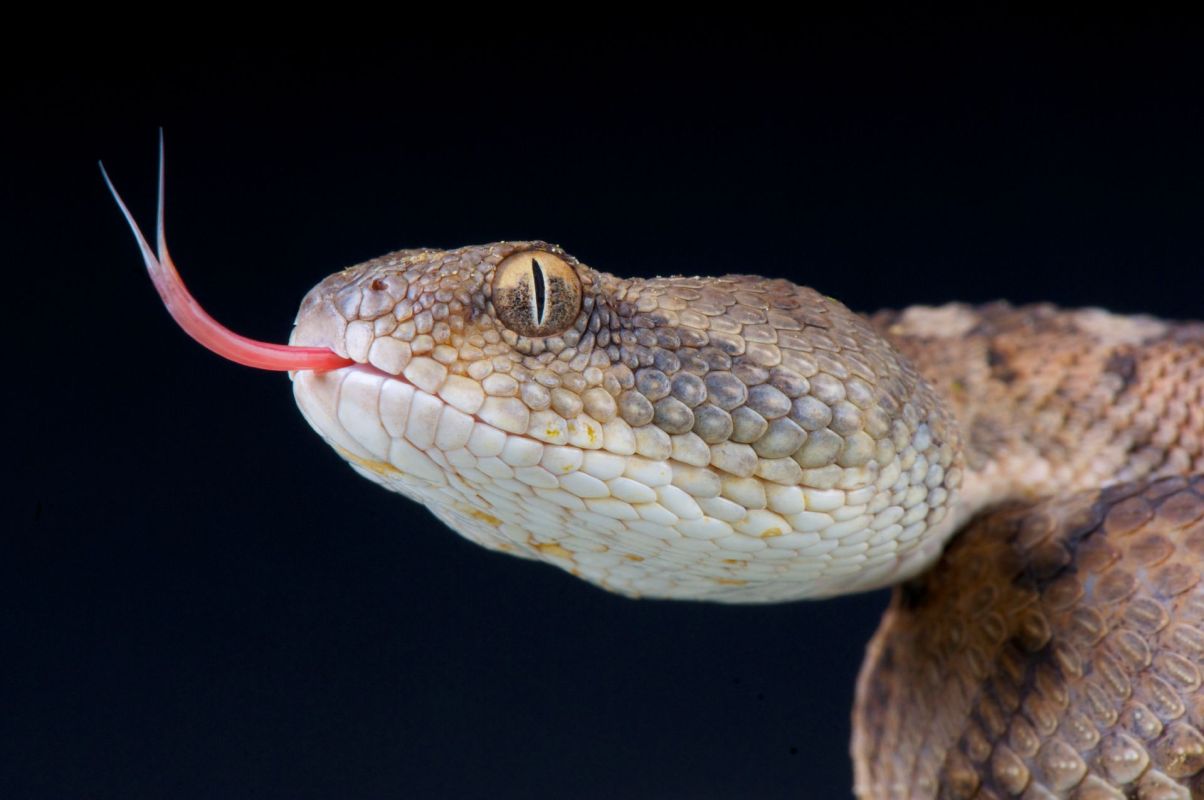
A highly venomous desert snake in the United Arab Emirates has been documented eating fish for the first time — an unexpected behavior for a viper better known for preying on lizards, small mammals, and amphibians.
Researchers spotted the Oman saw-scaled viper at drying wadis where small freshwater garra had concentrated in shallow water.
Here's what to know
Evidence comes from two sightings in the UAE, later detailed in the journal Ecology and Evolution, as reported by Discover Wildlife. Together, they provide the first published record of the Oman saw-scaled viper consuming fish.
In the June 2025 observation, the snake was seen approaching and catching a garra, the small freshwater fish Garra barreimiae. In a May 2023 sighting beside a drying river, also known as a wadi, researchers found a viper with a fish already in its mouth before it swallowed it.
Theo Busschau of New York University Abu Dhabi led the report. As the authors wrote, "The diets of snakes are important ecological variables that give insight into the evolution of species and how they interact with their environment."
Because feeding ecology has played a major role in shaping viper skulls and fangs, even one newly documented prey item can give researchers a better sense of how a species has adapted to local conditions.
TCD Picks » Quince Spotlight
💡These best-sellers from Quince deliver affordable, sustainable luxury for all




More background
The Oman saw-scaled viper belongs to Echis, a genus of 12 venomous species found from Northern Africa through Western and Southern Asia. These snakes are about 12 to 35 inches long, and their name refers to the saw-like keels on their scales.
Their scales can also serve as a warning system: when disturbed, the snakes may rub them together to make a crackling sound. Since saw-scaled vipers are most often linked to deserts, savannah, and arid scrubland — dry habitats — feeding on fish is especially unusual.
In Northern Oman and the UAE, the Oman saw-scaled viper inhabits mountainous areas where seasonal water flow forms wadis that can briefly support freshwater life. The garra involved in the study is thought to spawn ahead of floods, which may help spread its fry.
As floodwater recedes, some fish become trapped in temporary pools while others concentrate in very shallow water, creating an uncommon opportunity for a land-based predator. The report said, "It is not clear what factors influence diet, but it is likely that diet, and therefore venom evolution, is driven by the most abundant appropriately sized prey available to each species/population where they occur."
What's being done?
Researchers observed the behavior at different stages. One observation captured a snake already swallowing a fish, while the other showed a viper actively moving toward and catching a garra. The multiple examples that capture different parts of the process indicate that this wasn't just a chance encounter or the result of scavenging — this was intentional hunting behavior.
The report also places the behavior in a broader ecological context for the Viperidae family. As the paper explained, "Among vipers (venomous snakes in the Viperidae family), feeding ecology has contributed significantly to the evolution of fang and skull morphology."
By documenting exactly where the behavior occurred and what prey was involved, the researchers have added a concrete new data point for future work on how desert snakes take advantage of seasonal water systems and shifting prey availability.
Where can I learn more?
Plenty of other examples show unusual snake behavior and venomous species adapting to specific environments. They cover aquatic hunting, rapid evolution, cannibalism, and newly distinguished vipers across Asia and the United States.
• In the eastern United States, queen snakes rely on crayfish shedding their armor before striking.
• In a Philippine lake, a rare venomous sea snake appears to have evolved rapidly.
• From India to Southeast Asia, some snakes are evolving a taste for their own kind.
• In Pakistan's high mountains, DNA exposed three new pit viper species hidden in plain sight.
• In Myanmar, genetic evidence showed one pit viper lineage was distinct despite its look-alikes.

Get TCD's free newsletters for easy tips, smart advice, and a chance to earn $5,000 toward home upgrades. To see more stories like this one, change your Google preferences here.






