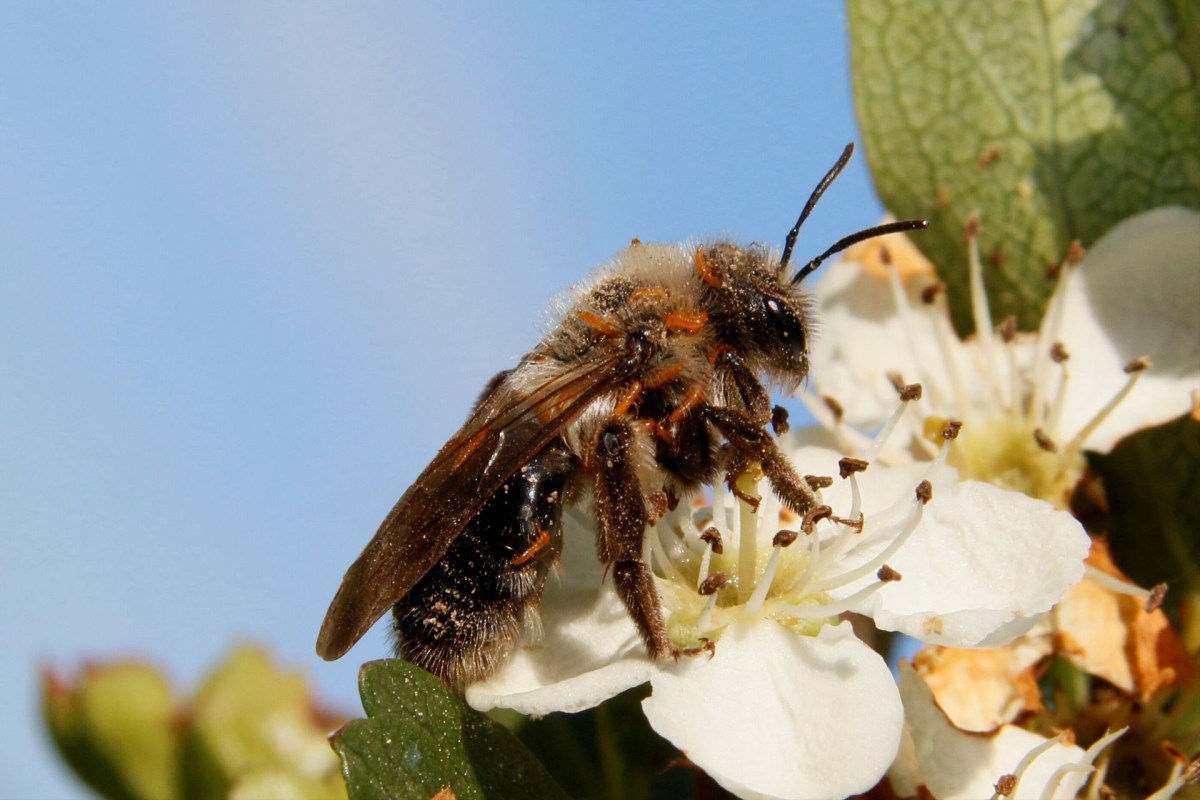
Tiny European oil beetle larvae have a remarkable survival trick: They smell like flowers. Researchers in Germany found that the larvae can produce floral scents from scratch, luring wild bees close enough to help the parasites hitch a ride back to the bees' nests.
What happened?
Researchers at the Max Planck Institute for Chemical Ecology and Friedrich Schiller University in Jena reported what appears to be the first evidence that an animal can imitate a floral odor as a way to steer pollinator behavior, according to Phys.org. The study appeared in Proceedings of the National Academy of Sciences.
Survival for Meloe proscarabaeus depends on getting its young into the nests of solitary bees. Once inside, the larvae consume the bees' eggs along with the food stores set aside there. Because so few larvae make it, females produce eggs by the thousands.
Chemical tests showed that the larvae release a blend of 17 monoterpenoids — a class of scent compounds often found in blossoms including plum and cherry flowers. Experiments then showed that bees moved toward the odor even when the larvae themselves could not be seen, indicating that the smell by itself was enough.
Tobias Köllner, who leads the Department of Natural Product Biosynthesis, said the researchers set out to learn whether this European beetle used the same bee-pheromone tactic seen in a North American relative or something else entirely: "We wondered whether its European relative Meloe proscarabaeus—whose larvae accumulate on plants and apparently use a wide range of wild bee species as hosts—employs a similar strategy or a completely different form of chemical deception."
Why does it matter?
Wild bees are a crucial part of healthy ecosystems, and many plants rely on them for pollination. The work adds another layer to scientists' understanding of how communication systems in nature function.
TCD Picks » Quince Spotlight
💡These best-sellers from Quince deliver affordable, sustainable luxury for all




The scent also does not seem to come from plants or from the beetles' earlier life stages. The team did not find the flower-like monoterpenoids in the eggs, the adult beetles, or the surrounding environment.
Genetic work pointed to two larval cytochrome P450 enzymes — CYP347BT1 and CYP345BZ1 — as part of the process that makes these flower-mimicking chemicals. Lead author Ryan Alam said, "This discovery describes a previously unknown form of mimicry and expands our understanding of how parasites use chemical signals to manipulate other organisms."
Understanding pollinator behavior and ecological deception can help clarify the pressures facing bee populations and the relationships that support flowering plants and food systems.
What's being done?
Researchers are now taking a closer look at how the scent-making machinery works. By pinpointing those enzymes, they showed that the larvae make the flower-like scent compounds from scratch rather than borrowing them from plants.
Field tests supported that conclusion as well: when isolated monoterpenoids were placed on cotton swabs, they still attracted wild Andrena sand bees.
Alam said that broad appeal may let the larvae exploit more than one kind of host bee: "By mimicking a resource that attracts many different species of wild bees, the larvae are able to reach a broader range of potential hosts."
Sarah O'Connor, head of the Department of Natural Product Biosynthesis, said, "Our next goal is to elucidate the entire biosynthetic pathway of these volatile compounds. To that end, we also plan to study related beetle species to understand how widespread this strategy is and how it has evolved."

Get TCD's free newsletters for easy tips, smart advice, and a chance to earn $5,000 toward home upgrades. To see more stories like this one, change your Google preferences here.