


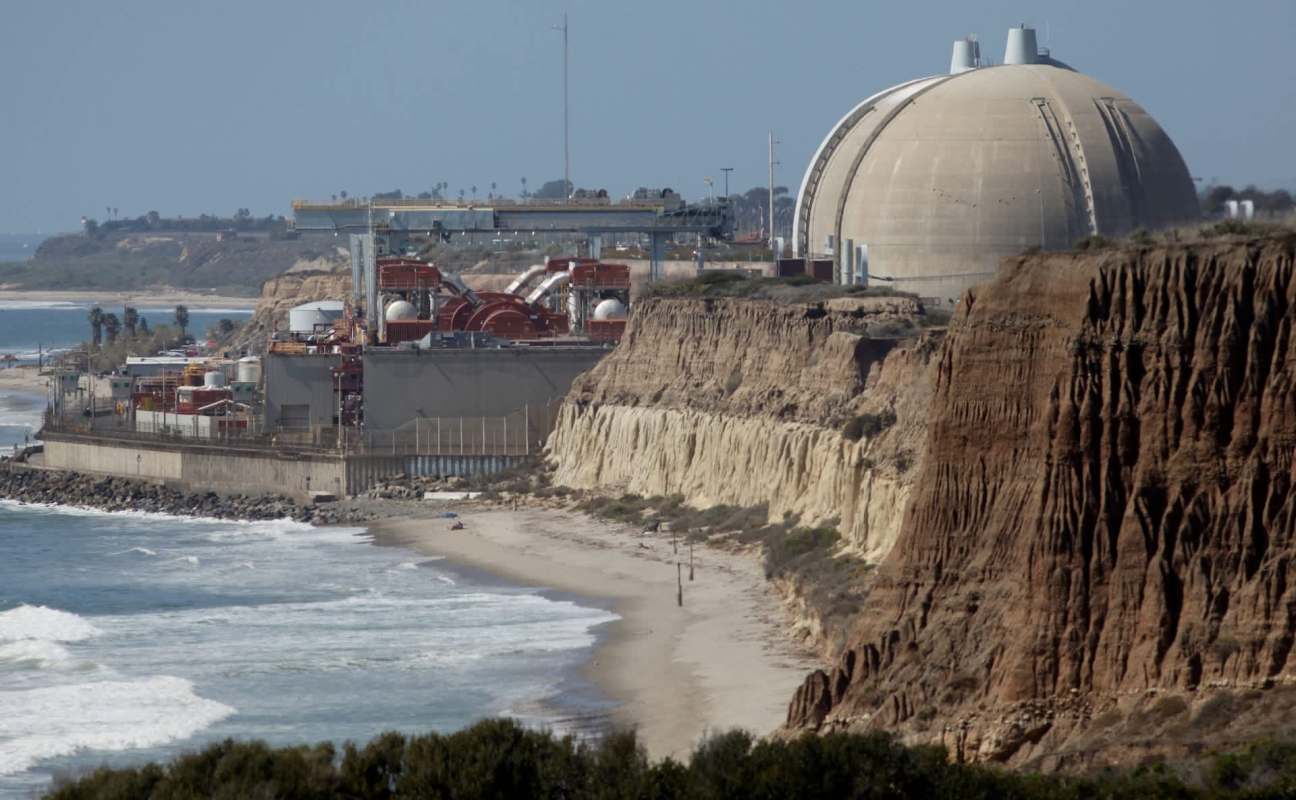
Powerful surf and flooding eroding Southern California's coast have many wondering why 3.6 million pounds of spent nuclear fuel is still being stored just 100 feet away.
Here's what to know
Coastal damage from heavy waves has intensified attention on the decommissioned San Onofre Nuclear Generating Station near San Clemente, where high-level radioactive waste is stored in steel canisters on a concrete pad behind a seawall, as the Los Angeles Times reported.
Kim McCoy, a former wave dynamics researcher who has long opposed beachside nuclear-waste storage, warned, "Rising sea levels, storm waves, El Niño which increases wave height ... these could wash away a section of the walkway that protects the San Onofre seawall and the waste canisters are just 100 feet away from that."
Even so, most of the experts quoted by the Times said there is little immediate danger.
Nuclear power can generate large amounts of steady electricity with far less planet-warming air pollution than coal, oil, or gas, but the spent fuel it leaves behind remains one of the industry's biggest unresolved problems.
More background
San Onofre stopped operating in 2013 after problems with faulty steam generators, and much of the site has since been dismantled.
TCD Picks » Quince Spotlight
💡These best-sellers from Quince deliver affordable, sustainable luxury for all




Most lower-level rubble has already been shipped away, while the plant's iconic twin domes are expected to come down in early 2027. The spent fuel, however, is set to remain there indefinitely.
James Day, a geology professor at UC San Diego, described San Onofre as a seismically active area on relatively young rocks. Southern California Edison says the storage system was designed to withstand these threats, but former head of the Nuclear Regulatory Commission Greg Jaczko said of Edison, "They could be doing more monitoring."
Manuel Camargo, principal manager of decommissioning for Edison, said, "The maximum credible tsunami here would not even overtake the seawall," adding, "The maximum credible earthquake, somewhere around a 7.0 magnitude, would produce something about half of what this system is designed to withstand."
If the waste cannot be moved, Edison may need to begin transferring fuel into new canisters in 2103.
What's being done?
According to the Times, Edison says it monitors temperatures and radioactivity, checks canisters for external cracking, and examines test canisters for degradation. The utility has also told the California Coastal Commission it would move the waste to a higher area of the property if projections show sea-level rise or erosion becoming a major problem.
A long-promised federal disposal site at Yucca Mountain effectively collapsed after years of opposition, leaving spent fuel stranded at roughly 80 reactor sites across the country. Camargo told the Times that utilities now file yearly claims against the federal government to recoup storage expenses, with those cases costing taxpayers $2 million per day.
In July 2026, the U.S. Department of Energy said it had reached deals with Utah, Tennessee, Oklahoma, Idaho, and Louisiana to examine possible "campus" storage sites tied to jobs and investment.
Carmen Valdez, radioactive program manager with the nonprofit Heal Utah, said, "Our communities have always said no to becoming a waste site. We don't want to be the toilet bowl of the nation."
Where can I learn more?
San Onofre's predicament shows how technology can curb pollution, but the waste it leaves behind can remain dangerous for generations. These stories explore how governments, utilities, and critics are wrestling with disposal plans, reactor expansion, and nuclear energy's political legacy.
• In France, an ambitious underground repository is moving ahead for high-level radioactive waste.
• Across the energy sector, nuclear power's low-carbon promise still collides with long-term waste concerns.
• In the United States, small modular reactors are drawing scrutiny over cost, timing, and oversight.
• Historians argue anti-nuclear backlash reshaped global energy systems and strengthened fossil fuel dependence.

Get TCD's free newsletters for easy tips, smart advice, and a chance to earn $5,000 toward home upgrades. To see more stories like this one, change your Google preferences here.






