


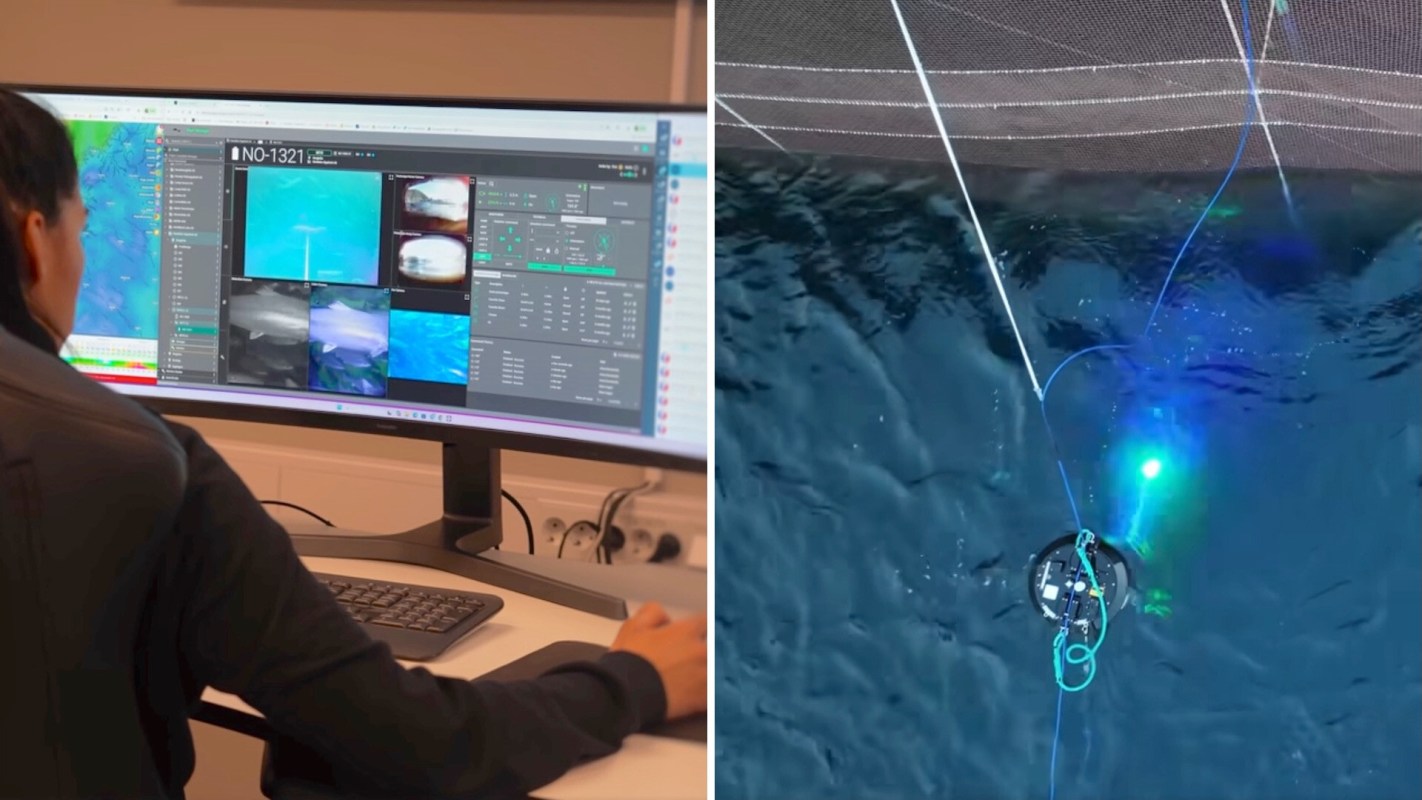
Underwater robots are helping Norway's salmon farmers tackle sea lice, a tiny but costly threat.
Here's what to know
Oslo-based Stingray Marine Solutions serves 20-25% of Norway's farmed salmon with its equipment. Its annual report puts deployment at more than 3,500 machines protecting over 112 million fish at Norwegian farms, according to Tom's Hardware.
The lasers target sea lice — tiny parasitic crustaceans — with guidance from artificial intelligence machines that operate around the clock, identify the parasites, and fire at them as fish swim through their pens.
Norway now has more than 2,000 underwater AI laser robots shooting lice off its salmon they're made by a company called Stingray, and they already guard more than 50 million salmon and trout 24/7 the reason is sea lice, tiny parasites that latch onto salmon and feed on them as few as 11 can kill a small fish, and one pen can hold 150,000 salmon the usual fix is pumping the fish out and blasting them with warm water or water jets to knock the lice off but the handling is so rough that Norway's fish health report ranks it the top cause of death in full-grown farmed salmon so instead, Stingray puts a robot inside the pen that hunts lice one at a time, all day: > two cameras watch every salmon that swims past > AI checks two frames to make sure it's really a louse > then a green laser fires from up to 2 meters away > the salmon's scales reflect the beam, so the fish swims off fine and the louse is dead we now live in a world where AI lasers do pest control on your dinner lmao
— Ole Lehmann (@itsolelehmann) November 9, 2026
Farmers can use the equipment to manage lice without gathering fish for chemical baths, a solution that can cause wider environmental problems through runoff, in addition to its potential to negatively affect the product itself.
The laser solution, then, should reduce use of pesticides. A form of the tech has been in use since at least 2017, when IEEE Spectrum reported about it.
More background
As IEEE and NPR have noted, salmon farming is a controversial practice in the first place, with many Norwegians expressing concern about environmental damage to the country's vaunted fjords, and there are debates about the quality and health of the meat compared to wild. Some also consider the lice problem "self-inflicted" since it is a problem not nearly as common in wild-caught salmon.
TCD Picks » Quince Spotlight
💡These best-sellers from Quince deliver affordable, sustainable luxury for all




If salmon farming is a reality that is not soon to go away without legislation against it or a massive change in buying habits, though, a switch to lasers from chemicals appears to be an improvement over the status quo.
Chemical treatments can harm the surrounding environment even though they let farmers treat large numbers of fish at once. Future infestations can become harder to manage if the parasites develop resistance to those chemicals. Those treatments can also stress fish, though it's hard to imagine being shot at by a robot with lasers would not also be stressful, and as Gadget Review noted, there is some evidence that the lasers occasionally cause eye damage to the fish.
Tom's Hardware reported that the lasers lead to consistently cleaner salmon with fewer deaths, better welfare, and improved growth. Nearby wild fish populations also benefit when farms reduce the lice those fish are exposed to.
What's being done?
Stingray's operation ranks among Scandinavia's biggest commercial uses of AI. Tom's Hardware reported that the company added about 1,000 units during the year covered by its annual report.
Continuous operation helps keep local parasite populations low, supporting prevention before infestations build.
Lice may collect in dim, cloudy corners of the pens or beyond the equipment's reach. The machines can target only parasites within their operating range, so round-the-clock operation still leaves gaps in coverage. Farmers also face upfront deployment costs.
A behind-the-scenes video featured by Tom's Hardware shows two laser-equipped units targeting parasites inside a salmon pen. The company has 250 employees.
Where can I learn more?
Beyond salmon farms, AI is being used to monitor animals, and other technologies are drawing scrutiny for their effects on marine habitats.
• Boston is building an AI-powered rat dictionary to predict where infestations could strike next.
• In Florida, sonar and AI systems could detect lurking alligators and send phone alerts.
• In Alaska, endangered belugas face a tidal turbine proposal tied to data centers.

Get TCD's free newsletters for easy tips, smart advice, and a chance to earn $5,000 toward home upgrades. To see more stories like this one, change your Google preferences here.






