


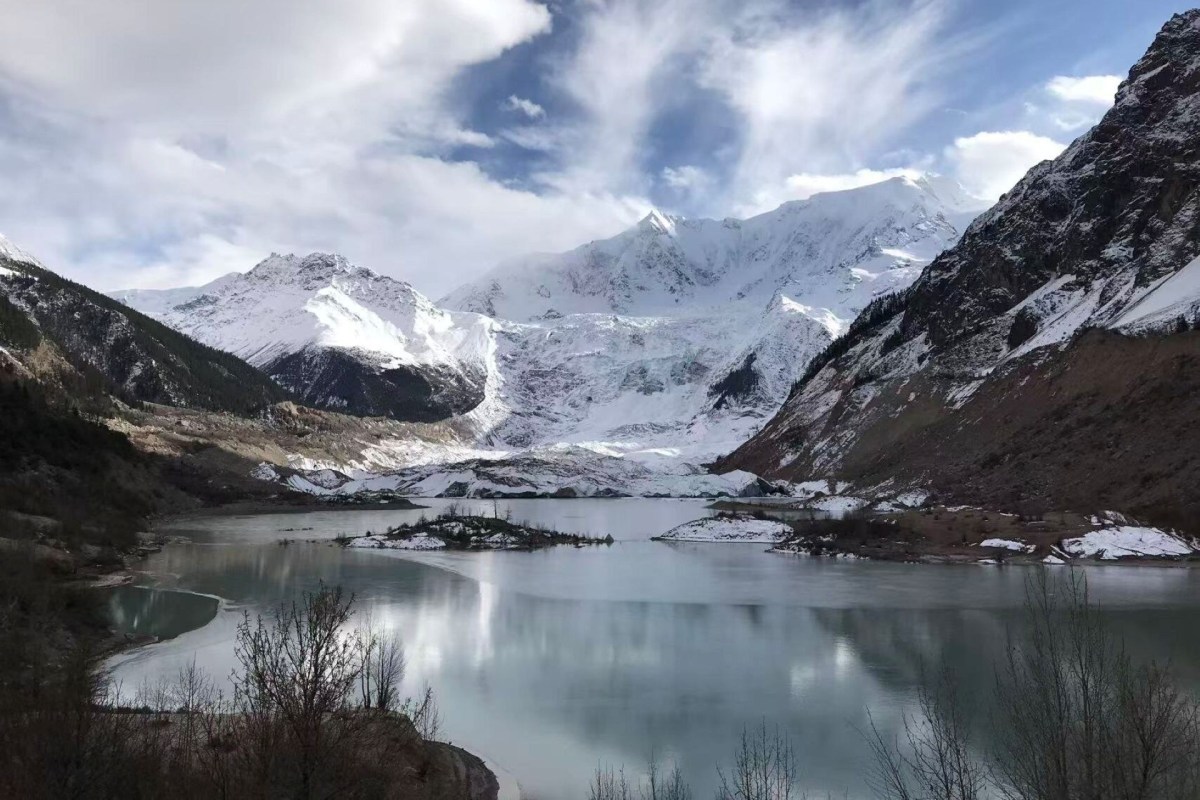
While a lake's cover of winter ice might be seen by many as just a typical sign of the season, this temporary layer of ice actually plays several important roles in supporting the local ecosystem.
For example, winter ice helps control heat, light penetration, and life beneath the surface of the lake.
However, scientists are sounding the alarm after new research indicated that these ice levels could be at significant risk. The researchers warned that many Northern Hemisphere lakes may be close to a threshold at which even a small amount of extra warming leads to much larger winter ice losses.
What's happening?
In a new paper published in Proceedings of the National Academy of Sciences, scientists reported that declines in lake ice are not necessarily gradual or linear. Using ice records and air temperature data from 724 lakes collected between 2000 and 2022, they found that vulnerability to significant ice loss can accelerate once winter conditions pass certain temperature thresholds, according to Phys.org.
The research involved an international collaboration led by scientists at China's Nanjing Institute of Geography and Limnology, which is part of the Chinese Academy of Sciences, together with Nanjing Normal University, Bangor University, and the University of Regina.
One key discovery was that warming shifts spring melt timing more than fall freeze-up timing, so ice disappears earlier in spring faster than it returns in autumn.
TCD Picks » Quince Spotlight
💡These best-sellers from Quince deliver affordable, sustainable luxury for all




The team also pinpointed important winter temperature thresholds of 7.3 to 19.8 degrees Fahrenheit (minus-13.7 to minus-6.8 degrees Celsius). When a lake's average winter air temperature rises past that band, ice loss can speed up sharply, increasing by as much as 22 times.
"Below these thresholds, ice cover responds to warming in a gradual manner," said Dr. Zhou Jian of Nanjing Normal University, first author of the study.
However, once temperatures pass these thresholds, ice loss increases significantly.
Why does it matter?
Seasonal lake ice is a major part of how freshwater systems operate, shaping light levels in the water, heat storage, and the way underwater habitats function from winter into spring.
As ice seasons contract, the effects can spread to water quality, fish and plant life, and to people who use frozen lakes for food, seasonal travel, recreation, and local traditions.
Under a high-emission scenario, by the end of the century, the share of Northern Hemisphere lakes that have crossed these critical temperature thresholds could climb from 23% to 70%, while winter ice cover could shorten by about 40 days.
Professor Shi Kun from the Nanjing Institute of Geography and Limnology of the Chinese Academy of Sciences, co-corresponding author of the study, said: "Our findings suggest that many midlatitude lakes are approaching a state of heightened vulnerability."
Continued warming could have wide-ranging impacts on both ecosystems and people. Less stable winter ice can disrupt freshwater food webs while also making seasonal activities and travel more dangerous for nearby communities.
What's being done?
According to the study, these thresholds are tied more closely to large-scale climate conditions, especially winter air temperature and surface reflectiveness, than to the shape or depth of any particular lake.
This information gives scientists and planners a better basis for identifying the regions most at risk. It also suggests that climate and freshwater models should account for abrupt shifts after warming crosses certain thresholds, rather than treating ice loss as a linear trend.
The authors said next-generation climate models will need to include these nonlinear sensitivities to improve projections of freshwater ecosystem change.
Zhou said: "Once the threshold is crossed, the system enters a fundamentally different regime where each additional degree of warming triggers a disproportionately large loss of ice cover."
Shi warned of "cascading consequences for water quality, aquatic ecosystems, and northern communities that depend on stable winter ice cover."

Get TCD's free newsletters for easy tips, smart advice, and a chance to earn $5,000 toward home upgrades. To see more stories like this one, change your Google preferences here.






