


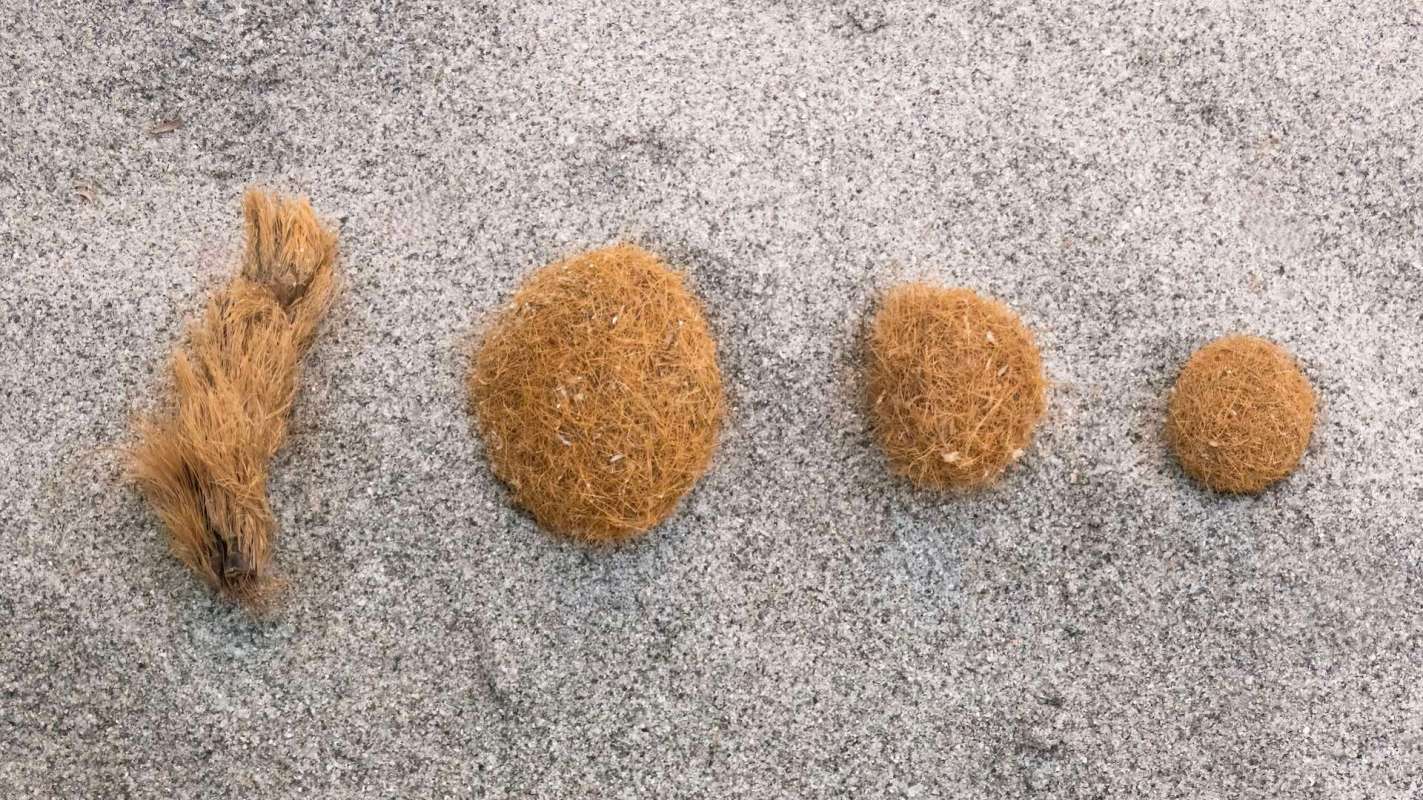
Nature may have already provided an unexpectedly effective blueprint for capturing one of the world's most persistent pollutants.
Earth.com reported that researchers at North Carolina State University have developed a "fluffy" mesh inspired by seagrass balls, and the material works on plastic particles of many sizes.
What's happening?
According to Earth.com, the researchers, whose study was published in Science Advances, modeled the material on the debris-catching behavior of seagrass and drifting seaweed.
In lab tests, the mesh captured more than 90% of plastic particles by weight across a size range of about 300 nanometers to 100 micrometers (0.000012 to 0.004 inches). That second measurement is roughly the width of a human hair.
"Our goal here was to develop a multiscale structure that allows us to capture the full range of plastic microparticles," said Orlin Velev, a professor of chemical and biomolecular engineering at North Carolina State University who led the work.
Using materials from brown algae and crab and shrimp shells, the researchers formed a branched, porous mesh. That structure helps by snaring plastic physically and drawing in many particles through electrical attraction.
TCD Picks » Quince Spotlight
💡These best-sellers from Quince deliver affordable, sustainable luxury for all




In tests using a real sample of ocean plastic from Hawai'i's Kamilo Beach, a 0.00018-ounce (5-milligram) piece of mesh removed 92% of the plastic from the vessel and ended up holding over twice its own weight, according to Earth.com.
How could this mesh help?
According to Earth.com, scientists have detected microplastics at every sampled ocean depth, as well as in food and air. These particles are generally defined as plastic pieces smaller than 0.2 inches, and they could greatly impact the environment and human health.
To move water quickly, filters usually need wider openings, but those gaps can let the smallest plastic particles slip through. Tightening the mesh enough to catch them becomes a problem.
By aiming at both very small and relatively larger particles with the same material, the researchers hope to make water cleaning tools easier to use and possibly cheaper.
A better way to remove plastic from water could also help protect fisheries and coastal ecosystems that communities rely on every day. Plastic pollution can harm marine life and even interfere with the ocean's natural ability to absorb carbon. Earlier intervention, and less plastic production in the first place, could offer many benefits.
What's being done?
Velev said the team's design was directly inspired by nature.
"We wanted to create structures that mimicked what the tangled seaweed is already doing," he said, according to Earth.com.
The material also retained particles in salty water at concentrations comparable to seawater.
Still, the researchers were clear about the limitations. The tests were conducted under controlled lab conditions rather than in open water. And the plastic concentrations used were higher than what is typically found in lakes or oceans.
The group is already considering next steps, including pairing the mesh with self-dispersing cleaners that travel through water and later resurface with captured particles.

Get TCD's free newsletters for easy tips, smart advice, and a chance to earn $5,000 toward home upgrades. To see more stories like this one, change your Google preferences here.







