


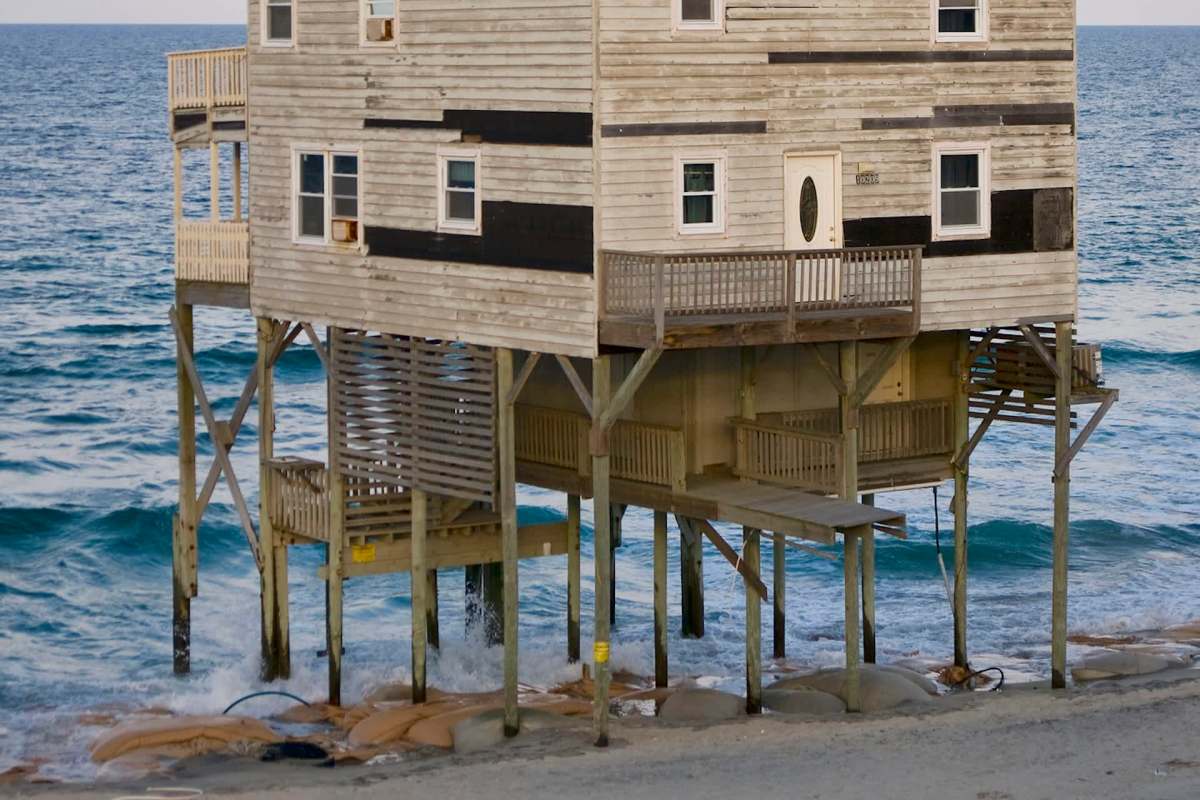
In Dare County, North Carolina, shoreline loss has sent more than 30 beach houses into the ocean since 2020, and 100 more are threatened as sea level rise accelerates erosion.
Compounding the problem, FEMA flood insurance rules can leave owners with a stronger financial incentive to wait for a house to break apart than to remove it beforehand.
Here's what to know
North Carolina is not alone; NPR says waterfront homes have been collapsing from California to Maine. A central issue is that many owners facing severe erosion on their properties cannot collect an insurance payout until a home has already been damaged. Correspondent Rebecca Hersher described one North Carolina homeowner's situation, saying, "The more [Michael] McDaniel loses, the more the insurance policy pays out."
NPR reported that McDaniel's Buxton beach house could go into the ocean after one more storm, and the National Park Service warned in a letter that the home was "frequently surrounded by water at high tide and exhibits structural lean indicative of imminent collapse." The agency added, "The most effective way to address threatened oceanfront structures is to remove the structure."
@npr Dramatic videos show waterfront houses collapsing into the water. It's happening across the United States, from California to Michigan to Maine. One hotspot is Dare County, N.C., where more than 30 homes have collapsed since 2020, including one as recently as this summer. About 100 additional houses there are threatened by erosion exacerbated by sea level rise. Yet there is no plan to remove most of the threatened houses — or to empty them of personal belongings before they fall — because of perverse incentives created by the Federal Emergency Management Agency (FEMA). NPR dug into the upside-down world of FEMA flood insurance in coastal areas, and found many homeowners have no financial choice but to let their homes collapse. That's leading to massive amounts of debris and pollution, which closes beaches, threatens wildlife and necessitates costly taxpayer-funded cleanup efforts. And the problem is only getting worse. As climate-driven sea level rise accelerates erosion around the country, there is growing alarm among waterfront homeowners, local officials and even members of Congress. Everyone agrees the status quo is unsustainable. But can they agree on a long-term solution?
♬ original sound - npr
A sequence of photos shared by NPR helps explain why homeowners can't be blamed for building too close to the water. Taken from one home's porch in 1980, 2011, 2015, 2020, and 2025, the images show the shoreline moving closer until the house was standing over the ocean. "A lot people didn't watch the video. The houses weren't built directly on the beach originally. Sea level rise has made erosion worse," one commenter wrote.
More background
In some coastal communities, annual beach loss that used to be counted in inches is now measured in feet because rising seas are speeding up the natural erosion process. North Carolina is a hotspot, per NPR, with sea level rise occurring at about twice the rate it was 50 to 70 years ago.
TCD Picks » Quince Spotlight
💡These best-sellers from Quince deliver affordable, sustainable luxury for all




The consequences go beyond the loss of homes and also threaten lives and livelihoods. Once a house gives way, debris can also spread across miles of beach within hours, closing shorelines and putting wildlife at risk.
What's being done?
For a period, federal law provided a way to act before collapse, NPR reported. Section 544 of the Housing and Community Development Act of 1987 allowed owners of homes facing imminent erosion-driven failure to access flood insurance money to relocate or demolish those structures. Over the next six years, hundreds of homes in 27 states were moved or torn down before they collapsed.
That program ended in 1994, when Congress repealed it after deciding it was not cost-effective, in part because owners wanted to keep renting out vulnerable properties. A bipartisan bill introduced in May 2025 would bring back advance payments for demolition or relocation while penalizing owners who do not act, but Julie Youngman, a senior attorney at the Southern Environmental Law Center, told NPR it "probably is not going to pass."
Officials are leaning on expensive temporary measures. Federal buyouts can cover the full value of a home, but they take five years and were designed for repeatedly flooded houses, not ones that will be damaged. One North Carolina beach is undergoing an $8.6 million jetty restoration and $15 million in beach nourishment — even though the previous sand addition lasted only three years.
"It's frustrating that you have to wait for a house to fall in the ocean," McDaniel told NPR

Get TCD's free newsletters for easy tips, smart advice, and a chance to earn $5,000 toward home upgrades. To see more stories like this one, change your Google preferences here.






