


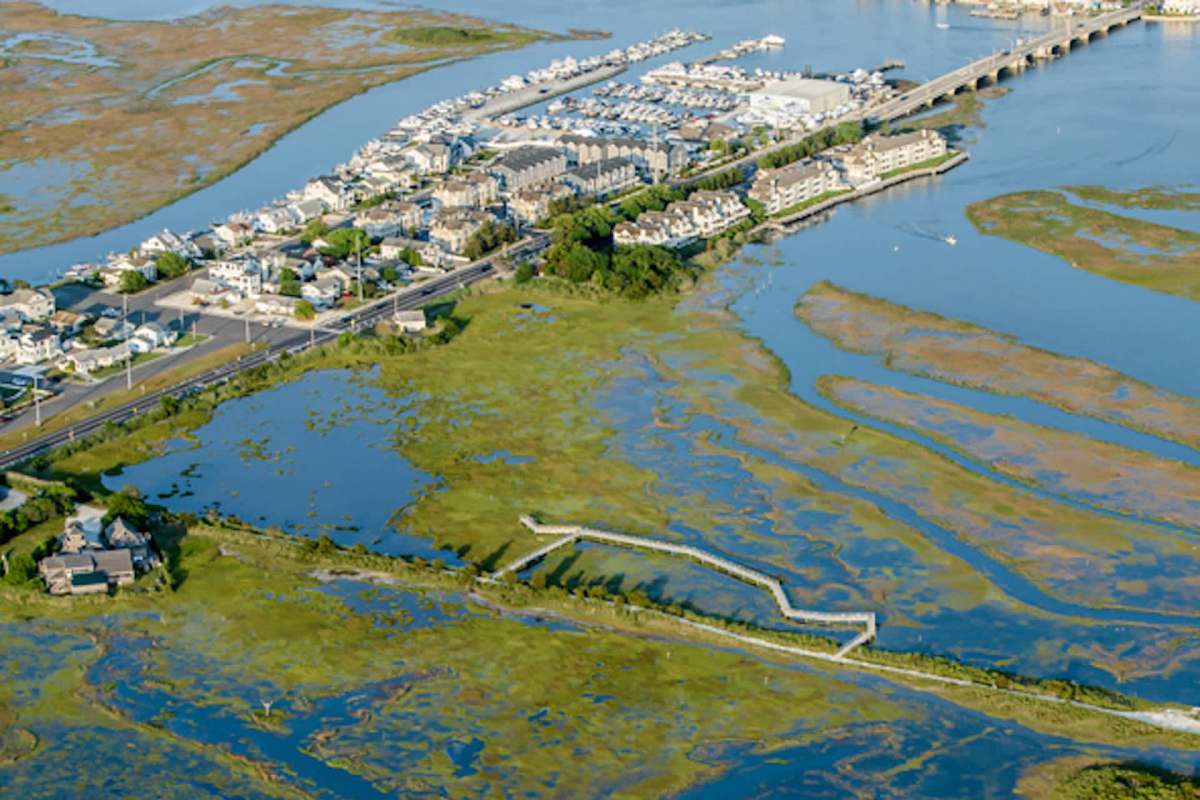
On New Jersey's coast, researchers are trying to keep vulnerable marshes from vanishing by spreading dredged mud and sand across low wetlands, raising the ground before higher seas overtake it.
According to Inside Climate News, that strategy is underway at Scotch Bonnet Island near Stone Harbor, where the goal is to extend the life of an ecosystem that shields homes, supports wildlife, and sustains local waters.
Here's what to know
The five-and-a-half-acre Scotch Bonnet Island enhancement project is one part of a larger push to help marshes endure sea level rise.
Data collected by The Wetlands Institute showed that over 30% of the area's coastal wetlands have disappeared since the 1950s. Its modeling further estimated that by 2050, only 34 of 86 acres will remain, ICN noted.
Beyond providing habitat, wetlands soak up floodwater; filter pollution; store planet-warming carbon; and support birds, fish, and other wildlife important to coastal communities. They can lessen storm-related property damage by holding about 1 million gallons of water per acre.
The findings alarmed Lenore Tedesco, executive director of The Wetlands Institute.
TCD Picks » Quince Spotlight
💡These best-sellers from Quince deliver affordable, sustainable luxury for all




"As the data was coming in, I was getting more and more panicked," she said, per ICN. "I'm like, 'Holy crow, this whole platform's too low.'"
More background
Marshes gradually build height as tides deposit sediment over time. At Scotch Bonnet, however, that natural gain is not keeping up. Sea levels in Southern New Jersey are rising 6 millimeters each year, while the marsh is adding only around 4 millimeters annually, the outlet said.
If that imbalance continues, the marsh could end up underwater.
The loss of marshland can leave nearby communities exposed to flooding and saltwater intrusion, putting roads, homes, farmland, and local economies tied to fishing and recreation at risk. Wetlands also offer food, cover, and spawning habitat for over 75% of commercially caught species and 90% of recreationally caught species.
"If you can maintain native marsh, it does a lot to actually protect the upland area," Kate Tully, a University of Maryland researcher focused on sea level rise and saltwater intrusion in farmland, said, per ICN.
What's being done?
Because development and a road prevent Scotch Bonnet from moving inland, researchers focused instead on boosting the marsh's elevation.
In fall 2024, crews removed 14,000 cubic yards of sediment from a nearby navigation channel and pumped it roughly two miles onto the marsh, as ICN reported.
The material initially buried vegetation, reaching more than 3 feet deep in some places before settling by about 1 foot. Researchers say full recovery may take two to three years, but early signs have been encouraging. Thirty-two bird species have been recorded at the site, and marsh grass seeds are beginning to sprout in the dredged mud.
The area is part of the Seven Mile Island Innovation Lab, a partnership involving The Wetlands Institute, New Jersey, and the U.S. Army Corps of Engineers. The goal is to test restoration methods that could help other vulnerable mid-Atlantic marshes stay above water longer.
"I think we can get a lot of wetlands back," Samantha Chapman, a wetland ecologist at Villanova University and leader of the WETFEET Project, said. "They're not always on this one-way street to destruction."
Where can I learn more?
Similar work is underway on the U.S. coast. Other projects are restoring tidal marshes, testing new shoreline materials, and tracking how sediment changes ecosystems over time.
• Along San Francisco Bay, a 50-year tidal restoration project is rebuilding habitat and flood buffers.
• On vulnerable coasts, scientists are testing electric current to bind sand into reeflike shoreline protection.
• In Washington, Elwha researchers are tracing how freed sediment rebuilds ecosystems after dam removal.

Get TCD's free newsletters for easy tips, smart advice, and a chance to earn $5,000 toward home upgrades. To see more stories like this one, change your Google preferences here.






