


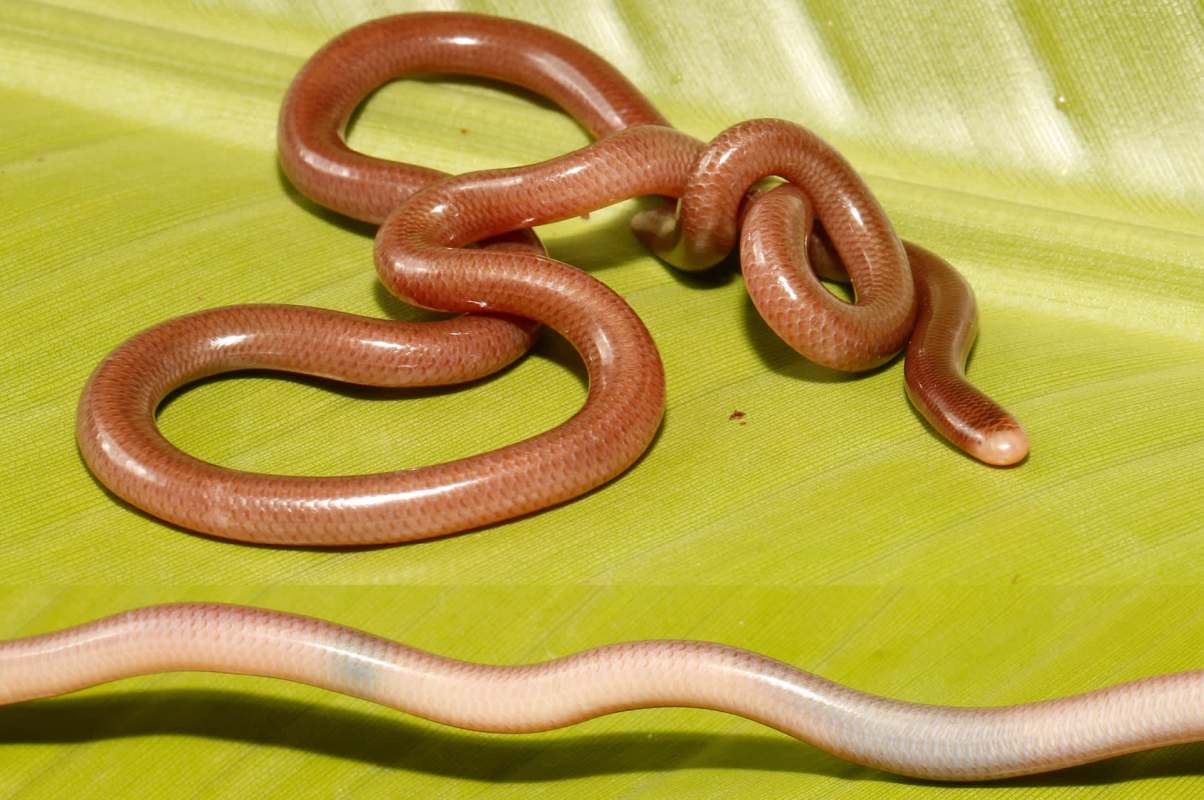
A newly identified snake from western China is prompting a basic but fascinating question: How much wildlife is still going unnoticed in some of the planet's most extreme landscapes?
In this case, the answer is at least one more species — and it barely looks like a snake at all.
Here's what to know
Researchers identified the new blind snake on the Qinghai-Xizang Plateau in western China, a high-elevation region covering about 970,000 square miles (2.5 million square kilometers). Researchers found the specimen beside a forest road near the China-Nepal border and later described it in the journal ZooKeys, Discover Wildlife reported.
Its scientific name is Indotyphlops gyirongensis. The known specimen, a female, was 10.4 inches (26.5 centimeters) long, with a pale cream-colored cap on the head and a light brown body that became paler toward the tail. She also had the reduced eyes typical of blind snakes, positioned beneath the head scales, a feature associated with species that spend their time underground or in logs and leaf litter.
Because these snakes are so wormlike, people often mistake them for something else. Their scientific group name, Scolecophidia, comes from Ancient Greek terms for "earthworm" and "snake," reflecting both how they look and how they live.
The researchers sorted out the snake's identity by examining both its anatomy and its DNA against other blind snakes. Based on that comparison, they placed it in the Typhlopidae family, which Discover Wildlife said is the most species-rich and most broadly distributed of the five blind snake families.
TCD Picks » Quince Spotlight
💡These best-sellers from Quince deliver affordable, sustainable luxury for all




More background
The snake was found in one of the world's largest and highest plateaus, a place that still seems to hold major biodiversity surprises.
I. gyirongensis has been recorded only in Xizang, China, according to Discover Wildlife. But since the discovery site lies so near Nepal, the study authors think the species probably also lives across parts of the border there.
A small, underground reptile can easily be overlooked in rugged border areas where wildlife surveys may still be incomplete.
The study authors also proposed common names tied to nearby Gyirong Town: "Gyirong blind snake" in English and "吉隆盲蛇" ("Jílóng Mángshé") in Chinese.
What's being done?
Researchers say "extensive field exploration" is ongoing in Xizang, especially along the borders with India, Nepal, and Bhutan.
That combination of on-the-ground surveys and DNA analysis allowed researchers to recognize this snake as distinct in the first place.
As the study authors put it: "In recent years, with the extensive field exploration being conducted in Xizang, China, many new taxa or new national records have been recorded, particularly on the borders between China and its neighbours such as India, Nepal and Bhutan, indicating these regions need further investigation."
Where can I learn more?
Other snake finds across Asia show how often elusive reptiles still turn up in places scientists haven't fully surveyed, as these stories expand on.
• In southern China, the Guangxi two-headed snake uses its tail to mimic a second head.
• In Sichuan, China, Berezowski's reed snake resurfaced decades after vanishing from scientific view.
• In Fujian Province, scientists made a secretive discovery after stumbling onto an elusive mountain snake.

Get TCD's free newsletters for easy tips, smart advice, and a chance to earn $5,000 toward home upgrades. To see more stories like this one, change your Google preferences here.






