


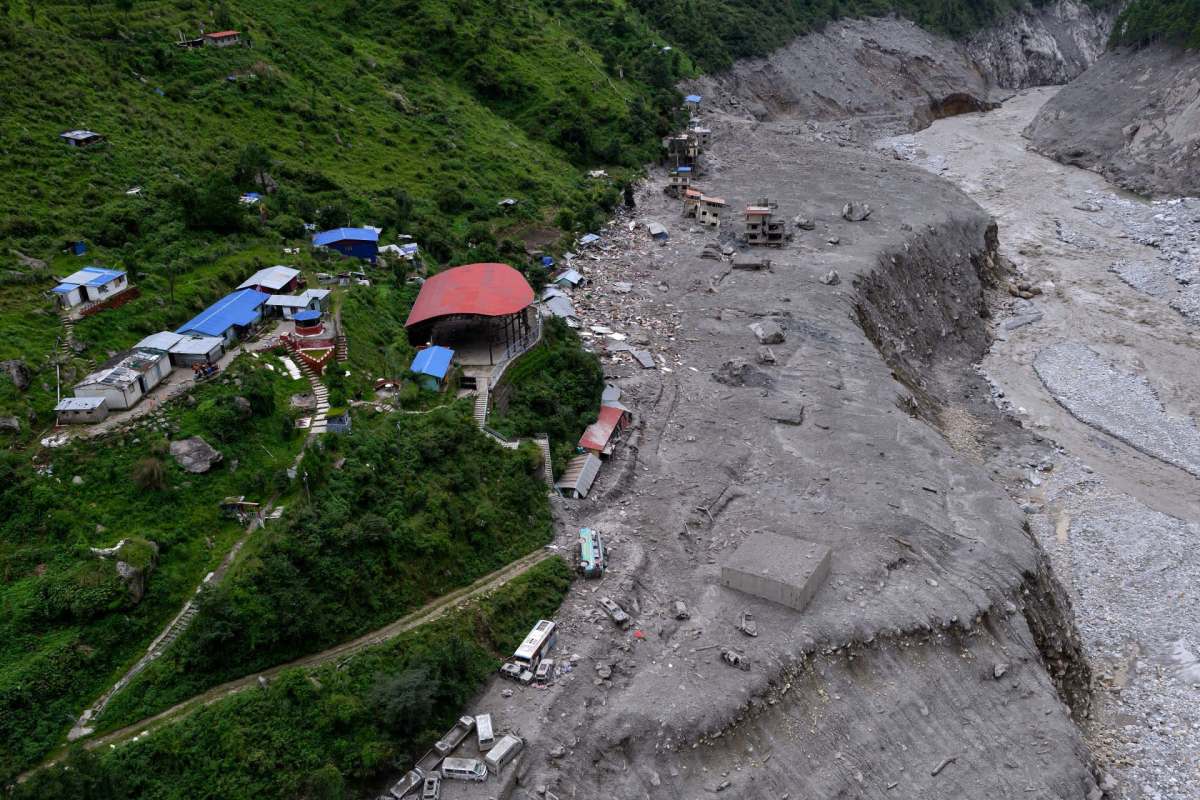
A deadly mountainside collapse near the Nepal-Tibet border killed more than 1,300 people, and thousands of others are still missing.
Researchers say rising temperatures and glacier retreat are likely to make disasters such as this increasingly common.
Here's what to know
As Grist reported, nearly 7 billion cubic feet of rock and glacial ice broke loose Aug. 26 and plunged about a mile into the river below, sending a mud-filled surge down the valley at speeds of up to 100 mph.
This disaster stood out even in an area that is no stranger to floods and landslides.
The mass that came down was big enough to fill 100 football stadiums, and villages many miles downstream were destroyed. Scientists may need months to determine the precise cause, but the larger processes that can lead to such catastrophes are already well understood.
Mountain slopes can become unstable in several ways as glaciers retreat. Receding ice leaves behind loose silt and rock, thawing permafrost weakens ground that was frozen, and meltwater can seep into bedrock cracks.
TCD Picks » Quince Spotlight
💡These best-sellers from Quince deliver affordable, sustainable luxury for all




"Glacial loss destabilizes slopes in many far-reaching ways that are often unpredictable and catastrophic," Mark Carey, a professor of environmental studies and geography at the University of Oregon, told Grist.
Glaciers around the world have lost about one-fifth of their mass, and they are expected to lose at least another quarter by 2100.
More background
When glaciers recede, they can leave moraine dams that hold back water until those barriers fail. In other cases, glaciers themselves serve as dams, trapping enormous reservoirs that can burst through with little warning.
These kinds of disasters are often hard to forecast. In Juneau, Alaska, annual flooding from the glacier-dammed Suicide Basin is managed through careful monitoring, Grist reported, citing Eran Hood, a hydrologist and professor of environmental science at the University of Alaska. Hood said that approach works there because the danger has been thoroughly mapped and closely watched.
The Himalayas present a much tougher problem.
The region's thousands of glaciers are spread across huge, remote landscapes, and no system can constantly monitor for a sudden collapse of rock and ice.
"There's really no effective way to monitor all these glaciers," Hood told Grist. "When you're dealing with something that releases immediately and moves downslope so quickly, how can you find a way to provide people with any warning?"
What's being done?
Preparation, however, can save lives.
According to Carey, Peru has spent decades lowering the danger posed by high-risk glacial lakes in the Andes, "no doubt saving tens of thousands of lives." In Switzerland, authorities evacuated 300 residents of the village of Blatten before a glacier collapse buried it.
Scientists are investigating tools that could strengthen warning systems. One possibility is adapting earthquake early-warning networks to detect glacier-driven landslides and floods. The Nepal collapse produced a signal comparable to a magnitude 5.2 earthquake, and a warning that reached a school downstream gave the principal time to evacuate 900 students, Grist noted.
Researchers are also examining fiber-optic cables that can pick up tiny "icequakes," along with the new U.S.-India NISAR satellite, which can detect subtle shifts in Earth's surface through cloud cover. An analysis found that the satellite had spotted slumping on the Nepal slope weeks before the collapse.
"Many of these mountain ranges are at a tipping point. Freezing, or not freezing, is binary," Dan McGrath, a glaciologist and associate professor at Colorado State University, said. "And as temperatures warm above that and permafrost thaws, that is undoubtedly going to lead to an increase in disasters like this."
Where can I learn more?
The warming that likely destabilized the Nepal slope is changing glaciers across the Himalayas and beyond. The articles here look at how retreating ice, swelling glacial lakes, and long-term glacier loss can set the stage for sudden, destructive disasters.
• Across the Himalayas, higher glacial lakes are raising the risk of catastrophic downstream floods.
• Worldwide, scientists say much of the damage to glaciers cannot simply be undone.
• In Central and West Asia, a cascading crisis from glacier melt threatens water, farming, and food.
This highlights the importance of monitoring and preparation as mountain ice continues to disappear.

Get TCD's free newsletters for easy tips, smart advice, and a chance to earn $5,000 toward home upgrades. To see more stories like this one, change your Google preferences here.






