


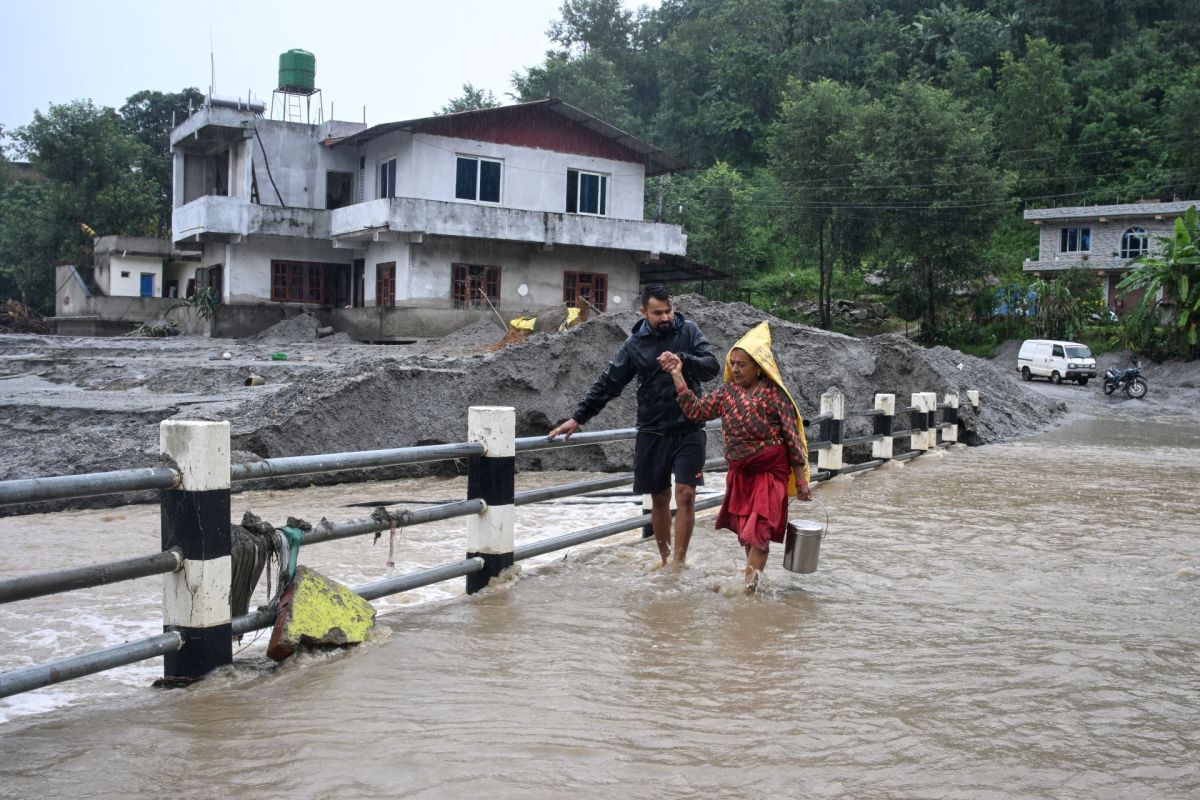
As climate-fueled hazards grow more severe globally, the programs designed to address them are being cut, leaving many countries and their inhabitants devastated.
Here's what to know
After the flash floods in Nepal, over 1,450 people were killed, and more than 6,000 are missing. The country now faces "billions of dollars in avoidable damage" due to program shutdowns, unmet obligations, and reduced funding.
The Associated Press reported that the funding crisis in climate-adaptation and disaster-preparedness aid was deepened by the closure of SERVIR-Hindu Kush Himalaya — a joint initiative of the U.S. Agency for International Development (USAID), NASA, and the Kathmandu-based International Centre for Integrated Mountain Development (ICIMOD).
The initiative monitored Afghanistan, Bangladesh, Myanmar, Nepal, and Pakistan through flood forecasting, landslide monitoring, risk communication, and public data-sharing. However, SERVIR-HKH shut down after the Trump administration reduced U.S. foreign assistance in 2025, along with other large donor countries.
The region, meanwhile, is heating quickly, glaciers are melting, and climate-related disasters can spread across borders. A new report by global consultancy Systemiq with ICIMOD found that glacier mass loss in the Himalayas is happening 65% faster than it was a decade ago. Detailed long-term monitoring covers only about 0.1% of the region's roughly 40,000 glaciers.
Harjeet Singh, who leads the Satat Sampada Climate Foundation, told the AP, "The reality is that we need trillions of dollars every year, but developed countries have not met their obligation."
TCD Picks » Quince Spotlight
💡These best-sellers from Quince deliver affordable, sustainable luxury for all




More background
A Nepal flood survivor, Tenzin Dolma Ghale, said waters swept away her village and members of her family, leaving her with only the clothes she was wearing. "It's all finished," she said.
In northern Pakistan, melting glaciers have created 3,044 glacial lakes, and the United Nations Development Program says more than 30 could trigger destructive floods in areas where more than 7 million people live.
Countries across the area rely on the Himalayas for agriculture, industry, tourism, household water use, and energy systems. ICIMOD says close to 2 billion people live in or downstream of the region. The Emergency Events Database at the University of Louvain in Belgium put the region's losses from climate-driven extreme weather in 2025 at at least $7 billion.
What's being done?
The U.S. State Department told the AP that the United States still supports Nepal's flood-warning capacity through programs with the World Meteorological Organization and NOAA.
Richard Sherman of the Fund for Responding to Loss and Damage, who sits on its board, argued in comments to the AP that the goal is resilience. "We're not expecting developed countries to act as an ATM." He added, "But supporting vulnerable countries, helping them adapt and become more resilient means they're less likely to suffer the kind of impacts we have right now."
Where can I learn more?
These stories take a closer look at the glacier melt and flood risks worsening across the Himalayas and wider South Asia.
• Across the Himalayas, higher glacial lakes threaten communities with devastating outburst floods.
• Scientists say high-altitude Himalayan glaciers are melting faster, raising risks downstream worldwide.
• Around the world, deadly floods are becoming more destructive as global temperatures climb.
• In Pakistan, heavy rains have terrified families still recovering from the last mega-flood.
• In Bangladesh, floods destroyed 1.1 million tons of crops and squeezed farmers.

Get TCD's free newsletters for easy tips, smart advice, and a chance to earn $5,000 toward home upgrades. To see more stories like this one, change your Google preferences here.






